This article first appeared in the Solutions newsletter. Click here to learn more and sign up.
There’s a street expression in St. Louis: Tap in with me. It’s an invitation. It means, “Come talk to me, we’ll figure it out.”
Stay informed on the area’s civic issues
Subscribe to the St. Louis Solutions newsletter to learn about public problems and possible fixes.
Hence the name of a legal phenomenon spreading across the metro region: the tap-in center. It’s a weekly window of opportunity in which folks who missed a court date for a low-level offense and thus face an arrest warrant can simply get a new court date by calling or meeting with coordinators—without fear of being jailed in the process.
“The people who want to flee accountability—they’re not trying to contact us,” says Miranda Gibson, the St. Louis County Library employee who leads the effort. “The people seeking us out really do want to address the situation.” And it appears to save time and resources for everyone involved.
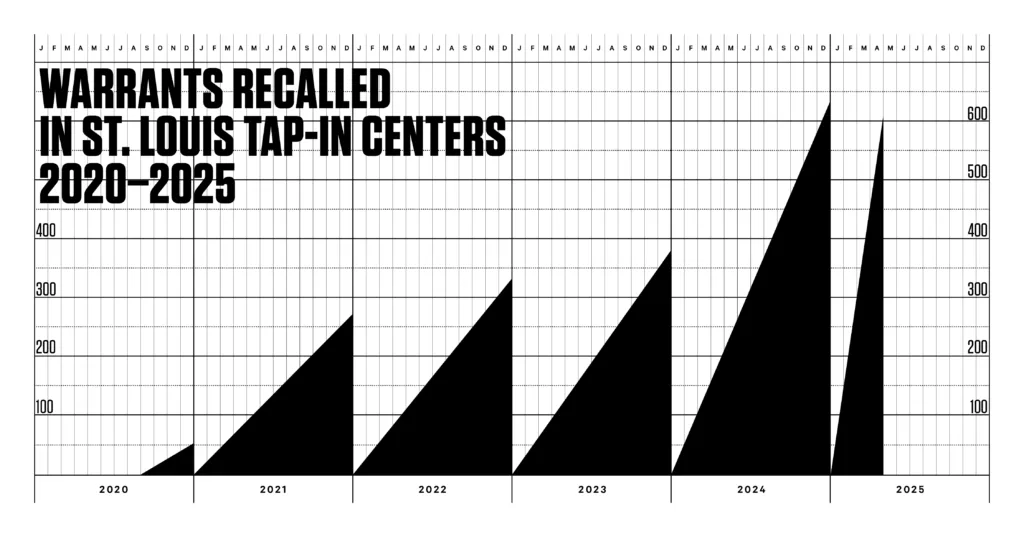
The logic of tap-in policies is appealing to more and more area jurisdictions. What started in 2020 at the St. Louis County level has since spread to the city of St. Louis’ municipal division (in 2023), to Florissant and University City (in 2024), and to the St. Louis Circuit Court (in February). Most recently, officials in Webster Groves have expressed interest in setting up a center, Gibson says.
To understand the logic, consider whom it serves—and whom it doesn’t.
Gibson says it’s for people facing charges such as drug possession, stealing, not paying child support, and most commonly, traffic violations. They miss court for all kinds of reasons. Some choose to skip because the alternative seemed worse (e.g., leaving babies at home; missing a shift and thereby losing a job). Others intended to appear but a family emergency arose, or the bus came late, or they fell ill. Gibson says that nearly half of participants report never receiving the mailed notice. That itself can result from a variety of circumstances: the court’s sending the letter to a previous address, or an ever-evolving living situation.
After missing a hearing, though, lots of defendants don’t realize that they can most likely show up to court and reschedule without consequence—or they don’t trust that to be the case. Observes Gibson: “A lot of people say, ‘That sounds like a trap.’ And the municipalities in St. Louis County are all disjointed with their own rules and procedures, so it’s hard to know what each municipality will do.”
The stakes are high, because although police officers aren’t required to arrest people with “bench warrants” (which are issued for a failure to appear), many officers do make such arrests—and being thrown in jail does a special kind of damage to those barely keeping their heads above water.
That kind of damage became a hot topic after the Ferguson unrest and the court reforms that followed—and in fact, that’s the context in which this policy arose. In 2016, St. Louis County received a grant from the MacArthur Foundation to reduce its jail population, and in 2020, tap-in became a part of that effort. Gibson, who was then an employee at the jail, was coordinating it; when she went to work for the county library, she took her coordinating duties with her. (It made sense, she says, to locate the center in the Florissant Valley Branch of SLCL because it’s a non-intimidating space.)
Using tap-in centers to avoid bench-warrant arrests doesn’t merely help defendants, Gibson argues. It also relieves busy police officers, court clerks, and judges of the burden of dealing with them. “Overall,” Gibson says, “it’s a benefit to each part of the criminal-justice train.”
Evidently, that includes prosecutors. Jennifer Lorentz, who directs the diversion unit in the office of St. Louis Circuit Attorney Gabe Gore, says that when she pitched her boss on the idea, he quickly saw its benefits—and not just for participants. “We have witnesses and victims who don’t want to testify,” Lorentz points out, “because they have warrants.” In February, the office began offering tap-in for misdemeanors and felonies. (Lorentz says it may be the only prosecutor-led tap-in center in the country.) So far, she says, most of the 179 people who have asked her team for help were city residents facing bench warrants in other jurisdictions, so the team referred them to the right place; it’s common for tap-in jurisdictions to cooperate in this way.
On a recent evening, two of Lorentz’s case managers and an attorney who handles misdemeanors were posted up in a meeting room on the second floor of downtown’s Central Library. The public defender’s office was available remotely. Every Wednesday, from 5:30 to 7:30 p.m., people facing bench warrants can stroll in or even just make a phone call to access the entire group.
“I’ve had a few of them cry,” said Sopheea Vomund, a case manager, “because they have so much going on and everything’s spinning out of control.” Also on hand were two representatives of Mission: St. Louis, who can link up participants with wraparound services upon request.
Lorentz was present, too. Asked why tap-in centers don’t incentivize blowing off court, she said that for one thing, the people seeking help are trying to do the opposite: re-arrange a court date. But if they do show a history of missing court dates, prosecutors can oppose (or judges can deny) a motion to recall their bench warrants. That’s rare, however: According to Gibson’s data, from September 2020 to December 2024, requests were granted in 84 percent of felony cases, 95 percent in misdemeanor cases, and 97 percent in ordinance violations.
“I don’t know what the general population’s opinion is of humans who have traffic warrants,” Lorentz said, “but they’re just good people who had things go wrong.”
No humans walked into the tap-in center that night. “Very typical,” said Lorentz, adding that the vast majority simply call in. “If it were easy to get here,” she said, “it would be easy to get to court.”