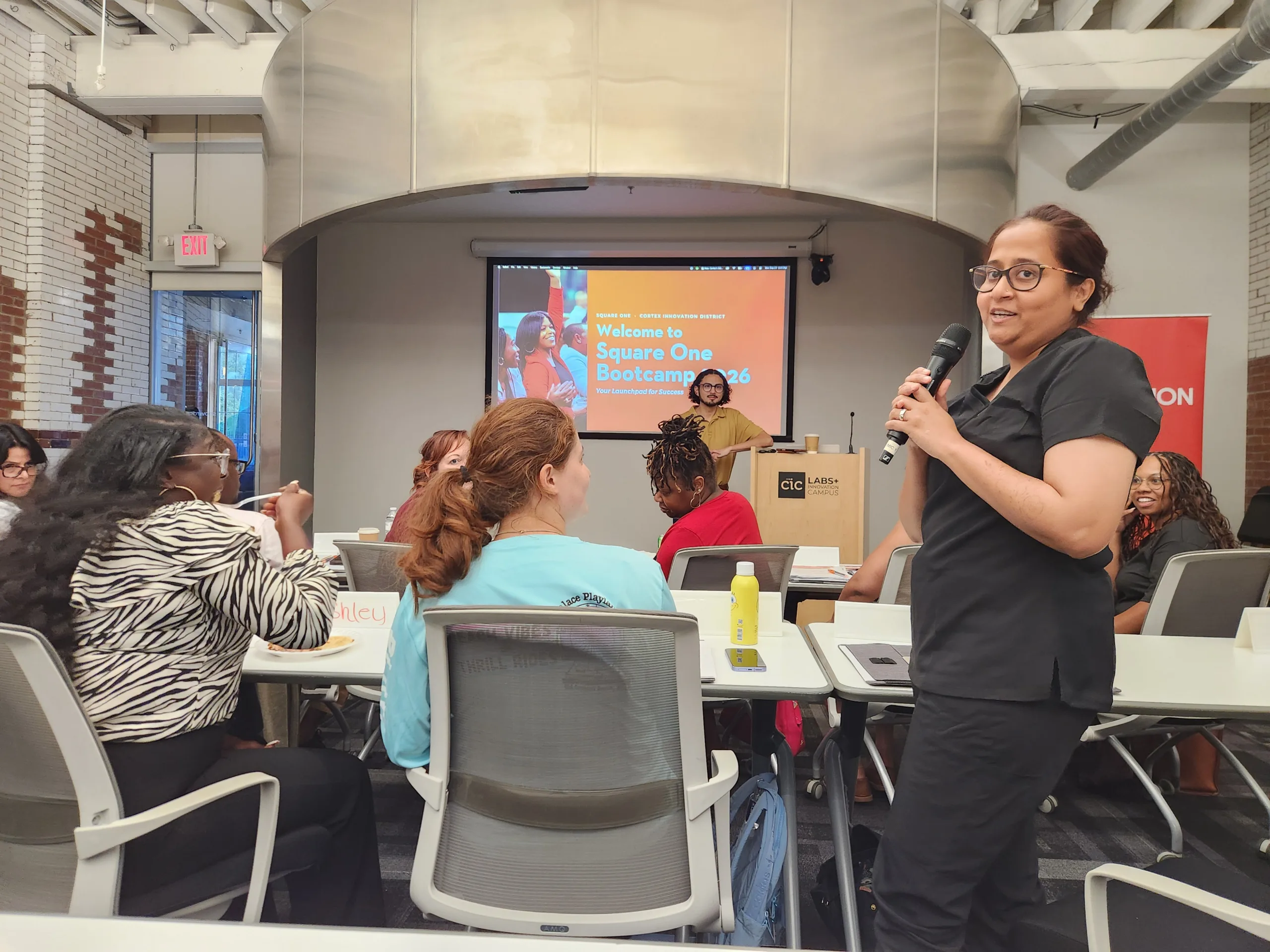
On a recent evening inside the Cortex building at 20 S. Sarah, Khutaija Noor was the brave one. She stood up, took a microphone, glanced at her two dozen fellow students, and let fly a single-sentence pitch for her fledgling company: “We are offering a data-driven decision-making tool to help healthcare organizations reduce wait time for patients needing mental-health treatment.” It was a mouthful, but everyone clapped. Later, out in the hallway, she mulled where to adjust. “Today, my approach was more technical,” she said. “It has to be more layman.”
This is what students do at the Square One bootcamp organized by Cortex, the innovation district in the Central West End. Over 10 weeks, aspiring St. Louis entrepreneurs in the tech, manufacturing, service, and food sectors get practical instruction in more than 15 areas. These include communication, customer research, marketing, pricing, contracts, negotiation, hiring, and accounting. The cost is $250 but full scholarships are available for most students, who have tended over the last five years to be women and people of color. And in that time period, a lot of students have found upward economic mobility, according to co-instructor Gabriela Ramirez-Arellano: She says she has seen students graduate and not just grow businesses but also run for office, get promotions in their current jobs, increase their credit scores, and pay off debts.
Stay informed on the area’s civic issues
Subscribe to the St. Louis Solutions newsletter to learn about public problems and possible fixes.
The 2026 cohort also has quite a few immigrants hailing from Africa, Latin America, Afghanistan, and Europe, but despite some language barriers, there’s a lot of camaraderie, observes Ramirez-Arellano. Success, she says, “is not always about having the skills to build a website. It’s about having the confidence that this is going to work and being surrounded by a tribe and a group of people that cheers you on.”
Sometimes the feedback is constructive criticism. That’s certainly what Ismael Wayne of Florissant appreciated when he went through Square One a few years ago. At the time, he recalls, the marketing for his dessert company Puddin Puddin reflected his personality: teasing, playful, honest. He would joke to customers about his lack of passion for the grunt work, saying, “As much as I like baking, I don’t.” But when he brought this to his fellow students, they warned him that some customers may equate his candor with lowered quality. So he axed that part and now emphasizes pride and consistency.
Two other takeaways for Wayne: the power of QuickBooks for accounting and the power of personal connections. “Who you know is just as important as how good your product is,” he says. “Your food may be great, but if you don’t know where to sell it, who to sell it to, what’s the process of getting into different places, then you wind up being stuck.” Through a series of connections he made through Square One and also Kitchen Hub STL, a food-industry incubator and commissary in High Ridge, he is now selling his pudding in Fresh Thyme and Straub’s. “Square One is a great entry point into that world,” he says.
LaParis Hawkins, another recent graduate in North County, also sees the Square One network’s value. Until recently, she was operating her company Tailored Pieces, which makes bonnets and shower caps, out of her home. It wasn’t ideal, and she struggled to find commercial space in her price range. She mentioned this to her former Square One instructor, Ramirez-Arellano, who knew there was a vacancy at the Wellston incubator space run by STL Partnership. Hawkins applied and was accepted. The space, which is 500 square feet, turned out to be not only affordable but has made it easier to use hired help and scale her business. “Had I not reached back out or asked, then I wouldn’t have gotten that,” says Hawkins. “But they’re there for you.” And she tells others. “It’s getting to the point where a lot of entrepreneurs want to meet with me and ask about business advice. My go-to: Go to Square One.”
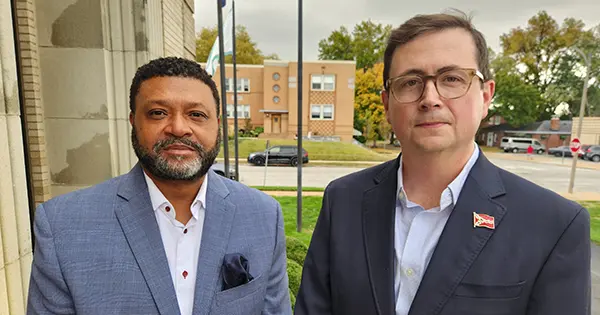
A third recent graduate, Stephen Perkins, of Maryland Heights, is grateful for how Square One forced him to rethink his overall strategy. “That class completely changed my business model,” says Perkins. Several years ago, he was working a full-time corporate job but grew intrigued by a side hustle: Selling educational toys like the ones that helped his daughter learn to count. So he procured Chinese-made wooden puzzles and magnetic tiles. He was selling these out of the trunk of his car by the time he found his way to Square One. Urged by his fellow students, he came up with a new name, AIM Steam Products, and also decided to set up an infrastructure where he could exert more control over the design and manufacture of his toys—which he decided to enhance with the intellectual property in his series of children’s books, Proverbs from the Hood. (Perkins grew up on the South Side of Chicago.) Through the lessons and mentoring he got at Square One, Perkins says, he was able to ramp up to about $100,000 in sales within a year.
In this year’s cohort, the students are pursuing all kinds of ideas. Rc Versie has an “anti-depression” clothing brand called W.A.G.D.O.D. Deanna Primm wants to start a beauty salon geared toward young stylists. Benetta Ward has already launched her business, Nurturing Nature Birthing Institute, which she says provides perinatal doula support as well as workshops and retreats for birth workers. But she wants to expand it. She says she’s booked an appointment with a librarian at the St. Louis Public Library, who, she’d learned from Square One, can help entrepreneurs with market research.
Ramirez-Arellano, who has been an instructor since 2021, says that most students are employed full-time and trying to launch a business on the side. She knows how hard the logistics can be; that’s why the program provides dinner in the back (on a recent evening, it was pasta and salad) and now offers childcare. With those things taken care of, the students can focus on what matters most at the moment: laddering up economically. What Square One wants, Ramirez-Arellano says, is for students to “see possibilities within themselves.”