This article first appeared in the Solutions newsletter. Click here to learn more about the newsletter and sign up.
If you think downtown St. Louis suffers from (a) too few humans and (b) too many empty offices, then conversion might attract you as an elegant solution to both.
Stay informed on the area’s civic issues
Subscribe to the St. Louis Solutions newsletter to learn about public problems and possible fixes.
Calgary is doing it. That Canadian city now has 13 active office-to-residential conversions going in its downtown area, and four more such projects are “under review.” Calgary’s municipal government is betting big on its Downtown Office Conversion Programs. It has set aside about $148 million USD as an initial investment, and at first was offering roughly $55 USD per square foot to developers but had to press pause because of high demand.
One oft-noted tool that Calgary used to get started was an algorithm that takes into account various building features—floor plate size, ceiling height, etc.—to recognize strong candidates for conversion. The landscape is less complicated in downtown St. Louis, where local leaders are already focused on a handful of key properties, including two that take up entire blocks: the AT&T tower and the Railway Exchange building.
But the financing is still a real bear. In late February, Goldman Sachs released a report on this very subject, finding that high commercial mortgage rates, high construction costs, and high acquisition prices mean that converting offices to multifamily housing is financially feasible in less than 1 percent of U.S. office inventory. So what hope is there in downtown St. Louis?
Kurt Weigle, the chief downtown officer at the regional business group Greater St. Louis Inc., has some hope. We sat down last week at his office in the Met Square building to talk about a state tax credit bill, SB 792, that he believes would be a “major step” toward clinching big redevelopment projects downtown—and yes, maybe some office-to-residential conversion.
Why aren’t our downtown office buildings converting to residential? Higher costs. Across the country, on average, the cost of developing apartments increased roughly 40 percent between 2019 and 2024. And the cost of capital has gone up. Operating costs have increased, too. Our rents have not kept pace with these increases.
So what needs to happen to get things moving? Greater St. Louis Inc. has crafted a bill with other partners. The common name for it is the “office-to-residential conversion tax credit.” It’s a 25 percent tax credit. What it does is just help us keep up with these extraordinarily high costs. It would be a major step toward filling that gap and making projects pencil.
Is there any hope that it will pass? There is. It got a good hearing in the Senate committee and was voted out with nearly unanimous support. It’s a really balanced bill. It sets aside a portion of the tax credit for mega buildings—larger than 750,000 square feet—and also creates a set-aside for small main streets across the state.
But there’s another layer of complexity here: Mayor Tishaura Jones’ administration has prioritized affordable or “workforce” housing, which generally requires a subsidy even if you build from the ground up. Are affordable units even conceivable in these already-expensive conversions? Depends on the project, because low-income housing tax credits can bring in funding. That’s probably right for some projects and not right for others. But I think it’s conceivable that at least some portion of these could be affordable.
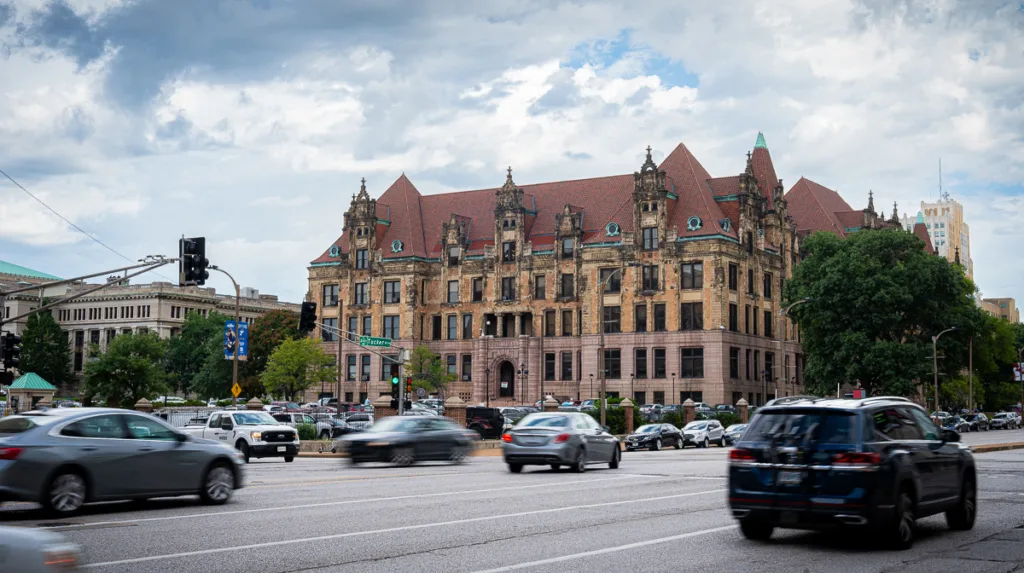
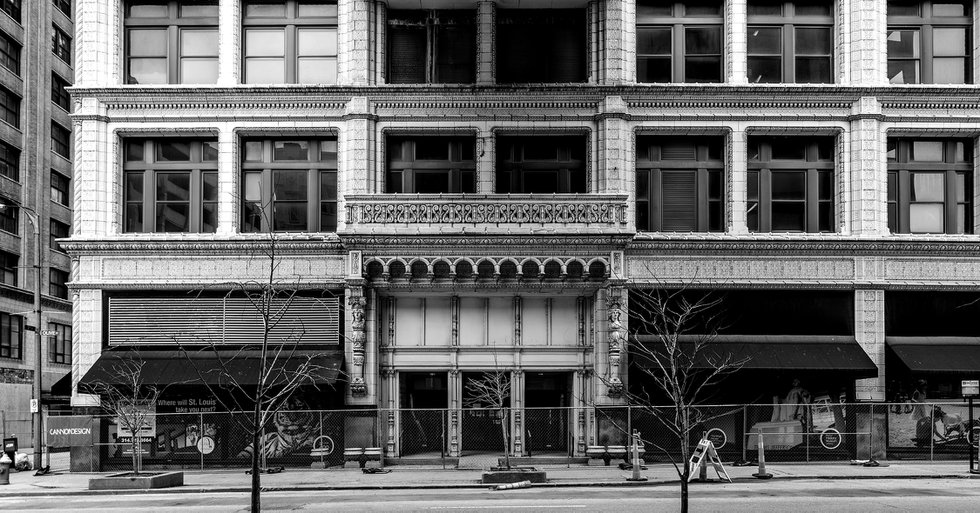
Fluorescent lights and air conditioning allowed office towers to be built with deep floor plates and fewer windows, so in some cases, converting them means coring them like pineapples. Might that happen here? Yeah. Look across the street at the Railway Exchange. There already is a light well in the middle of it, which increases its feasibility as a redevelopment project. But it doesn’t go down all the way. The development plans I’ve seen would extend that down even more to enlarge the space that’s “double-loaded” off a single corridor—rooms on both sides—because that’s the most efficient. But even in that building, you can only take the light well so deep for engineering reasons, so you end up with 250,000 square feet in the middle. There, you’d need to find a user for whom windows are not an advantage but a disadvantage. That’s a small group. But there are certainly a few users out there looking for space where they can completely control the environment.
Like who? Indoor agriculture? Conceivably. But in the core of downtown, we’d be looking for something much more active. Downtown’s 2 square miles produce almost 20 percent of all the city’s revenue, between sales, employment tax, and property tax, and this is one of the most important blocks downtown. So something along the lines of entertainment that’s going to bring more people into the space and create amenities.
What are the prospects for the Railway Exchange building? We’re working with a developer now. I know there’s more than one who is interested, actually, but all we need is one to make it go. We’re bringing everything to bear in terms of intellectual firepower, finance know-how, and all the rest to move that forward.
How close are you to a deal? It’s a big project. It’s a complex project. I would be thrilled if we had that property financed within a year from today.
Is there a point at which the city would be better off subsidizing the demolition of these larger buildings and starting fresh? That has been done in places, and I’m not one to say that it should never be an option. There are cases where buildings just cannot be reconfigured or financed to make a go of it. But right now, I don’t see any of those buildings in downtown St. Louis. I’m not willing to throw in the towel yet.