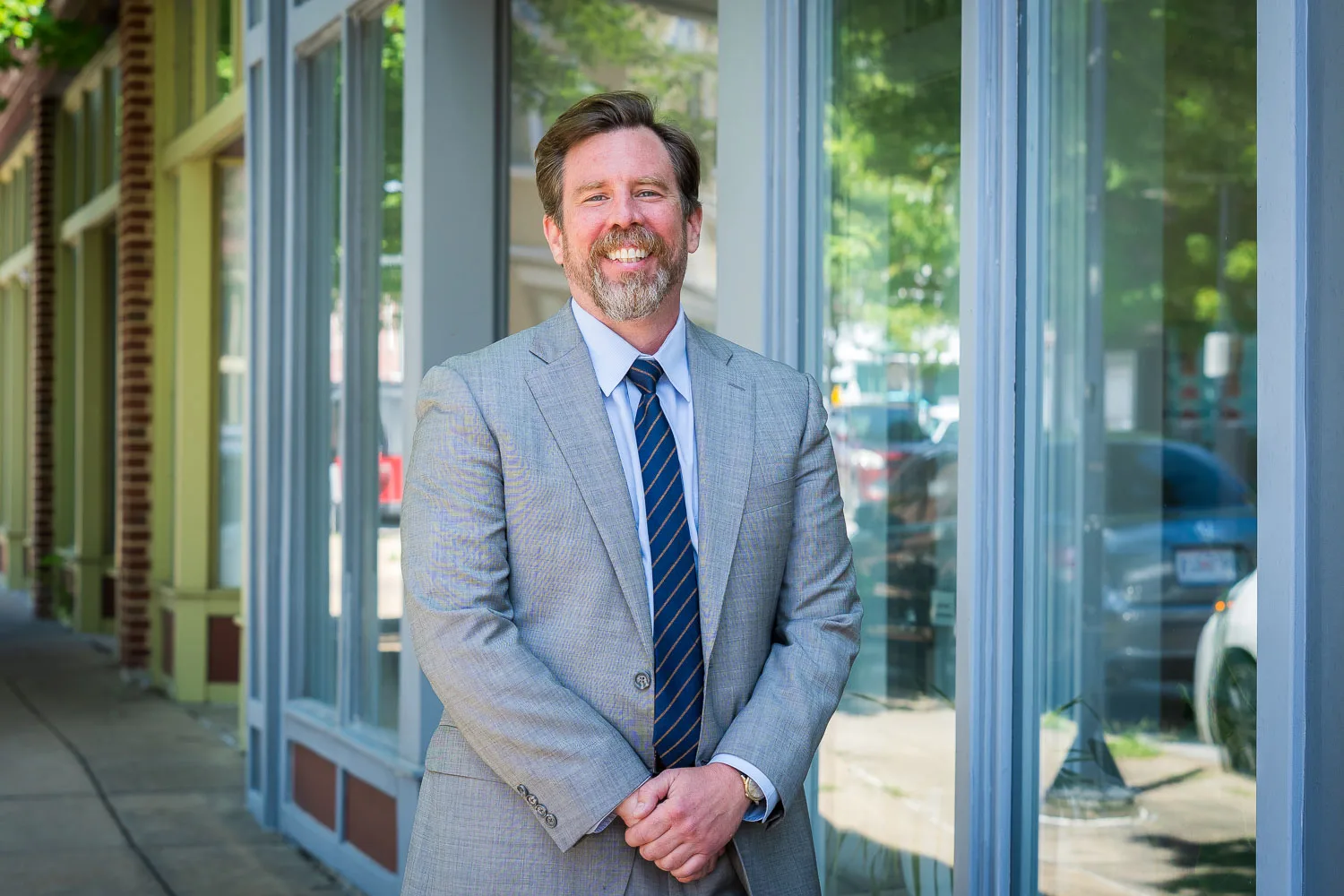
Attorney Peter Hoffman is doing as much as anyone in St. Louis to combat the problem of vacant properties in the city—and there is no doubt that vacancies are indeed a problem. Hoffman calls it “existential.”
”The population for the region is stagnant,” he says. If we don’t stem the tide of property abandonment and sprawl, “At some point, we could just disappear.”
Get a fresh take on the day’s top news
Subscribe to the St. Louis Daily newsletter for a smart, succinct guide to local news from award-winning journalists Sarah Fenske and Ryan Krull.
The roughly 9,000 vacant buildings in the city exist because of decades of people leaving, of course. But those vacant properties end up driving more people out of the city, leading to more vacancies that in turn drive more people away. It’s a vicious cycle.
But, as Hoffman describes in a new episode of The 314 Podcast, he’s actually optimistic about combating the problem. The Neighborhood Advocacy Program at Legal Services of Eastern Missouri, for which Hoffman is the managing attorney, works with neighborhood organizations to wrest control of rundown homes from their derelict owners, turning a property weighing down its block to one that’s actually lifting it up.
It’s an arduous process. The work is often done one piece of property at a time. Since property rights are sacred in the U.S., says Hoffman, it can be difficult to force someone to do something they don’t want to do with a property they own, and even more difficult to wrest control of it. It is possible. But first, everyone needs to be at the same table—or in the same courtroom—and that is no easy task. Increasingly, investors as far away as Dubai are buying up housing stock in St. Louis and holding it like one would a stock in a portfolio, sitting on it in hopes it goes up in value.
”Real estate prices are so high that you can’t buy a house in California for $1 million,” he says. “But you look at the St. Louis market, and they’re like, ‘Well, I can buy a whole block of properties for a million.’”
He adds, “There’s always some YouTube video telling people they can get rich in real estate. There are suckers born every minute.”
As those speculators wait for property values to go up, the houses they own often crumble, dragging down both the quality of life and the property values for those living around them.
But Hoffmann has proof that pairing neighborhood organizations with a nonprofit legal firm does get results, one house at a time. His project’s website publishes its successes every year, with photos of crumbling husks of homes, abandoned by their owners, replaced by new builds that in some cases are worth $500,000—or more. “I’m very optimistic, because I’m in those neighborhood meetings and I’m meeting with those resident leaders,” he says. “I see how resilient and determined they are. We have seen, just through our direct support, almost 1,000 formerly vacant units put back to productive use.”
As unusual as it might sound, vacancy is a lifelong passion for Hoffman. His dad grew up in Walnut Park, but Hoffman grew up in North County. His parents told him, We don’t go back into the city anymore.
So naturally, once he got his driver’s license, that was the first place he went.
“ We have such beautiful architecture in the city of St. Louis. We have really cool neighborhoods. We have a really cool cultural scene—music venues and restaurants,” he says. “And then the vacant buildings are just part of that landscape.”
As a young man, he and his friends snuck into vacant buildings with flashlights and explored their hollowed out husks. It was spooky. It was exciting. And, for Hoffman, it was life changing. On his first date with his longtime partner, they snuck into the then-empty City Hospital on Tucker just east of Lafayette Square, before the massive building was redeveloped into condominiums.
“Being able to sit on the roof of an abandoned building and look at the Arch, it’s exciting when you’re young,” he says.
“Now I do the same thing, but under a court order. It’s all legit,” he adds. “The court has allowed me to go into the vacant building.”
Hear more from Hoffman on The 314 Podcast.