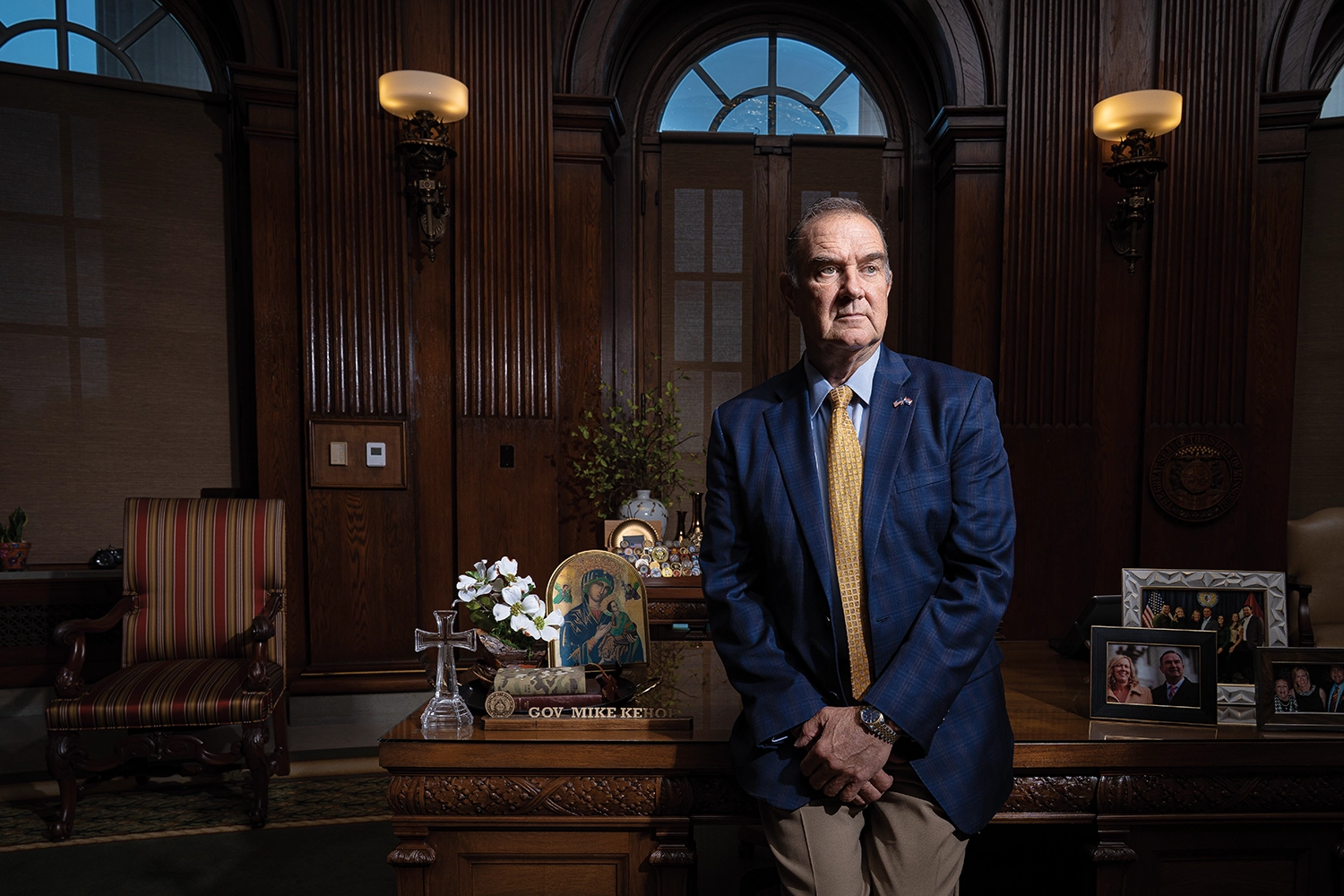
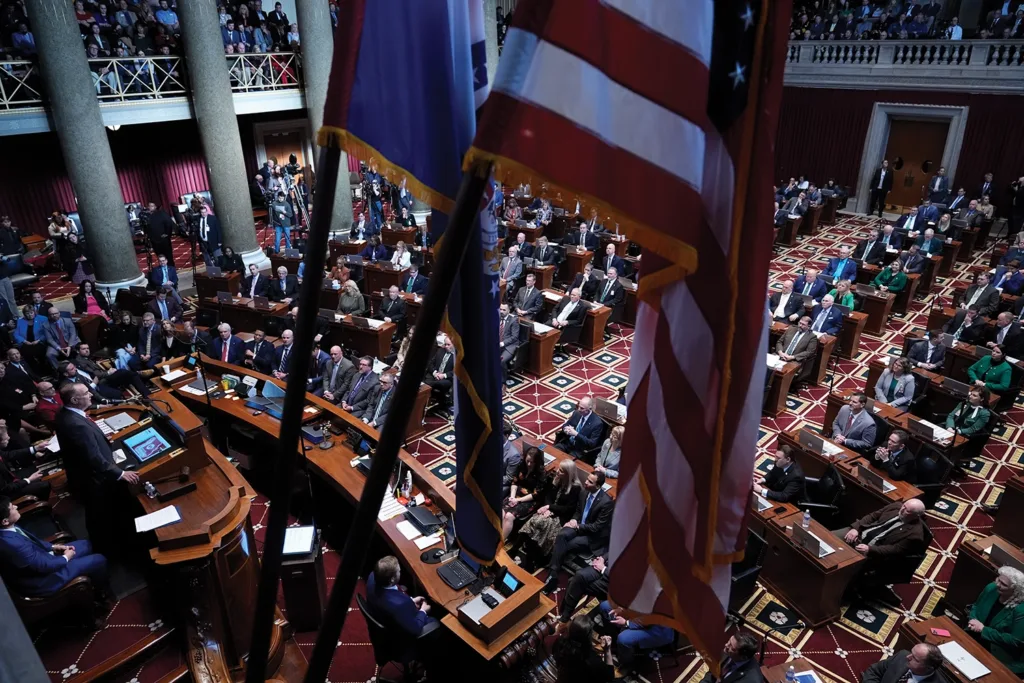
The Missouri governor’s State of the State Address on January 28 was thoroughly Mike Kehoe-esque. A jowly former car salesman, Kehoe gripped and shoulder-patted his way down the center aisle of the state capitol’s House chamber, as fluid as ever, then ascended to the podium. His first move was to recognize his wife of 35 years, Claudia, and joke: “Still gets more applause than me.” At one point, he held aloft a folded paper plate, on which he’d scribbled a note to himself; such notes were a life-organizing habit he’d learned from his mentor, the late South County Ford dealer Dave Sinclair—yes, he of the TV commercial tagline, “Thank you, and here’s my address.” One of Sinclair’s parting pieces of advice, the governor told his audience, was that Kehoe never forget his roots and “stay humble”—so Kehoe vowed to do just that as the state’s chief executive. He laid out his priorities: beefing up law enforcement, boosting business, expanding school choice, cutting taxes. Fairly standard GOP fare.
But Kehoe did emphasize an upbringing that was unique for a Missouri governor: He had been raised by a single mother on St. Louis’ North Side. And nowadays, he said, the kids who live on those blocks feel that the only way to survive is through gangs and violence. “I have walked the streets of my childhood homes in Walnut Park and Baden,” he said, “and I’ve talked to these young people. They simply believe there is no other option.”
Get a fresh take on the day’s top news
Subscribe to the St. Louis Daily newsletter for a smart, succinct guide to local news from award-winning journalists Sarah Fenske and Ryan Krull.
He wasn’t B.S.-ing. This white Missouri Republican really had spent time as of late on the solidly Black North Side. Ask Darren Seals.
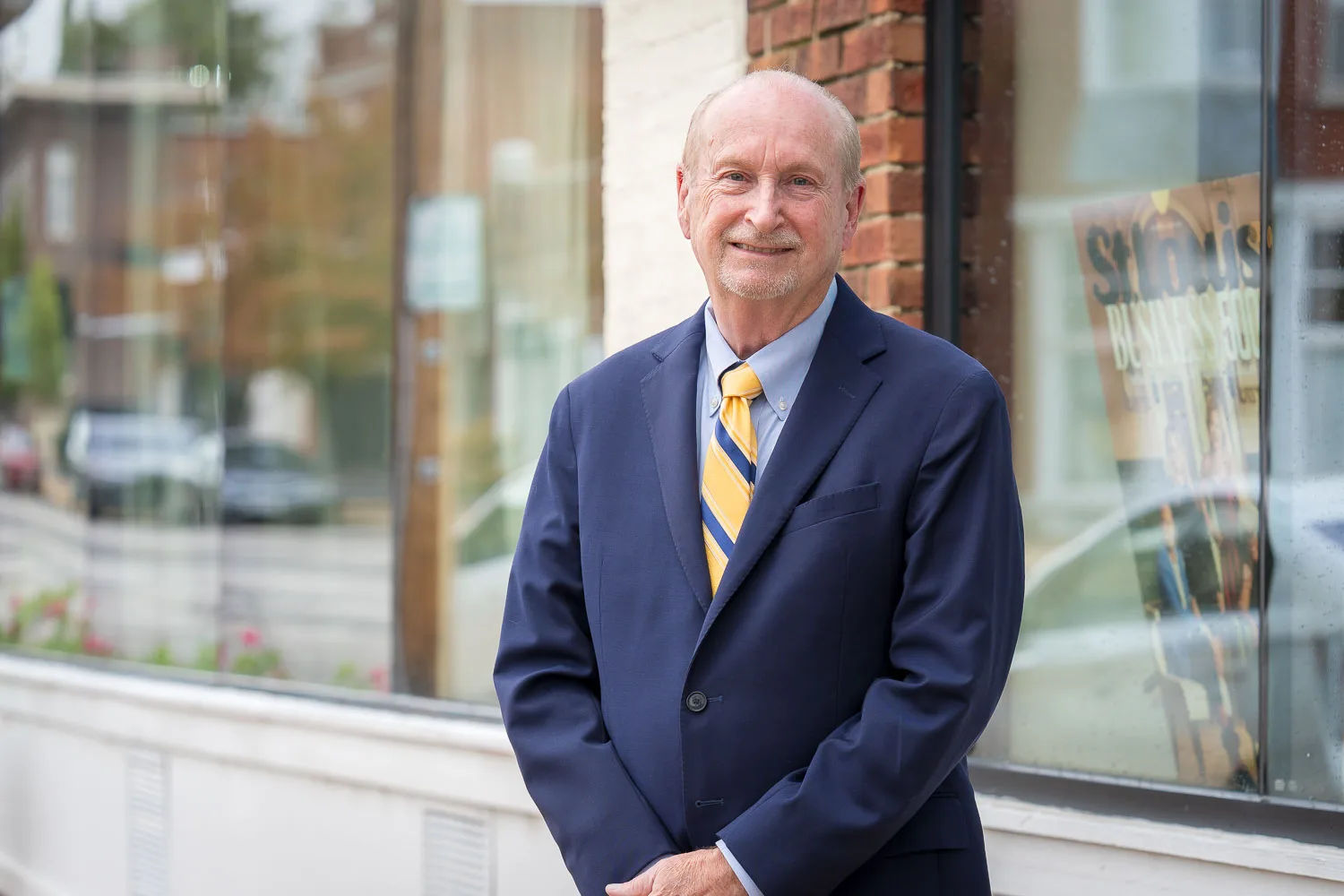
Seals met Kehoe several years ago. He tells the story this way: That in the ’90s, he’d been involved in “the wicked part of the world” in Walnut Park. Got shot about a dozen times. Had an epiphany one day and dumped his bulletproof vest on the altar of the Rose Hill Missionary Baptist Church, resolving to straighten out. Seals later managed to acquire that church, which he aimed to fix up so that kids could hang out and stay clear of trouble. But the building was missing a wall. So he asked around for help. Various business leaders, along with then–Lt. Gov. Kehoe, heard about his project and helped him with the remodel. At the new Sankofa Unity Center, Seals has hosted movie nights, tutoring services, a food bank, job placement help.
In Seals’ recollection, Kehoe showed up at Sankofa for a Thanksgiving turkey drive in 2022 and promised, “I’m gonna come back.” Seals was skeptical. But Kehoe did come back. Over and over—sometimes with his wife, sometimes by himself, no entourage, no security. “He’s not afraid,” says Seals.
During the gubernatorial race, Seals agreed to appear in a Kehoe campaign video. In the spot, he described Kehoe as a big-hearted “man of his word.” He holds fast to that view today, dismissing any notion that Kehoe had assisted Sankofa for electoral benefit. “Politically, it didn’t help him,” he says. “Black folks goin’ vote for Democrats no matter what.” (One exception, he concedes, was his own mother, who voted for Kehoe in the primary and said of him: “That white guy is about his business.”) Seals has a point. Even though some Black Missourians did indeed vote Republican in November, Kehoe could’ve lost every single one of them and still won handily: His margin of victory was larger than Missouri’s entire Black voting-age population by about 100,000.
And more than any politician of either party, Seals says, Kehoe put in the time to connect with Sankofa’s kids. “Some of my guys that come down—we’re talkin’ about kids that come from a rough life—walk up to him and hug him. Or he’d be sitting back, playing Pac-Man with them.… It’s not a photo op where he just come down and then stand around and leave. Mike come down, spend hours. Hours.” In August, Seals’ mother died. Kehoe showed up to pay his respects. “The only white man that was at my mama’s funeral,” Seals recalls. Kehoe has even visited Sankofa since being elected governor. Seals, in turn, has given him a nickname: Big Ticket. Asked about its meaning, Seals explains: “As Black folks say, he the shit.”
Kehoe feels like a throwback to the compassionate conservatism of 20 years ago. That makes his ascent during the grievance-fueled era of President Donald Trump all the more striking. But those who know Kehoe aren’t surprised—for example, at how he announced his candidacy and immediately racked up key endorsements, or how even Democrats in Jefferson City speak well of him. Says the lawmaker-turned-lobbyist Jeff Smith, “There’s a million ways to burn people, but only one way to do right by people, and the reason you don’t find people who hate [Kehoe] is that he does right by people.” For Kehoe, social-media spats count for nothing next to in-the-flesh relationships. He cultivates those over long periods, partly because it’s useful and partly because it makes him feel good. Dave Sinclair’s son, James Sr., who grew up with Kehoe, says: “I see him in interviews about this terrible tornado, and he looks exactly like the guy I sold cars with: Everybody is his friend, and he’ll help you if he can. And he’ll tell you the truth.” Many people think successful car salesmen are “bullshitters,” Sinclair adds, but that’s false; the good ones don’t play games. I ask: Is that how Kehoe is? “Absolutely,” Sinclair says. “Just no B.S.”
Now that Kehoe sits atop Missouri’s government, he has made clear he’s paying close attention to St. Louis and all the challenges it faces—violent crime, lukewarm investment, the havoc wrought by the May 16 tornado. He may even be focused on it more than his recent predecessors were.
The question that St. Louis is still trying to figure out is whether that’s a good thing.
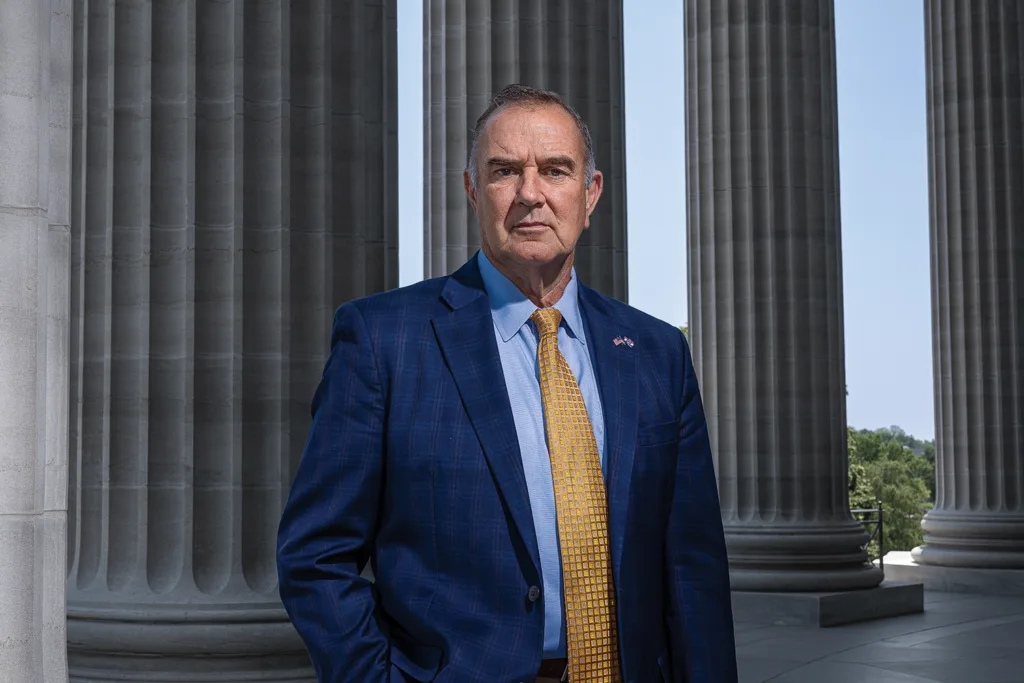
“As soon as my hand comes off the Bible,” Kehoe swore in November, right after clinching victory, “the Kehoe administration will be relentless in our efforts to make Missouri safer.” And indeed, in his first 10 weeks as governor, he prioritized and signed a law that wrested control of the St. Louis Metropolitan Police Department away from the city’s mayor and handed it to a governor-appointed board.
The change may have been wonky and structural, but Kehoe’s affinity for the police runs deep.
Kehoe’s father, John Kehoe, was a city cop. According to the governor’s autobiography, Someone on My Side, John was “emotionally abusive” to his wife, Lorraine, and after the couple lost a daughter to leukemia in 1960, he hit the bottle hard, at least in the opinion of certain family members. But there’s no ambiguity about what John did after their sixth child, Mike, was born in 1962. He abandoned them all—and, it turned out, had failed to pay the rent for months. So the family moved into Lorraine’s mother’s house nearby. Their neighbors, Kehoe later wrote, were “hardworking people who carried their lunches in paper bags”—mainly tradesmen and first responders, the latter of whom chipped in with things like groceries, recalls James Sinclair: “People from the police and fire department helped the family a lot.”
By the 1970s, shops were going dark, families were migrating to the suburbs, property values were sinking, and as Kehoe wrote, “crime began creeping in.” Relatives gave him a bicycle, which he treasured, but one day, Kehoe got ambushed, as he would remember decades later:
A much bigger kid stepped out from behind a tree and swung a baseball bat at me. He hit me squarely in the mouth, knocked out my front teeth, and I fell off the bike and tumbled to the ground. When I picked myself up, moaning in pain, with tears in my eyes, my attacker and bike were both gone … I never forgot it.
Some time later, a gang fight erupted on the front lawn of his grandma’s house. Mike found a .38 Special outside afterward and brought it in. His mother called the police to come collect it, but they never did. For her, Kehoe wrote, this was the final straw. The family relocated to South St. Louis.
In the decades that followed, law enforcement in American cities swung from the tough-on-crime ethos of the ’90s to a more progressive stance in the post-Ferguson 2010s, but in the minds of Kehoe and other conservatives, the left’s call to “defund the police” after the killing of George Floyd in 2020 was a pendulum swing too far. Last January, the Kehoe-backed police board bill got its first hearing in the House. Representatives of the St. Louis Police Officers Association testified that the SLMPD was in bad shape. It was hundreds of officers below budgeted strength, and the officers it did have were nearly the lowest-paid in the region. Its shooting range—necessary for licensing the force—had partially collapsed. Up until 2013, the city’s police had been under state control; the local-control experiment that began in 2013, one rep said, had failed: “We’re outmanned and underpaid.”
A strong police force, Kehoe tells me, is “an important piece of the puzzle, but it’s a piece of the puzzle.”
The bill that Kehoe signed into law in March was meant to respond in two ways. First, it required that the city spend a quarter of its general revenue on the police by 2028. Certain city residents saw this as an unfunded mandate and are now challenging it in court. But cops cheered, recalls Joe Steiger, the union’s business manager: “Morale went through the roof the day this passed.” Union reps argue that there’s a basic level of police funding you can’t feasibly borrow from to try out prevention programs; on the contrary, it’s a precondition for some of those programs to succeed—specifically, ones that require officer participation. Take focused deterrence, an evidence-backed approach that zeroes in on the likeliest perpetrators of gun violence and persuades them, through carrot-and-stick incentives, to stay peaceable. No department that’s chronically understaffed can fully dive into such work. Union president Martin Garcia insists his members want to come into 2025, not return to some bygone era. “I am not going to sit here and say we have the answer on our utility belt,” he says. “If you have a program that the numbers show is effective, yeah, we’re totally in favor of that.”
Yet the ability of Police Commissioner Robert Tracy to commit to such programs will hinge on the second (and most hotly debated) feature of Kehoe’s legislation: state oversight. The SLMPD will no longer be governed by Room 200 at City Hall but rather by a six-person board of police commissioners. It has five voting members. The mayor is automatically one of them; the governor appoints the other four, and on June 23, Kehoe announced his picks. One was the city’s former personnel director, who’d been fired for cause in March. The other three were business owners (a pair of restaurateurs and a man whose companies relate to photography and real estate). Some city Dems grumbled that, in a city that’s 41 percent Black, only 20 percent of the board’s voting membership was. “So much for north-side representation,” posted 14th Ward Alderman Rasheen Aldridge on social media. Even the conservative Bill Eigel, Kehoe’s closest rival in the 2024 primary, pointed out the lack of any former cop, prosecutor, jurist, or defense lawyer on the board—and that two of appointees had contributed to Kehoe’s campaign. One of these, the non-voting member, was also a vendor to the SLMPD. Eigel described that on X as a “conflict of interest,” concluding that the board was really about “rewarding political allies.”
In any case, this is the board that will be able to hire and fire the chief. Whether it will micromanage him on strategy, day-to-day operations, and community engagement remains to be seen. Kehoe asserted at the press conference that it won’t. “The board is not going to run crime-fighting,” he said. He has also explicitly denied that he wants St. Louis to revert to trying to arrest its way out of the crime problem. A strong police force, he tells me, is “an important piece of the puzzle, but it’s a piece of the puzzle.”
The metric that Kehoe values most for St. Louis isn’t crime data, he said in his January 28 speech, but rather “whether or not a business feels safe enough to invest in our cities. That’s the barometer. Period.” Entrepreneurship looms large for Kehoe. He sees it as a ladder out of scarcity.
It certainly was for him.
After his father left, he recalls, his mother worked three jobs, and young Mike Kehoe hustled: He mowed grass, heaved snow, plopped phone books onto porches, swept out coal rooms in North Side basements, sold newspapers near the church of his family’s Catholic parish, Our Lady of Mount Carmel. Even then, says James Sinclair, he seemed charged by a special battery: “He was always fixing, working, volunteering. I thought, ‘This guy is goofy, he never just rides a bike around.’ He was way ahead of his age.”
A big break for the family came when William Corrigan, a judge in the federal bankruptcy court downtown, needed a stenographer. As a favor to one of Kehoe’s uncles, he hired Lorraine—even though she had no training in shorthand. But she worked hard and would remain there for more than 30 years. That solid government job, Kehoe would later reflect, began pulling the family out of poverty.
Lorraine and Judge Corrigan teamed up to persuade the Catholic Marianist brothers at Chaminade Preparatory High School in Creve Coeur to accept Kehoe on a full work scholarship. (Kehoe says he may have been the first student to secure that arrangement.) Kehoe remembers riding the bus there from North City with the school janitors—a 1-hour-and-45-minute ride—before seeing his buddies pull up in Trans Ams, Corvettes, and Mustangs. Kehoe’s fascination with cars would begin at age 15, when he sought an after-school job from Dave Sinclair, a former city cop and friend of the family. Sinclair hired Kehoe to wash vehicles—and ultimately changed his life.
Kehoe saw Sinclair as “a modern-day John Wayne, a man you simply did not cross. He was huge: broad-shouldered, 6-foot-5 with size 14 shoes.” He says Sinclair taught him many life lessons: Treat customers well (“if it’s not right, we’ll make it right”); work hard (“don’t be a clock-watcher”); exceed expectations (“under-promise and over-deliver”); cultivate a thick skin (Sinclair often “fired” Kehoe in a huff but didn’t really mean it).
By 1983, just a few years into Kehoe’s tenure, the company was the largest Ford dealer in the nation by volume, selling hundreds of vehicles per month. Kehoe got promoted to sell trucks and vans. Then Sinclair and his co-owners gave him a special assignment: Spend some time at their factory in Linn, Missouri, and figure out why it was losing money. Kehoe, 25 years old, quickly figured out that its manager was embezzling funds. Kehoe confronted him, and he left. Sinclair and the owners then made Kehoe an offer: If he could make the factory profitable, they’d sell it to him for a bargain. Kehoe and his team did turn the place around. He borrowed private money, took out two federal loans from the Small Business Administration, and bought the factory. (In 1991, he won the SBA’s young entrepreneur of the year award and later testified before Congress on the importance of that program.)
When the company pivoted to making ambulances, sales took flight, and Kehoe zoomed around the country to close deals. By this time, however, he’d met and married Claudia, and when she became pregnant with their first child, he wanted to stay put.
In 1992, a Ford dealership in Jefferson City became available. Kehoe wanted it, but at 30 years old, he was seen by the national carmaker as too young. Sinclair stuck up for him with Ford execs, and Kehoe got the dealership. (He sold the factory to his managers.) Thus was born Mike Kehoe Ford, which would prosper for two decades. Plenty of central Missourians can still recite his tagline and its variable assurances that you, your friends, your neighbors, and everyone will “love a Mike Kehoe deal!”
Sinclair died in 2009. “I would not be here without him,” Kehoe wrote at the time. “I miss him every day.” He shared those words on his brand-new blog. The blog was named Mike’s Paper Plate.
But the last few months have made something else clear about Kehoe: That he believes some strokes of misfortune are so severe that only the might of government can solve them.
Ensconced as Kehoe was in the state capital, it was only a matter of time before a businessman of his stature moved into politics.
He became friendly with the family of then–U.S. Rep. Roy Blunt, whose son, Matt Blunt, ran for governor in 2004. Kehoe donated—and even drove—the campaign Winnebago. When Blunt won, he persuaded Kehoe to join the Missouri Highways and Transportation Commission. Thus began Kehoe’s longtime interest in properly funding highways—and public infrastructure in general. (He still considers himself an “infrastructure Republican.”)
When a state Senate seat opened up in the district that included Jefferson City, Kehoe saw it as a chance to beat the highway-funding drum. His advantages were manifold. Ford-tough name recognition was one. Another was a deep understanding of rural constituents: Years earlier, he’d bought a farm on the Gasconade River and, with the help of a farm manager, was raising cattle there.
After Kehoe won the seat in 2010 and ascended to Senate majority leader in 2015, he certainly behaved like a pro-business conservative: He notched wins in tort reform, tax cuts, and changes to unemployment and workers’ compensation. But, as he wrote in his book, he came to conclude that “the vast majority” of politicians in both parties were “honest, sincere, and well-intentioned men and women trying to do the right thing, as they saw it.” Gina Walsh, a pro-labor senator who represented North County, says of Kehoe: “He always listened to me, and he was always honest with me when he couldn’t help with issues I was working on.”
Which is not to suggest that in 2024, when Kehoe vied to be the Republican candidate for governor, he ran a warm-and-fuzzy campaign. In one video spot, he promised to stand up to “woke prosecutors” and “liberal extremists.” On X, he wrote that the progressive left “wants to destroy” the ability to achieve the American Dream through hard work, as his family had done. In reference to the 2020 election, Kehoe said that President Joe Biden had “no business being president” and was “illegitimate in the eyes of the voters”—a carefully worded statement seemingly designed as red meat for the election-denying MAGA base without explicitly endorsing Donald Trump’s false assertion of victory. Kehoe beat his closest challenger in the August primary by 7 points and won the general election against Democrat Crystal Quade by 20 points.
Yet in January, Kehoe’s inaugural address was markedly different from the one Trump would deliver a few days later, upon his return to the White House. “Political opponents cast each other as traitors and criminals,” Kehoe said. “I reject this. I believe we can work together without sacrificing our core beliefs… Missourians are more alike than we are different.”
Where Kehoe departs with Missourians on the left is what to do about the luckless in this world. Kehoe’s prescription for them is in his autobiography: “Work hard, treat people right, have some faith, and hang in there. That’s it. That’s the path to success.” He’s humble enough to recognize all the help that he and his family got, hence the title of his book, Someone on My Side—a reference to his neighbors, mentors, and the spiritual forces of his Catholic faith. Still, Kehoe believes that you can work your way out of any problem. “You make your own luck,” he tells me.
A liberal may counter here that the ability and desire to work hard are themselves the product of luck—not just the particular brain and body you got in the genetic lottery (and how well they conduce to hard work), but also the role models you had while young, and whether their hard work actually brought rewards that seemed worth striving for. Which is another way of saying that plenty of poor kids don’t have a Judge Corrigan or a Dave Sinclair in their lives—that some kids have nobody on their side. Making such kids productive and self-sufficient is not the task of the government, Kehoe believes, but rather, of the community: neighbors, charities, groups such as Sankofa. “I don’t think government should create jobs or solve problems,” he told me. “I always say we should just create an environment where those problems can get solved.”
But the last few months have made something else clear about Kehoe: That he believes some strokes of misfortune are so severe that only the might of government can solve them.
The morning sun of May 16 rose on a pretty good situation for Kehoe. The Missouri General Assembly had wrapped its session the day before and sent to his desk several bills he favored. One budgeted $50 million to help families pay for private and parochial school. Two others were designed to roll back voter-approved laws that had mandated paid sick leave and abortion access. (Kehoe often praises Missourians’ intelligence when extolling small
government—“Missourians are pretty smart,” he wrote in his book—but his confidence seems to wane when they vote on ballot initiatives.) Another bill carved out a new entertainment district in downtown St. Louis. In essence, this district can keep the taxes it would normally pay to the state and instead use that money to ensure that the organizers of marquee events, such as concerts and tournaments, will make a minimum level of revenue—making St. Louis, the thinking goes, a can’t-lose proposition.
One reason the bills made it to his desk was that the storm cloud of dysfunction over the Senate in recent years dissolved in 2025. But many observers credited Kehoe’s hands-on style. Unlike his predecessor, he was known to huddle with legislators over a turkey sandwich in the basement cafeteria and was spotted in the corridors strolling to and from their offices. Says one longtime Jeff City lobbyist: “He has not had an easy life, and I think he reads people very well—not in a gross way that politicians do, but more just knowing what they need.” With that knowledge in hand, Kehoe then helps lawmakers with favors large and small over the long-term. Not only does he genuinely enjoy doing this, the lobbyist says, but he never conditions it on getting something in return. If he does eventually make an ask, though, the gale force of Midwestern reciprocity—and the fear of disappointing him—is tough to withstand. “They almost can’t say no,” the lobbyist explains, “but it’s not, ‘I’m afraid I’ll be on his shit list.’ It’s more like, he’s your favorite high-school basketball coach and you want to be on his team.” (Adds the lobbyist: “I’ve seen angry Mike Kehoe a small number of times. It’s in there. But I’ve never seen him mad at somebody. I’ve only seen him mad at a situation.”)
Yet for all of Kehoe’s wins, by the morning of May 16, legislators had not delivered the package of tax incentives he wanted for the building of new sports stadiums—and to the governor, that was an emergency. Kansas was trying to lure the Royals and Chiefs across the state line, and its incentive package would expire in weeks. Losing those teams, Kehoe asserted, would cost Missouri “thousands of jobs and millions of annual revenue.”
Then, that afternoon, a second emergency descended from the sky. In St. Louis, a tornado with 152 mile-per-hour winds ripped a lane of wreckage from Clayton to North Riverfront. The toll, as later tallied by the city: 5 dead, 38 injured, some 5,000 buildings heavily damaged or destroyed.
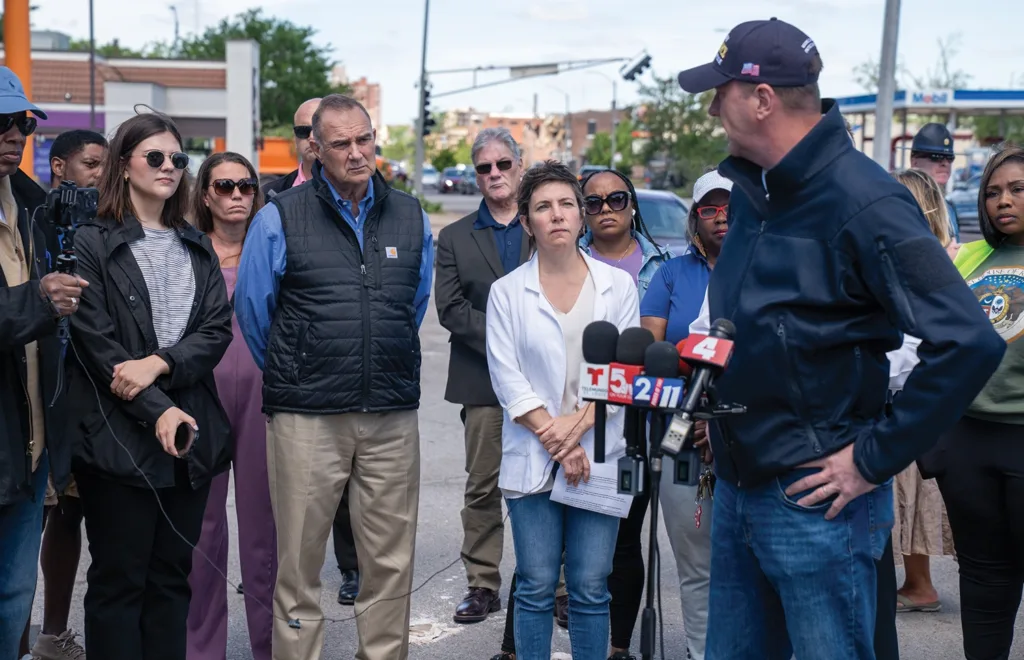
Kehoe flew to St. Louis the next morning to see it up close and then appeared at a press conference alongside Mayor Cara Spencer and other officials. He had already sent several state-level search-and-rescue teams, he announced. (He would later deploy 41 engineering personnel from the Missouri National Guard to help with debris removal.) “This is when you really see the goodness of Missouri,” said Kehoe, clad in a Carhartt vest, squinting in the sun, “when you see these men and women step up and help their friends and neighbors who they’ve never met.”
Hours later, Kehoe spoke on the phone with President Trump. They’d met in person in the Oval Office just weeks prior. Trump remembered that meeting and showed a keen interest in the damage assessment, according to Kehoe, who recounted part of the call this way:
Trump: Missouri loves me.
Kehoe: Yes sir, I know, Mr. President. They do.
Trump: Would you tell St. Louis something for me?
Kehoe: Yes sir.
Trump: Tell ’em I love them and that I’m praying for ’em.
Kehoe: I’ll tell ’em, Mr. President.
Trump: No, I’m serious, I want you to tell ’em.
Kehoe: I will.
Beyond the need for Trump’s love and prayers, though, was the need for a presidential major-disaster declaration—the tool that unlocks tens of millions of dollars in recovery reimbursement from the Federal Emergency Management Agency. Kehoe sent Trump a declaration request on May 26.
The next day, he called for a special session to commence June 2.
He asked legislators to take up stadium funding and tornado relief. Blowback hit him from both flanks. The Freedom Caucus called the stadium funding a “handout to billionaire sports team owners.” Democrats decried Kehoe’s tornado proposal—which included $25 million for a response by the Missouri Housing Trust Fund—as paltry: There was no telling how long Trump and FEMA would dither, they argued, and at that very moment, damaged homes were exposed to weather and folks needed shelter. Dave Drebes, a seasoned capitol watcher, wrote in the St. Louis Business Journal that it would be “a masterstroke” if Kehoe managed to make the special session succeed.
Then Kehoe made it succeed.
Not singlehandedly, observers say, but by serving as the glue that held it together. “I’m not sure I know of any other governor that could’ve pulled it off,” the longtime lobbyist says. Sen. Steve Roberts (D-St. Louis) recalls the negotiations as “intense” but says that in the end, he and a handful of his fellow Democrats agreed to stadium funding in exchange for a $100 million appropriation for St. Louis tornado relief (plus the $25 million for housing). Across the aisle, a handful of Freedom Caucus senators agreed to stadium funding in exchange for property tax relief in certain areas of Missouri.
These factions may or may not have trusted each other, but everyone trusted Kehoe: He had spent five months in good-faith dealings with leaders in both chambers, the lobbyist says, so he knew “when to take his foot off the gas and let the process play out because he could trust that they wouldn’t ask for more than they needed. And they knew they could trust him and, frankly, his staff.” The leadership, this lobbyist concluded, “wouldn’t have helped every governor” get this done. But they helped Kehoe.
Then Trump helped Kehoe—and Missouri. On June 9, in the thick of these negotiations, the president approved Kehoe’s request for a major-disaster declaration, which could reimburse recovery costs in St. Louis to the tune of more than $70 million.
St. Louis got something else in the special session, too: The stadium funding package was written in such a way that allows the Cardinals to use it to update the 19-year-old Busch Stadium.
In the view of the lobbyist Jeff Smith, the session ended in “a compromise that not everyone loved but that people could live with. There’s a reason the guy sold more cars than maybe any living Missourian. He’s damn good at finding a path to get people to ‘yes.’”
But when I ask Kehoe about how he used to sell cars, he corrects me. “Still do,” he says. True, he sold his Jeff City dealership back in 2011. But folks still call him asking for help buying vehicles, so he’ll meet them up there and try to connect them with a good manager. “Once a salesman,” he says, “always a salesman.”