This article first appeared in the Solutions newsletter. Click here to learn more about the newsletter and sign up.
To understand why St. Louis officialdom is gearing up to try “focused deterrence”—an anti-violence strategy with a robust evidence base—you first need to absorb a nuance about our region: Violence is high, but it’s also highly concentrated. Which is to say it’s a problem but not necessarily an immutable one.
Stay informed on the area’s civic issues
Subscribe to the St. Louis Solutions newsletter to learn about public problems and possible fixes.
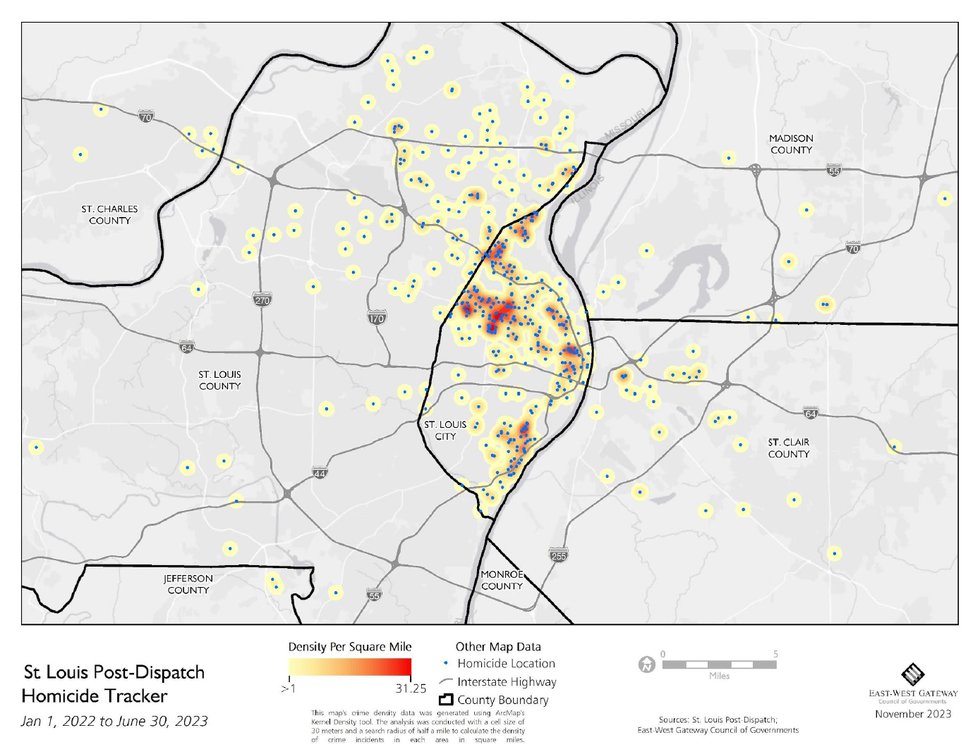
Forget the noise about “Most Dangerous Cities” lists and how our weird city-county divide distorts the crime stats. (It does.) The fact remains that the homicide rate in the St. Louis metropolitan statistical area has been at least double the U.S. metro average for nearly a decade, according to data released last week by the University of Maryland’s Violence Reduction Center. This is bad. It scares people away and devastates those who must live with it every day. Yet murder is not flaring up all over St. Louis. Geographically, it occurs in clusters. Most clusters are on the city’s North Side; one is in the city’s southeast.
Demographically, there are patterns, too. Analysts at the John Jay College of Criminal Justice at the City University of New York just finished an in-depth review of 212 recent St. Louis homicide incidents. They found that the known victims and suspects have “nearly identical characteristics” (83 percent were male, 89 percent were Black, 68 percent were under age 35). Another finding was that these individuals had similar histories with law enforcement (78 percent were already known to the criminal justice system at the moment the violence broke out). That last piece is critical because it provides intel on who is likeliest to be a shooter or victim in the future.
With that intel, practitioners of focused deterrence set up a key component of their strategy: “call-ins.” These are meetings at which a community gathers around potential shooters/victims—physically, in a room. We’re talking mothers, girlfriends, neighbors, past offenders, pastors, social workers, behavioral healthcare providers, judges, prosecutors, public defenders, police. Together, they deliver a message: We’re here to help you, but if you won’t let us help you, we’re here to stop you.
It’s a promise of both carrot and stick. Would-be shooters/victims are offered assistance with housing, cognitive behavioral therapy, and job training if they put the guns down. But if violent behavior continues, they face consequences that are clear, swift, certain, and fair. The balance of “tough” and “soft” is central to focused deterrence. The idea is that cities can neither arrest their way out of violence nor social-program their way out. They need to do both. An ideologically pure progressive or conservative may get grumpy about that claim, but strong empirical evidence backs it up: According to a systematic review in 2019, focused deterrence showed significant positive effects in 22 of 24 localities that tried it.
A top advocate of it these days is Thomas Abt, an associate research professor who founded the VRC at Maryland and authored the book Bleeding Out. Abt was in town last week to lead a five-day VRC practicum organized by East-West Gateway. (You could tell that the region was taking him seriously by how many top politicians and law enforcement officials showed up.) By Friday, the working groups were recommending several strategies, including focused deterrence, all with a goal of a 20 percent reduction in homicides and shootings over three years. What they seemingly signed onto was Abt’s proposition that “a small set of evidence-informed strategies can make a difference when implemented properly.”
And proper implementation, by many accounts, is hard. About a decade ago, then-Circuit Attorney Jennifer Joyce tried several components of focused deterrence, including call-ins. A source with her administration who requested anonymity recalled that Joyce’s team did conduct some call-ins but couldn’t get commitments from all the stakeholders that are necessary for them to succeed. One North Side minister told me off-the-record that certain officers showed up to those call-ins with tactical gear—a site-security decision that tipped the balance of the message toward confrontation and made participants bristle.
But it sounds as though the region is going to try this again, together this time—which itself is a challenge, given the crazy number of local governments here. The concentration in the city, though, simplifies matters. And Abt told everyone at the practicum that although he’d been worried beforehand that St. Louis’ fragmentation would hamper a regional strategy, his concerns were not realized. “I have to say,” Abt said, “I’ve just been deeply impressed.”
As for focused deterrence, Chief Robert Tracy of the St. Louis Metropolitan Police Department told me at the end of the practicum that he’s been a practitioner of it for about a decade—most recently, in Wilmington, Delaware, where he himself participated in call-ins. “It’s not going to reach everyone,” he said, “but a lot of [participants] do come around.”
Tracy added that it doesn’t require the hiring of more officers, only changing up the mix of some officers’ duties. That’s important because, as he acknowledged, the SLMPD remains below budgeted strength as it tries to slow attrition and bring new cadets in. In any case, Tracy concluded, focused deterrence “is not the be-all, end-all. It’s just another layer. And I like that layer because you start to work with families and get to root causes.”
The timeline right now calls for a regional anti-violence plan to be approved in March.