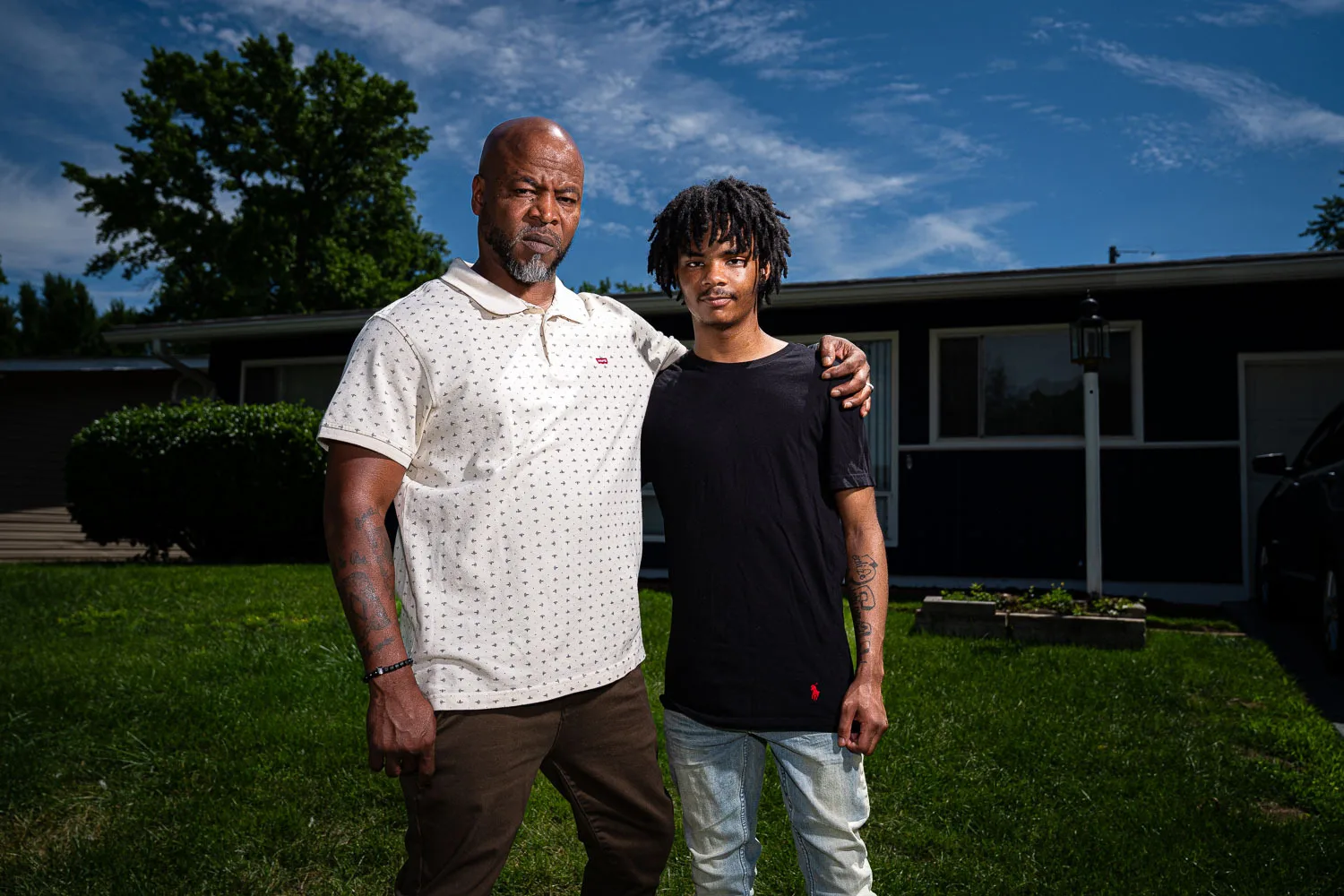
A man hears his car alarm start to wail. It’s the mid-1980s, near the water tower at 20th and Grand, in North City. The man steps outside his duplex and finds a boy standing there. The boy is Antwane White, who lives across the alley with his mom and granny and siblings. He has knocked on the door before, to no avail, so now he’s trying a new tack: Having learned the man’s work schedule and waited for him to come home, he has tripped the car alarm, knowing that the man will need to approach the front of the car to turn it off. How you doin’? the boy asks. I’m busy, the man says.
Decades later, White, who is now 48, can recall these factual details of being brushed off by his biological father. He cannot summon the feelings; maybe his brain has sealed those off, he says. In any case, the result was clear: “I stopped going.”
Get a fresh take on the day’s top news
Subscribe to the St. Louis Daily newsletter for a smart, succinct guide to local news from award-winning journalists Sarah Fenske and Ryan Krull.
Not many years later, White’s life took a turn into darkness. But that wasn’t the end. His life suggests that while growing up without a dad can leave a person damaged, the damage need not be destiny.
Dads matter to St. Louis because, one day, the region’s success—maybe even its viability as a place to live and work—will depend on the grit and verve of today’s kids, and kids seem to do better when their fathers help raise them. The word “seem” is chosen deliberately here: Human affairs are messy, and depriving children of their dads to run a social experiment is unethical, so a lot of existing research is more suggestive than definitive.
Still, according to a recent book co-edited by scholars at the Harvard Kennedy School, a “growing body of evidence” has shown that fathers are important to kids’ cognitive, psychosocial, educational, and behavioral development—for example, whether they show up to school or engage in risky behaviors. While it’s true that two loving parents of any sex or orientation are better for kids than just one parent, the editors write, “the importance of engaged fatherhood is now undismissable in ways it was not in earlier decades.”
Indeed, in Missouri’s state capital, where the two major political parties don’t agree on much, it’s something of a rare bipartisan consensus.
State Rep. Jamie Ray Gragg of southwest Missouri knew this on January 27, when he sat down to face a committee in the state House of Representatives. His goal: persuade his fellow lawmakers to pass, for the second year in a row, his bill to launch the Missouri Fatherhood Engagement Project. “It is labeled a ‘father’ bill,” the Republican told his colleagues. But, he insisted, “It’s a kid’s bill.” That’s crucial, he explained, because “our children … are our future.” He thought of Whitney Houston. “Not to go into an old ’80s song, but yes.”
Gragg was optimistic because both Democrats and Republicans seemed to like his idea. The concept was to establish a state-run fund dedicated to helping estranged fathers reconnect with their kids. The fund could take in money from multiple streams—state or federal appropriations, private donations—but regardless of the source, the fund would not be spent trying to make dads care about their offspring. Rather, Gragg wanted to assist dads who already care but face logistical barriers, be they legal, work-related, or stemming from the foster care system. Gragg’s plan was for the state’s Division of Social Services to give out grants to local organizations that help dads overcome such barriers.
Florida has already set up such a program, which has channeled funds toward groups such as the faith-based nonprofit Man Up and Go. That group’s director of strategic development in southwest Missouri, Tim McConville, coaches dads who have lost their kids to foster care (or are at risk of doing so) and helps them show up to the mandated meetings, navigate the bureaucracy, and stay optimistic. McConville testified before the committee that his phone was always blowing up with calls from case workers at Missouri’s Children’s Division and charitable service providers. “They’re constantly like, ‘Tim, can you do this? Can you help this dad?’ And I have to limit what that is because I don’t have the ability to duplicate myself personally. And so this is a bill that would allow us to duplicate and do this work on a bigger scale.” Putting a child in foster care costs state taxpayers around $20,000 a year, McConville said. “If we can keep that from happening, it is better for the kids. It is better for everybody.”
After listening to McConville, Rep. Raychel Proudie, a Democrat from Ferguson, spoke up. “It just makes economic sense all the way around,” she said. “I do like this bill.”
She wasn’t the only Democrat on board. On February 25, during a full-chamber debate on Gragg’s plan, Rep. LaKeySha Bosley of North City said: “I wholeheartedly agree with this bill.” Rep. Marlene Terry of North County said the same. “If you have never had to witness or be part of a situation where something like this is necessary,” Terry added, “you probably wouldn’t understand.”
Some libertarian-minded Republicans balked, interpreting the bill as an invitation to the state to interfere in personal matters. “I’m not entirely sure that I’m comfortable with government trying to mold society into being better people,” said Rep. Bryant Wolfin of Ste. Genevieve. But his co-partisans pushed back. One read aloud the section of the Republican Party platform that said, “Republicans support policies that promote strong families.” And at the final hearing in March, another said he agreed with limiting state involvement in families, “but the problem is that no one’s stepping up, and no one’s lining up to do something like this.”
While the House passed the bill with little opposition, it died in a Senate committee, where members of both parties voted no. But despite the disagreement on the proper solution, everyone seemed to agree on the problem: Fatherlessness is harming Missouri. Gragg called it “an epidemic.”
The state is not an outlier in that regard. In 2020, 17 percent of Missouri households with children were headed by single mothers—the same percentage seen in the nation as a whole. Yet the statewide figure obscures the variation that exists by neighborhood. In St. Louis, for example, there were multiple census tracts in North City and North County (and nowhere else) where more than half the households with kids were headed by single moms.
The fact that many kids live with single moms doesn’t mean their dads are absent in their lives. As Richard Reeves points out in his much-discussed book Of Boys and Men, “There is no residency requirement for good fatherhood. What matters is the relationship.”
Yet at scale, father presence appears to be intimately associated with children’s economic outcomes. In the early 2010s, economists now at the Harvard University–based nonprofit Opportunity Insights got their hands on de-identified tax-return data from millions of Americans over decades. This data allowed them to see how income varied intergenerationally and geographically. One of their earliest findings, explained in a 2014 paper, was that the lower the fraction of single-parent households in a commuting zone (similar to a metro area), the higher the area’s upward mobility. The researchers couldn’t tell whether having a lot of single parents around was actively suppressing mobility, only that there was a correlation.
They could also see that family structure wasn’t the whole story. Their analysis showed that in general, “Black and white boys have very different outcomes even if they grow up in two-parent families with comparable incomes, education, and wealth, live on the same city block, and attend the same city schools.” Clearly, father presence alone had not closed the racial gap.
Yet in some areas, that racial gap was noticeably smaller—and to the researchers, this meant that “the Black-white gap in upward mobility is driven primarily by environmental factors that can be changed.” Using their massive trove of IRS data and the census records, the researchers found that Black boys in particular tended to have higher incomes later in life if they’d moved as children to neighborhoods where three things were true: poverty was low, white residents showed low levels of racial bias, and a majority of Black kids were living with their fathers. Again, the researchers declined to make strong causal claims on how much, if at all, any of those aspects directly lifted Black boys’ prosperity. Maybe they were treated differently, the researchers suggested, or maybe they benefitted from “mentoring by Black male role models in the community.”
Regardless, “mentoring programs for Black boys” was one of the initiatives that the Opportunity Insights researchers identified as “hold[ing] the greatest promise of narrowing the Black-white gap.”
Male mentoring happens to be one of the things that Antwane White didn’t get—at least, not at first.
Drug slinging, gang banging, street running: All “just part of the day-to-day,” says White of his boyhood on the North Side. In eighth grade he got arrested for auto theft and spent time in juvenile detention. It didn’t deter him. Pulling a robbery, he says, made him feel like he had superpowers—like he had control, if only for an instant. He yearned to prove to the neighborhood how tough he was; his dad clearly didn’t care either way. “Maybe I find myself trying to impress others to make up for that shadow that was missing,” he says.
When White was 20, his daughter was born, but he missed the first six years of her life: He was locked up for robbery in 1998 and didn’t get out until 2004. “It wasn’t a back-to-normal kind of thing,” he says, “but I was around the same people.” His son, Antwane Jr., was born in 2008. It was around this time that White made what he calls one of the worst mistakes of his life. He was babysitting his son and toddler nephew, who soiled his pants. The precise details of what happened next were “highly contested” at trial, according to a prosecutor’s filing, but nobody disputed that to clean the baby off, White set the baby in a hot bath without checking the water’s temperature, causing the boy to suffer partial-thickness burns on his legs. White immediately called the boy’s mother, who took him to the hospital; the boy had to stay there for weeks. To this day, White insists the harm was unintentional, and the jury deadlocked on a first-degree assault charge, which would’ve required a finding that he knowingly hurt his nephew; it instead found White guilty of second-degree assault, which required a finding of “recklessness.”
Because of his prior criminal offenses, though, White was sentenced to 15 years on that charge. While he was in prison, he hung with a gang, “dipping and dabbing in drugs.” Occasional visits from family would wreck him, he says, because he was powerless to be in their lives. “I’m talking to my son every day on the phone,” he recalls. “I’m just thinking, Man, I don’t want to go home like this…just laying in the bunk, looking up at the ceiling, thinking about where my life is.” Sometime around 2015, he decided that in order to take care of his kids, he had to get his mind right. He’d heard about the state-run Transition Center that serves as a kind of halfway house in the Near North Riverfront neighborhood. As he approached his release date, he applied and was accepted.
One service provider White found there was the Fathers & Families Support Center—the kind of entity that would likely be eligible for grants from a Missouri Fatherhood Engagement Project.
Launched in 1998, the nonprofit originally offered a six-week course for mostly low-income, non-custodial fathers who were committed to being better men and better dads—all-purpose “boot camps” heavy on tough love and lessons in self-regulation. Today, the nonprofit has separate programs related to family and employment. Maybe a guy needs a work mentor, or help navigating a custody or child-support dispute, or even a bus ride to another state to get a birth certificate so he can earn his commercial driver’s license. The support center does all that.
The support center also has a reentry project for participants who are leaving prison. It claims a recidivism rate of 7 percent, compared to the statewide average of 35 percent. It’s run out of the Transition Center, which is where White landed in 2019.
Charles Barnes, the project’s director, recalls White’s arrival. “I said, ‘I’m going to keep my foot on you the whole time that you’re here.’ And he said, ‘I want that. And I need that.’ I said, ‘I’m going to hold you accountable.’ And for the six weeks that he was in my program, and even past that, he stood up to be the man that he was supposed to be.”
For one thing, White reconnected with his kids. The first chance he got to spend free time outside the center, he surprised his son Junior by showing up at the parking lot of his school. “I just remember me walking outside and running up, giving him the biggest hug I ever could,” recalls Antwane Jr., now 18. “I missed him so much. I ain’t going to lie.” They ate at Denny’s, bought Junior a cell phone. “He was apologizing for missing the majority of my childhood,” Junior adds. “He apologized a lot.” White would soon get full custody of his children.
But in that moment, he needed a place to live. When White found a landlord willing to rent him an apartment, he asked for the support center’s help. “They said, ‘We got you. We’ll meet you there tomorrow at 9:30,’” he recalls. “At 9:30 that morning, they met me there, signed a check. I moved in…They going to do what they say they going to do if you do what you say you going to do.”
He found a job slicing onions and whipping eggs at the now-defunct Blondie’s diner on Washington Avenue, then found an additional job at a linen company that serviced hospitals—and eventually moved over there full-time. The reason: It offered upward advancement. Delivery drivers could build up their routes by finding new revenue streams and earning commissions on that. So White spent years building his route, keeping to the drivers’ unusual schedule: Wake up at 1 a.m., get into the truck around 2 a.m., finish the route by about 10 a.m., then in bed by 6 p.m.
By the time Diane Santiago, an account executive, joined the company in 2022, White had earned a specific spot in the linen-driver hierarchy. “They call him ‘The OG’ because he’s been there awhile, and he’s a little older than some of the other drivers, and they look up to him because he’s got kind of a quiet command.”
Santiago’s job was to ride along with drivers and help them talk to customers and engage in suggestive selling: Say, who cleans your mats? At first, she found the drivers to be an insular group who craved routine and showed little interest or trust in her. White was different. He invited her on ride-alongs and peppered her with questions—even if he initially revealed little of his own personality. “He was a bit guarded,” she says. But she noticed how he insisted on greeting everyone with a “good morning” before talking business. How his pants were always ironed. How he was systematic, followed protocol, and followed up, never having to be asked twice to communicate something to a customer. He jokingly asked her, “You going to make me some money?”
“Neither one of us was murdered in these streets,” he says. “And now here we are at a ripe age and making good money.”
She did. His earnings went up by about $35,000 after they worked together for a year. “It took me to that tax bracket where you start complaining about the government,” he says with a grin.
White says, and Santiago confirms, that he has built up his route to the point that he now makes north of $150,000 a year. His brother owns a trucking company, he says, and makes even more. White credits their drive to their mother, Mary Ann White, who worked long hours, even on holidays, to support them and their three other siblings.
White says that sometimes, when he and his brother sit back and sip beers, they think about growing up poor. “Neither one of us was murdered in these streets,” he says. “And now here we are at a ripe age and making good money, able to support our families, provide like we supposed to. And I tell him all the time, ‘Man, if they knew where we came from.’”
That’s exactly the point White makes to guys coming through the Transition Center: It can be done. He’ll sometimes get a phone call from Barnes, who’s in a room at the center with participants who don’t want to be there. On speakerphone, White will describe his own trajectory. “Guys that’s coming home may have it rough,” he says, “think that the elevator don’t go up for ’em. I want to give ’em an example and let ’em know it’s real…But if you ain’t willing to do the work, it’s not going to turn around.” Barnes has also sent dozens of participants his way. White coaches most of them on the phone; some, he meets in person. Like Barnes, White does not sugarcoat his message. “We come from the same walk of life, the guys that I’m dealing with,” he says. “So I ain’t no pussy. You ain’t no pussy. So I ain’t going to let you come and punk me in my face…When you call me and tell me you’re having a hard time, I’m going to shut up and listen. But if it’s one of them hard times that you created, then I’m going to let you know.”
Barnes occasionally sees their reaction in real time. “These guys say, ‘Man, I have somebody that can truly relate to me.’ Sometimes it’s shocking.”
White’s economic ascent alone is surprising: According to research from Opportunity Insights, St. Louisans who grew up in North City at the same time White did have some of the region’s lowest rates of generational upward economic mobility. In that sense, White is a statistical anomaly. The question is whether an intergenerational cycle of poverty can indeed stop with one father’s force of will.
The Opportunity Insights researchers found that for low-income Black boys, the economic benefits of growing up in a neighborhood that has a high presence of Black fathers were visible even for a child whose own father wasn’t around. What matters in the context of lifetime earnings, they concluded, had less to do with a boy’s individual circumstance and more to do with the community-level conditions where he grew up.
Strictly in that sense, Junior has some cards stacked against him: The young man has already spent much of his childhood in low-income parts of St. Louis, and even now, he says, “Most of my friends stay with their mother…I don’t got no friends that stay with their dad.”
But Junior does, in fact, stay with his father—and his father is trying to pull him up the economic ladder. White recently sat down with both his kids—his daughter is an Amazon driver, his son works at Wendy’s—and explained that they need to start saving so that, for example, if their cars break down, they can get them fixed without asking him for money.
Then, White had an idea. He was thinking about how his employer matches his contributions to his 401(k) retirement account. So he hatched a plan: If his kids set up savings accounts and deposited $5 a day, he would match it. He pitched them the idea in a group chat. “Take this serious,” he wrote, “and let’s save some money.” His daughter responded: “I’m definitely locked in.” Junior responded with a flexing-biceps emoji.
Junior says he hopes to follow in his dad’s footsteps—wants to eventually get his CDL, learn how to drive a truck, save up, and own a home so he doesn’t have to rent. He’s hyper-focused on money because his dad is.
But that’s not the only thing. Sometimes, they hang out on Antwane Sr.’s back deck, talk about sports, talk about serious things. Says Junior: “I wish he didn’t miss the majority of my life. But he been doin’ good. He caught up with me.”

If research ever proves fatherlessness to be a drag on upward mobility, then a strong argument will emerge for legislation like the proposed Missouri Fatherhood Engagement Project—and a way to channel public resources toward entities such as the Father & Family Support Center. The nonprofit claims that in 2025, it helped 267 fathers maintain or secure jobs that, on average, paid above minimum wage, and that from 2019–2024, its graduates collectively paid nearly $6 million in child support.
Not all participants make it through their programs. About 30 percent drop off before graduation. “We’re working with humans,” says chief operating officer Destini Goodwin. Many of them, she adds, have suppressed certain traumas. Reginald Slaughter, the community outreach coordinator, confirms that not all the men are willing to face those traumas, but some simply aren’t willing to follow rules—about showing up on time, or dressing appropriately, or speaking respectfully of their children’s mother. Others don’t appreciate being told that their drinking, drug use, attitude, or domestic violence is ultimately what’s keeping them from their children. “If you’re not going to be accountable and responsible,” Slaughter says, “then you won’t make it here.”
And even if you do make it, the work doesn’t end there. Take Caron Perkins, who is 26. Seated in his new and newly tidied-up Normandy apartment, he tells of being a 19-year-old football player at Culver-Stockton College when he found out his girlfriend of three months was pregnant with twin girls. “I almost cried when they was being delivered,” he recalls. “Seeing them being born and holding them…This was one of my happiest moments. I’m going to be honest. I thank God for that.”
The relationship with the mother soon soured. In 2025, she filed a petition with the court, which ordered Perkins to pay child support. But then, he says, after a teacher at the girls’ school called an abuse hotline to report the mother, state caseworkers began vetting Perkins’ ability to have custody of the girls—and one of them suggested he go to the Fathers & Families Support Center.
He didn’t want to. The first day of the six-week program, however, changed his mind. “The teacher—you could tell he been through the same similar situation that we’ve all been through. So I’m like, OK, he probably can help me out.” Perkins was especially surprised by the benefit he got from one-on-one counseling. “It was certain situations in certain parts of my life that I kept to myself,” he says. “It was traumatizing. But now, it’s like it helped me get over it.” He dismisses the stigma against therapy. “Some people may think, It going to make me weak…. It’s not about what the next person thinks about you. It’s about you, really.”
Aside from the practical advice he got about how to handle himself in moments of conflict or stress, he also appreciated tips on how to interview for a job or communicate in a business setting. Perkins graduated from the support center in May. For the time being, he’s a personal trainer—and must juggle his sessions with supervision of the twins, who recently turned 6. Yet through the center, he also grew intrigued by the prospect of working in real estate—perhaps launching a family business. “Something,” he says, “that I can pass down to my kids.”