Dr. Shirley Sahrmann, professor emerita of physical therapy at Washington University School of Medicine, won’t rest until we all troop in to a physical therapist’s office once a year for a movement evaluation.
She wants to correct the slight habits, quirks, and accommodationsthat throw us off balance before they spiral into chronic pain or limitation.
Your guide to a healthier, happier you
Sign up for the St. Louis Wellness newsletter and get practical tips for a balanced, healthy life in St. Louis.
As I’ve already spiraled, I volunteer for a demo.
“I’ve got this nagging back pain,” I announce, sounding like a late-night commercial for pharmaceuticals. I mutter something about driving a stickshift for an hour-long commute.
Instantly she’s alert—if she were a terrier, her ears would have pricked forward. “When you go from the accelerator to the brake, do you pick your foot up or pivot?”
“Oh, I pick it up,” I say proudly.
She’s already shaking her head. “Just pivot. They should have told you that when you started driving.”
She puts me through a few bends, feels my spine. We establish that for whatever reason, my right hip gets stuck and doesn’t turn outward very far.
“This is why I want to be a lifespan practitioner!” she exclaims. “You should have known this from the start.”
I think back to ballet class, not being able to do the splits; Zen meditation class, not being able to sit in the lotus position. I guess I did know. I just kept trying to stretch my body into normal.
She shakes her head again. “All you could’ve done was choose different parents. It’s not just tight muscles, it’s structural.”
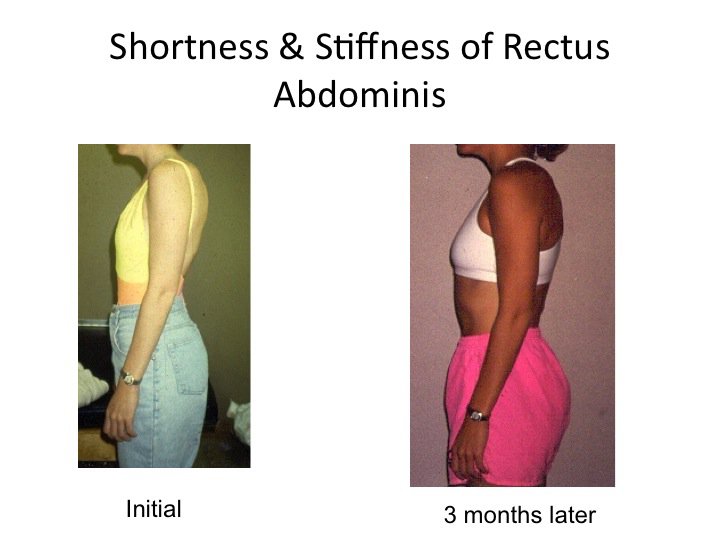
She turns me to the side and glides her hand down my back. “I’m going to guess you have been doing more sitting than anything else.”
Yup.
“The curve of your back is a C, right down to your waist, and in the ideal world it would be a bit of an S,” she says, and shows me two exercises that will help restore the curve.
“You mean I can fix it?”
“Oh, yes. It’s fascinating to me that you can make little-bitty adjustments and almost simultaneously, it makes a difference. The body is so efficient. It establishes a pattern and just keeps using it, and you have to perturb that pattern to break the cycle. Once people get out of these little maladjustments…”
She teaches me how to straighten, after bending over, by hinging at the hips, not tugging with my middle back. Her eyes run up and down the length of me. “Two more things I can tell just from looking,” she says. I try not to cringe, figuring it would only make my posture worse. “You are slightly rotated to your right,” she says. “All the way down your back, it’s slightly larger on the right than on the left.”
“How did that happen?”
“Just everyday activities, going to the right all the time.” In a flash I see myself at work, leaning right while I take my right-handed notes on my lap, then spinning to the right to make revisions. Only thing on the left is a window.
“And your shoulders should be higher and tipped back.” She gives me another exercise.
“You should keep your feet on a footstool when you are sitting,” she adds. “You’re only 5-3, and sitting in a regular chair, you put your feet into more plantar flexion to get your toes on the ground. And your foot’s already stiff, with a high arch. So you’re tightening your calf muscles by pointing your toes down. Also, having your knees higher than your hips keeps your back from going into the tilt that’s giving you that nagging pain.”
“Any other modifications?” I ask in a faint voice.
She suggests a small pillow or rolled towel at my waist when sleeping on my side. “Women, we have these hips, and smaller waists, so if your mattress is a bit firm, putting a pillow there will make you a lot more comfortable.”
She has me lie down, and when I roll to the other side for her, she says, “No twisting! Try again. Lead with your arm, it should go ahead of your leg, then roll in one piece, don’t twist your hips or push off with your feet. Just let your legs fall. And no twisting at the end, either.”
I’m even rolling over in bed wrong? No wonder my back hurts at night. Here I was blaming the dog (who occupies more space in our bed than we do).
The restricted hip motion is just a fact of my life. “You picked the wrong parents,” she says with a twinkle.
What Sahrmann’s really concerned about is “this collapso-smasho,” her term of art for the compression of my thoracic and lumbar regions. It happens to everybody, but we can forestall it and give our torso more length (and ourselves fewer back problems) with a few simple corrections and exercises. Even breathing more expansively makes a difference.
“The idea of taking a deep breath is to try to move the thorax,” she explains, “and then you want to learn to use these external oblique abdominal muscles to make your abdomen go flat.” I’m dwelling on that pleasant prospect when she informs me that I “should be able to change the circumference of the rib cage, from inhalation to exhalation, by about three inches. I don’t think you’re even getting an inch.”
“Aren’t we talking lungs and ribs here? How can I change any of that?”
“Breathing out, you’re using abdominal muscles that help to force the air out,” she explains. Breathing in, I’m apparently using my “diaphragm and accessory muscles of inhalation.” Sahrmann says the muscles of my ribcage and abdomen “need to be stretched and elongated and your ribcage moved. These muscles also are a big part of what has to hold you up. And they are just sitting there getting scrunched all the time.”
“So tell me again why I’m collapsing—is it just five decades of gravity?”
“It’s this constant weight of the world, the bra straps, the husbands, the children, the dogs,” she says, taking in all women with a sweep of her hand.
The old notion of p.t. was to look at something like my hip in isolation. But I’ve got a nagging pain in my back because of the hip’s limits. When the motion of the hip is limited, the lower back and pelvic region compensates and moves more than it should. And I went wrong by assuming for years that my problem was just a weirdly stiff adductor muscle. It’s structural. And it’s probably exacerbated by my not exactly statuesque height (and, I’m guessing, breadth of hips, though she’s too polite to say so), mushy abdominal muscles, and a back curved by years hunched over a notebook or keyboard.
I leave with three subtle, simple little exercises to correct all this wackiness, plus tips on driving, sitting, and rolling over in bed. “You should not have any more of this pain by the end of the week,” Sahrmann says.
I wait to be sure.
By day three, the pain I’ve been whining about for months is gone.