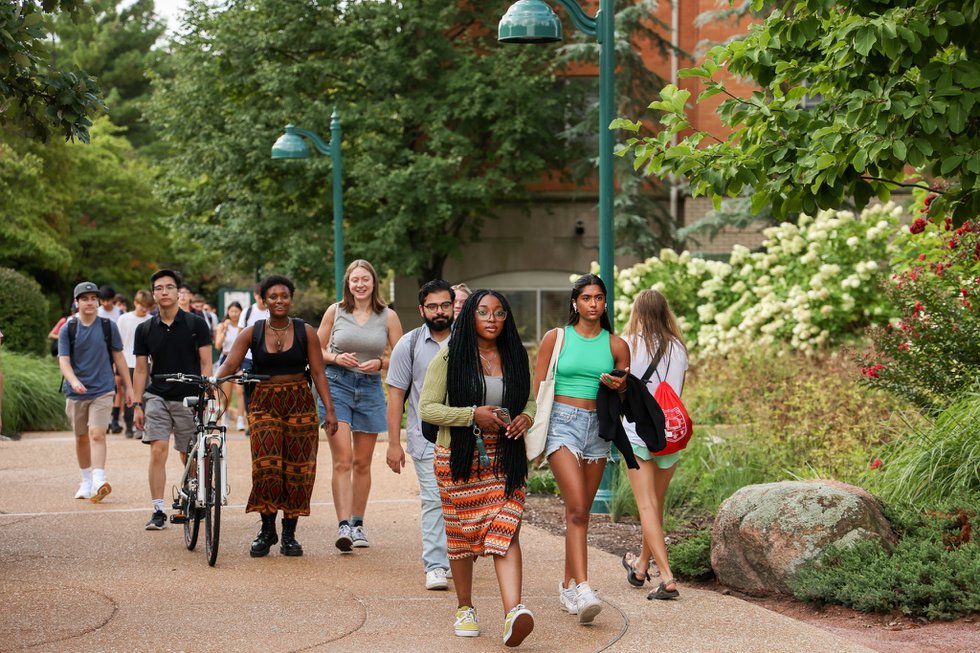
Last week, Washington University welcomed the class of 2026, but this group of scholars is particularly notable: 20 percent of them are eligible for Pell Grants, a 15 percent increase from 10 years ago. Fifteen percent of first-year students are first-generation students, meaning that their parents did not complete a four-year college or university degree. Fifty-one percent of the class identifies as people of color, making it the most diverse class in the university’s history.
Wash. U. has been trying to increase socioeconomic diversity since 2015, under former Chancellor Mark S. Wrighton. But this past fall, Chancellor Andrew D. Martin announced the Gateway to Success initiative, a program that added $800 million to the undergraduate financial aid budget and enabled Wash. U. to implement a need-blind admission process. Under a need-blind admission process, students’ financial needs are not taken into account when a higher education institution considers their admission.
Get a fresh take on the day’s top news
Subscribe to the St. Louis Daily newsletter for a smart, succinct guide to local news from award-winning journalists Sarah Fenske and Ryan Krull.
“Our need-blind policy helped us to continue to diversify and achieve the goals that we [set] this year,” says Ronné Turner, vice provost for admissions and financial aid.
Because of that diversity, students are able to bring their own perspectives to the classroom and ensure that their stories are heard. But the financial challenge of getting into college is not the only barrier that many limited-resource students have to overcome. Some have low academic self-esteem, or they may face racial and socioeconomic underrepresentation. Support from students of similar backgrounds or organizations that serve these students can help.
Annie Zhang, a first-year student, never expected to go to Wash. U. She was born in Shanghai, China, to a limited-income family. Her parents, however, were determined to give her what she needed to succeed in life. They packed up everything when she was 14 years old and settled in Seattle. Zhang never thought she would get into a top 20 school like Wash. U., but she says that need-blind admission was key to start to realize her dream of becoming a first-generation American graduate.
“A big reason why I chose Wash. U. was because everyone is so kind,” Zhang says. “They’re generous with their time and insights. They’re really willing to share their experiences.” Zhang wants to double major in Business and Philosophy-Neuroscience-Psychology and is part of Deneb STARS, a cohort that supports first-generation and limited-resource students before, during, and after their years at the school.
According to Dr. Mark Kamimura-Jiménez, associate vice chancellor for student affairs and dean of the Center for Diversity and Inclusion, the Deneb STARS program and the Office for Student Success ensures that first-gen and limited-resource students are set up for success. They are paired with a mentor who advises students about different life skills and teaches them to navigate college.
Deneb STARS and the Office for Student Success are just two out of the many initiatives that were launched at Wash. U. to help limited-resourced students. And there are more to come. John Jachimiak, a junior at Wash. U. and president of the QuestBridge Scholars chapter at the university, has plans for making sure future QuestBridge students will be supported and involved during their time at Wash. U.
“You need underprivileged students in a university,” Jachimiak says. “There’s something missing from the conversation if you don’t have an underprivileged student sitting at the table.”