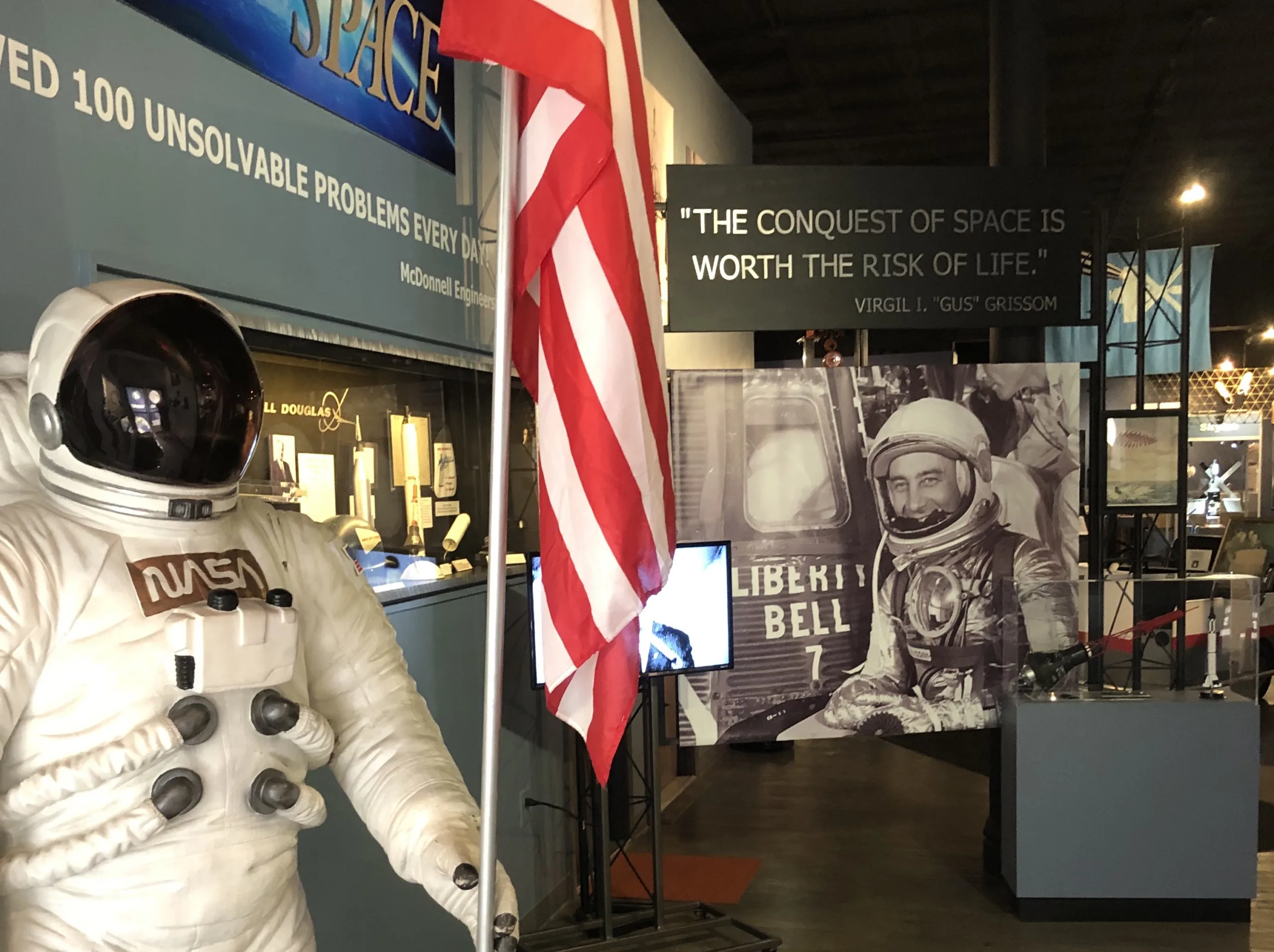
For the past two decades, one of the Midwest’s most extensive collections of space-flight artifacts has been housed in an unlikely location in Bonne Terre.
Soon, The Space Museum and Grissom Center could be on the move—and St. Charles wants to be its landing point.
Get a fresh take on the day’s top news
Subscribe to the St. Louis Daily newsletter for a smart, succinct guide to local news from award-winning journalists Sarah Fenske and Ryan Krull.
Museum president Earl Mullins confirmed this week that the institution is in serious discussions with St. Charles leaders about a possible relocation to the city-owned Sawtooth Building near Main Street. Any move, Mullins says, would depend on securing funding and enough space to properly display and store the museum’s collection of artifacts.
Among the museum’s holdings are a moon rock presented by NASA, astronaut Gus Grissom’s training suit, flown space artifacts, and even banana pellets once used to train chimpanzees before humans traveled into space.
The museum’s biggest problem is—no pun intended—space.
“We’re currently having to turn away excellent, wonderful historic artifacts because we just don’t have room,” Mullins says. “We host a lot of schools every year, but it’s very difficult when you get a large school in there. We want anybody that comes and uses our facility to have the very best experience that they can. Right now, we just don’t feel like we’re providing that because we’re so cramped.”
Despite its relatively remote location, the museum has become a destination for space enthusiasts since opening in 2003. Mullins says visitors regularly travel from across the country—and even overseas—to see a collection that pays tribute to NASA’s space exploration efforts, as well as Missouri’s role in the space program.
“Missouri has an absolutely huge aerospace legacy that they’re not really capitalizing on,” Mullins says.
He points to the Mercury and Gemini spacecraft, both of which were developed in St. Louis by McDonnell Aircraft—which later became McDonnell Douglas. Then there’s Neosho, Missouri, which hosted a Rocketdyne plant that played a part in developing rocket engines during the space race.
“If it hadn’t been for our guys and gals off our farms and out of our machine shops and welding shops right here in this area, who worked at McDonnell Douglas, they wouldn’t have had their ride,” Mullins says. “We built them here. We built them in St. Louis.”
Moving to St. Charles offers several advantages, Mullins says, including an established tourism base, proximity to Boeing, nearby schools, and easier access from major transportation corridors.
“It seems like a natural part of our history and culture,” Mayor Dan Borgmeyer told the St. Charles City Council during last week’s meeting. “We’re pretty excited about it.”
But it’s not clear that the Sawtooth Building itself would be large enough to accommodate the museum’s ideal footprint. Borgmeyer told city council members that the building could initially offer 20,000 square feet for the relocated museum. That’s less than half the size of the approximately 50,000-square-foot facility that Mullins envisions for the museum’s long-term needs.
However, St. Charles’ less-than-ideal space doesn’t seem like a dealbreaker. The museum current occupies a little more than 5,000 square feet.
“It would be a great start,” Mullins says. “Beggars can’t be choosers.”
Mullins says other Missouri communities have also expressed interest in hosting the museum, including Neosho and Marshfield, the hometown of the astronomer Edwin Hubble. Any relocation would likely still be at least a year away.
“Our goal—our desire—is not to be just a roadside wonder,” Mullins says. “If we do this, we want to do it right. The subject deserves it. The people in Missouri deserve it. The people in St. Charles deserve it, and all of those guys who no one ever heard of that took us to the moon, they deserve it.”