This story was commissioned by the River City Journalism Fund.
Flock Safety’s automatic license plate readers have been hailed as a game changer for law enforcement. But privacy concerns are so pervasive on both sides of the political spectrum that, on September 16, Missouri Governor Mike Kehoe signed an executive order aiming to regulate Missouri police departments’ use of these ALPRs.
Get a fresh take on the day’s top news
Subscribe to the St. Louis Daily newsletter for a smart, succinct guide to local news from award-winning journalists Sarah Fenske and Ryan Krull.
“This executive order is the first step in creating safeguards against abuse of this data, while still understanding the benefits of these vital public safety tools for law enforcement,” said Kehoe in the press release announcing the executive order.
But critics worry that Kehoe’s order doesn’t go far enough. They’re concerned about vast location data collection and data sharing across law enforcement agencies. And while they stress that their worries about surveillance technology go far beyond Flock, they see the pervasiveness of its camera network, and the extensiveness of its vehicle tracking, as a major concern.
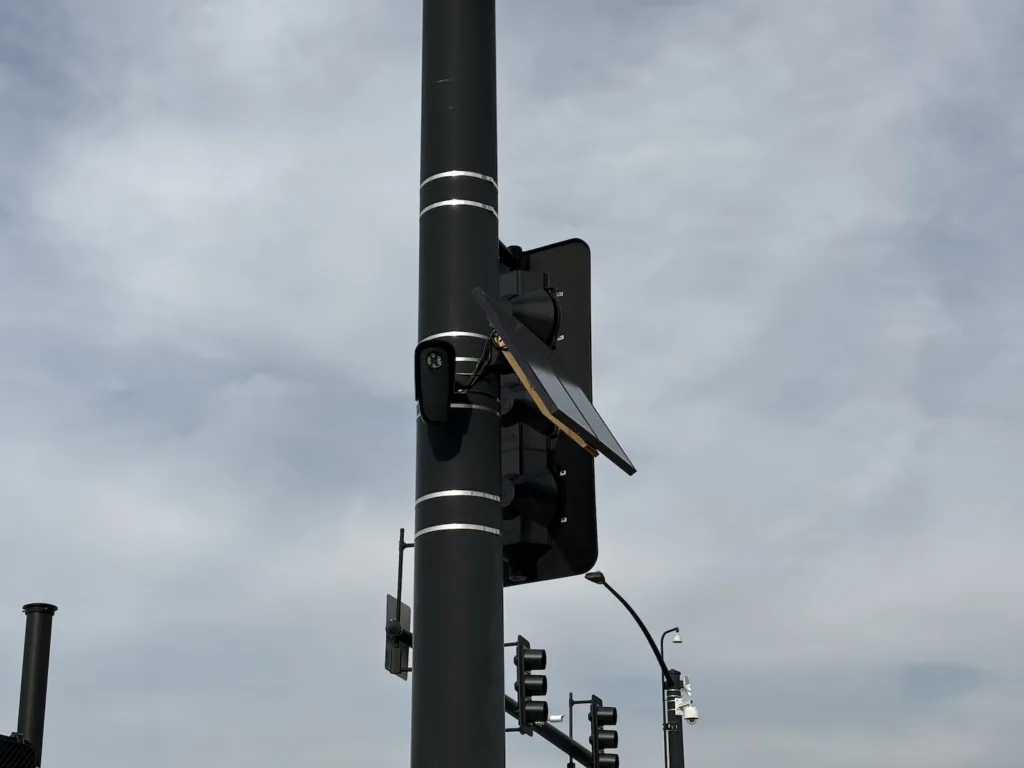
According to a crowd-sourced map, there are now approximately 1,000 ALPRs in metro St. Louis. And while license plate readers are not new, Flock Safety’s ALPRs enhanced data collection and sharing capabilities have sparked major concerns.
Unlike traditional license plate readers, Flock Safety’s ALPRs capture more than just license plates. According to Flock, they document “vehicle details” including “make, model, color, and other visible characteristics.”
At a University City council study session held in May, Flock representative Holly Beilin stated that law enforcement agencies can search for suspect vehicles in Flock databases by license plate numbers, or using these vehicle characteristics if the plate number is unknown.
For Al Schad, founder of the activist group DeFlock UCity, this is a major concern. “[Flock is] not just reading the license plate,” Schad says. “They make a vehicle fingerprint. So if you have dents, scratches, bumper stickers, it’s all matching that to [your] license plate.”
Neil Richards, a WashU Law professor and privacy law expert, believes that the massive databases Flock ALPRs build comprise a constitutional violation.
“It’s OK to check a license plate against a list of stolen cars or a list of cars known to be driven by people for whom there are arrest warrants,” says Richards. “It’s quite another to store every license plate going down Route 40, for 30 days or potentially forever.”
Richards referenced a recent U.S. Supreme Court ruling, Chatrie v. United States, which established that historical location data generated by cell phones is constitutionally protected—and should require a court-ordered warrant to access. But that’s not how Flock operates. According to Richards, Flock Safety creates a “time machine” to locate vehicles historically, similar to cell phones, and makes that data accessible to law enforcement clients without a court-ordered warrant.
Many believe this vehicular data is easily connected to individual people. Since learning about Flock cameras, law student Ben Unnerstall is investigating their usage through Sunshine requests.
“Flock says that license plates aren’t people, but … license plates are tied to the DMV, and any law enforcement officer could connect those dots,” he says.
Unnerstall says Flock ALPRs are located on both sides of Schoettler Road in Chesterfield, where he lived until recently, so he could not leave his house without ALPRs capturing his license plate.
Richards, of WashU, agrees that’s a problem.
“It is offensive to basic notions of civil liberties in general, [and] the Fourth Amendment in particular, for the government to be able to track our location, all of the time, or substantially all of the time,” he says.
A tool for law enforcement
Law enforcement agencies say that ALPRs routinely help solve crimes. Officer Shawn Birdsong of the St. Charles County Police Department recounts an instance where a Flock ALPR identified a vehicle that hit a QuikTrip worker and fled the scene.
“Luckily, we had an ALPR in that area, and we were able to bring some justice to that victim,” Officer Birdsong says. “Had it not been for the ALPR, we probably would have never identified the individual who struck him.”
In an internal study released in 2024, Flock Safety claims that 10 percent of all reported crimes in the U.S. are solved using its devices. But many have criticized the study. News outlet 404 Media quoted academic collaborators saying the study used potentially unrepresentative data points.
Flock Safety did not respond to several emails and phone calls seeking comment.
“I think the [numbers] are probably inflated,” Schad says. “[It’s] all internal white papers. It’s not been verified, to my knowledge, by any third-party entities.”
St. Charles resident Renato Cataldo says that he supports Flock technology to solve crime—but with proper transparency measures, like publicly sharing data retention models and local crime metrics.
“[Flock is] a private company. They’re going to say whatever they want to,” he says. “It’s more important for the local municipality, police, or law enforcement departments to come out and say how they’re using it, [and] what’s the percent of effectiveness.”
According to Officer Birdsong, the St. Charles County Police Department does not have metrics on the percentage of crimes solved using Flock technology.
Shortly after St. Louis Magazine’s conversation with Officer Birdsong, the St. Charles County Police Department discontinued ALPRs due to unauthorized searches by a police officer. (The officer now faces criminal charges.) The incident is part of a national pattern of officers using Flock databases to stalk individuals, including another recent case in Brentwood.
Data sharing networks
After building databases from ALPRs, police departments can also share data across local, state, or national networks of law enforcement agencies. Theoretically, this makes investigations more effective.
“The idea is that there’s a car stolen in St. Charles, they see a license plate in U City [and] go get the bad guy,” says University City councilmember John Tieman, who opposed expansion of ALPRs. “Were it as simple as that, I would have no problem with it.”
Vast data-sharing networks prompt concerns about who can search data—and why. Clayton officials have recently discussed tightening their network, noting that more than 200 departments across the state have access to that data, and run many more searches than officers within the department.
In U City, Tieman references 287(g) agreements, entered into by some local governments, including St. Charles County, to cooperate with the Department of Homeland Security.
“What happens when we share data if somebody has a 287(g)? Or maybe the person we share it with doesn’t have a 287(g), but they share it with somebody who does?” asks Tieman. “This needs, for the sake of our immigrant community, to be rock solid.”
On multiple occasions nationally, federal law enforcement officials made immigration-related searches without the knowledge or consent of localities. Tieman referenced Dayton, Ohio, where officials suspended ALPR usage after learning about 7,100 unauthorized federal immigration searches of its data.
A database of Flock ALPRs maintained by the Electronic Frontier Foundation reports 19 cameras in U City. It also shows St. Ann, Hillsdale, Woodson Terrace, and, until recently, St. Charles County, as operating Flock technologies—which, unlike U City, all have 287(g) agreements.
At the U City study session in May, Flock representative Beilin shared accountability measures available to localities, such as a publicly available transparency portal which includes an audit log of searches made by officers. Unlike St. Charles County, U City, opted into the portal, but even that has not assuaged concerns.
“I had been researching for four months, and I had no idea,” says Schad about the U City transparency portal. They only learned about its existence in May. “I wish I had heard that from the police department. And I don’t know why they wouldn’t have shared that information.”
The transparency portal does not include information like the networks U City is sharing data with or the number of ALPRs within its borders, which neighboring municipalities like Clayton have published.
At that same study session, Flock’s Beilin shared that U City opted into a filter prohibiting immigration-related searches. But this, too, has not dissolved concerns about the Department of Homeland Security gaining access to data. An audit in Columbus, Ohio, found possible immigration-related searches, even after implementing the filter.
“We know what could potentially go wrong. We know what probably will go wrong,” Tieman says. “We can get people killed, because that happened in Overland,” referencing a couple who were killed this past summer after deportation to Guatemala.
In 2025, the U City Police Department requested approximately $200,000 to finance police equipment. The original funding request made to the Economic Development Retail Sales Tax Board, which manages the fund from which the money would come, asks to finance “private security patrols and surveillance equipment like license plate readers,” per the meeting minutes.
The U City council approved the request in January, but weeks after, learned the funds would finance an expansion of Flock ALPRs. Following constituent input and the previously mentioned study session, the city council decided to hit the brakes on the expansion.
Tieman says he frequently hears from constituents concerned about Flock ALPRs, but has yet to hear from a constituent in support of the technology. “We have chosen at this time to put a hold on [expansion]. I’m very glad because the problem with Flock, as I see it, is that the more you look, the worse it gets,” says Tieman.
In response to an email requesting comment, the U City Police Department stated, “Because litigation concerning this matter is currently pending, the University City Police Department is unable to respond to questions about it at this time.” The email included a link to the U City transparency portal, which indicates that previously installed ALPRs remain in use.
Cameras everywhere
Locals’ concern about ALPRs go far beyond the potential misuse by federal authorities. Prior to St. Charles County’s discontinuation of Flock cameras, resident Vincent Mackenzie said, “My main concern with Flock cameras is the rapid rate of them being installed…And it doesn’t seem like any people are really asking for this.”
The location of cameras concerns Mackenzie as well. “I’ve seen cameras pointed at playgrounds,” he says. “It’s disturbing that kids are being recorded and then other people just have access to that footage, and there’s really no safeguard.”
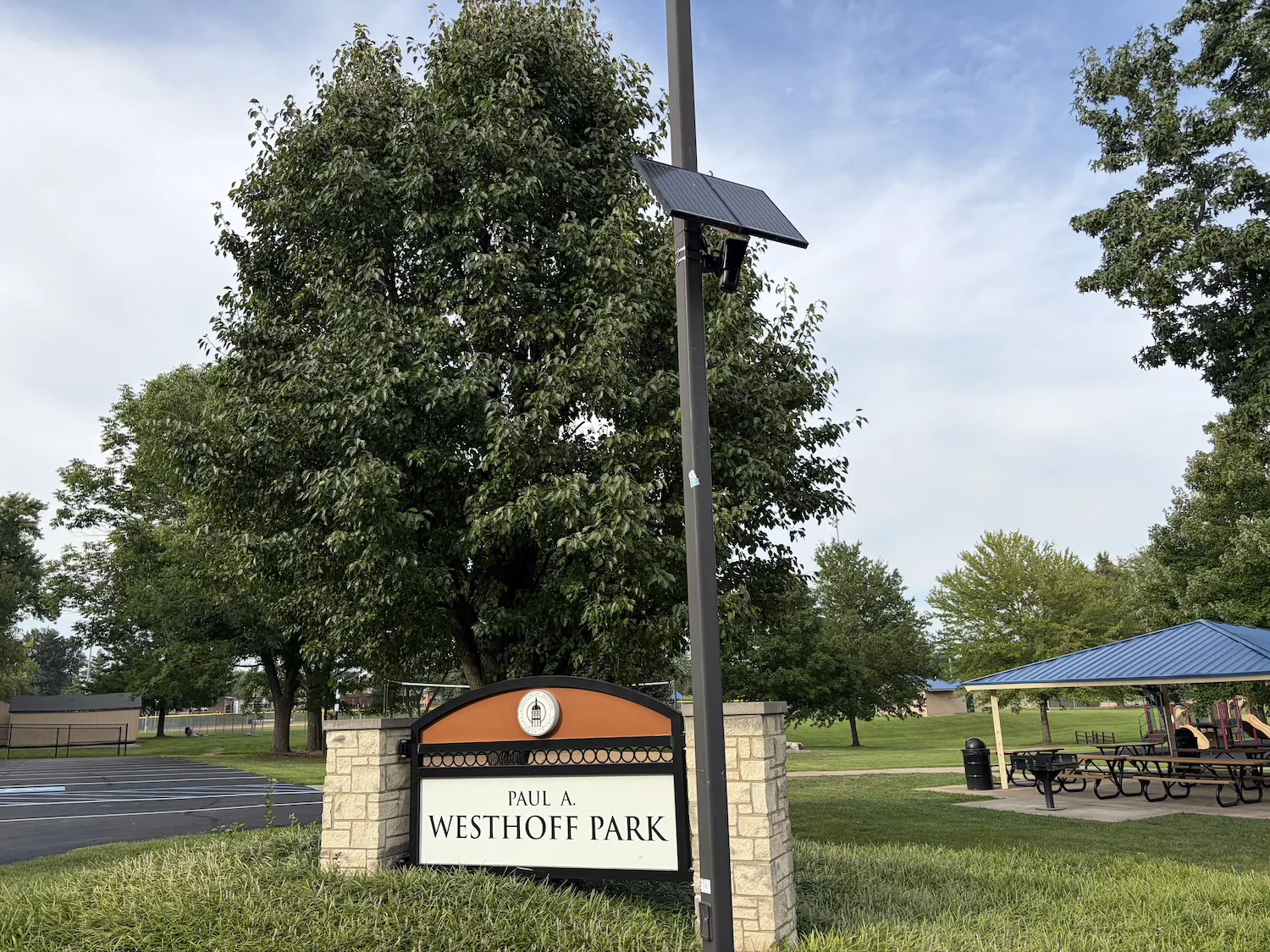
A 2022 memo from St. Charles County’s director of parks states that they installed 18 Flock cameras in parks and requested funding for two additional cameras, which was eventually granted. Flock cameras are installed in multiple parks within the county, including Westoff Park, Oglesby Park, and the Klondike Boat Ramp.
Mackenzie also references a Flock camera near a gun range in Columbia, Missouri, which he believes is a privacy violation.
Experts are inclined to agree. “Privacy is a bulwark against the government finding out things about us that it doesn’t like, and using that to discriminate,” says privacy law expert Richards. “And that’s the case whether we’re talking about people exercising their reproductive freedoms, or people attending gun shows.”
Customarily, governments must establish probable cause before subjecting people to searches into their private lives. But according to Richards, “These technologies flip that logic on its head and come from the position that collect[s] everything about everyone all the time under a fairly flimsy justification of public safety … That capability [may] be helpful to certain police investigations, but so, too, would the ability to walk into anyone’s living room any time.”
Kehoe’s executive order institutes guardrails like a 30-day maximum data retention period, penalizing misuse of ALPRs, and prohibiting the sale of data.
But Schad is not convinced the executive order changes much. “[Nearly] everything that Kehoe outlines in this executive order [are] things Flock ostensibly has in place in their own contract,” says Schad. They point to Kehoe putting forth a 30-day cap on retaining data collected by Flock. That’s a significantly less restrictive ceiling than Flock’s own default data retention period recommended to municipalities, which is seven days.
“The issue is that regulation doesn’t work. The danger of these products is that the data exists in the first place,” says Schad. “The safest data is the data that never exists.”
In similar fashion, Richards believes Kehoe’s executive order is an encouraging first step, but that subsequent legislation can do more. Local and state governments, he says, should “go beyond what the executive order does, [which] enables police to use warrants to find missing persons or other emergency issues, but doesn’t make constant tracking of everyone’s location the default of policing.”
He also says regulations should extend to companies beyond Flock, like Axon and Motorola, that produce similar ALPRs.
Indeed, Officer Birdsong previously told SLM, “Flock is not the only company that we work with. There are other camera systems out there…Flock is one of many.”
In a follow-up email, St. Charles County Police Department’s Managing Director Kevin Killeen confirmed the use of Genetec cameras, which he said were in compliance with the governor’s executive order.
Richards suggests that’s exactly the problem.
“It’s great that people are concerned about Flock, which is a dangerous technology threatening a lot of values we hold dear,” says Richards. “But there are other ALPR companies and surveillance technologies, and I think that’s the real story here.”
This story was commissioned by the River City Journalism Fund, which seeks to advance local journalism in St. Louis. See rcjf.org for more information.