After a brutal winter storm, and days of below-freezing temperatures thereafter, St. Louis’ new “Code Blue” shuttle program—which transports unhoused people to shelters when temperatures would put their lives at risk—seems to have made a dent in reducing the number of vulnerable people outside in the bitter cold.
A coordinator of these efforts for the city, Mike Gilbert, allowed SLM to observe the shuttle program during the height of January’s winter storm, as he and his team tried to bring in any remaining people from the cold, often tracking through snow and howling wind.
Get a fresh take on the day’s top news
Subscribe to the St. Louis Daily newsletter for a smart, succinct guide to local news from award-winning journalists Sarah Fenske and Ryan Krull.
Mayor Cara Spencer said last week that 500 people have been taken to shelters on the shuttle since the city launched Code Blue this winter. She and others said it has also made a marked reduction in the number of calls to emergency services for fires, likely indicating fewer people lighting fires in vacant structures for warmth. City firefighters typically receive around six calls for fires daily during winter months, Spencer said, but those calls have been reduced to around one daily since the shuttle service launched.
Once the city hits “Level 3” in the Code Blue winter response plan, triggered by temperatures falling to freezing, it activates the shuttle buses, which follow three routes looking to take in unhoused people and bring them to shelter: one in North City, one through the central corridor (including Downtown and Downtown West), and another in South City. “Rally points” for each route serve as indoor stations (either inside a building or a parked bus) where people can wait, and stay warm, for a shuttle.
From 5 p.m. until around 8 p.m. on each night the shuttles are active, teams on each route will make two or three loops, hitting the rally point and certain local landmarks before taking people to shelter. Shuttles can also occasionally transport people from more densely populated shelters to quieter ones.
The program is a partnership between the City of St. Louis, regional transit agency Bi-State Development (which oversees Metro Transit), and the city’s Continuum of Care (CoC) network of shelter providers. Outreach is handled by city staffers, most of whom have volunteered for the extra assignment outside of their regular duties; Bi-State provides both the drivers and shuttles, which come from its fleet of roughly 130 Call-A-Ride buses; and CoC providers supply the emergency shelter space and shelter services. Each bus is staffed by a Bi-State operator, outreach workers (typically city employees), and a security guard.
“I can’t stress enough how much this matters, especially preventing loss of life at a time when we have so many folks who are experiencing housing instability as a result of the tornado, but you’re seeing homelessness rise nationwide,” Spencer said last week. “This has just been an enormous effort and enormous, enormous amount of work for our community.”
Spencer also praised human services director Adam Pearson, saying he himself has even driven the shuttles. Pearson is heavily involved in the shuttles’ daily operations, coordinating with the CoC and Bi-State.
“I think that everybody who is involved really wants to be a part of it,” Pearson said. “So I think, by and large, for the rally points, for the shuttle buses, we’ve never had to turn a single person away. Everybody has been able to be placed at a shelter.”
This is the first time the city and its collaborators have done something like this, at least in recent memory. Bi-State executive vice president and chief operating officer of Metro Transit, Ron Forrest, said that Spencer’s administration came to him, asking if they’d be willing to partner. “I said, ‘Your honor, we would love to help,’” Forrest said. He added that Bi-State frequently does “mutual aid” requests for other municipalities, but has not done something like Code Blue. Still, he said the nascent partnership has been a success.
“We’re saving lives,” he said. “When you have an opportunity to save lives, and you do that, you can claim nothing but success. … We need people to understand that, when other people can’t be there, we will. Metro Transit shows up. We show up, rain, sleet, snow, right? I tell my guys, ‘Pandemic, we were there.’ Even when it’s a challenge for us to do, we’re still there.”
Even as roughly 10 inches of snow were accumulating around the city in late January, Code Blue workers were out there. On the Friday before the storm, Code Blue shuttles reportedly picked up 49 people seeking shelter, with around 30 on Saturday, leading to a quiet Sunday where the shuttle infrastructure mostly served to move people from one shelter to a less crowded one.
That meant, on occasion, routes for the Call-A-Ride shuttles changed at the last minute, taking buses out of their usual loop. This could’ve been a headache for some drivers, but Gilbert, who coordinates the shuttles on the ground, introduced himself to fellow Code Blue staffers as the man to blame for these changes, immediately taking responsibility for the tension that can come from the work, which requires a degree of situational and operational flexibility.
“I’m the guy they call all the time,” he told a Bi-State operator about his team of outreach workers, made up of mostly fellow city health department staffers. “When they say, ‘Let me call Mike,’ I’m Mike. I’m the guy they talk to every night.”
Gilbert is mission-driven, saying he returned to St. Louis—where he’d worked for 20 years as a firefighter—after retiring in Nashville, Tennessee. He said he came back to help the city after the May 16 tornado, moved by Spencer’s words in its aftermath. He attested to Spencer’s good intentions, repeating to multiple people that the mission to transport unhoused residents comes from a sincere place since, he said, they “don’t vote.”
“Think about all the lives that you guys have saved since we’ve been out here, right?” he mused to another. “One person dies, all that good stuff goes away. So once you get on this bus, I’m gonna find them a place to sleep. That’s why, sometimes, you run all over the place, because once you get on my bus, I’m finding you some place to go.”
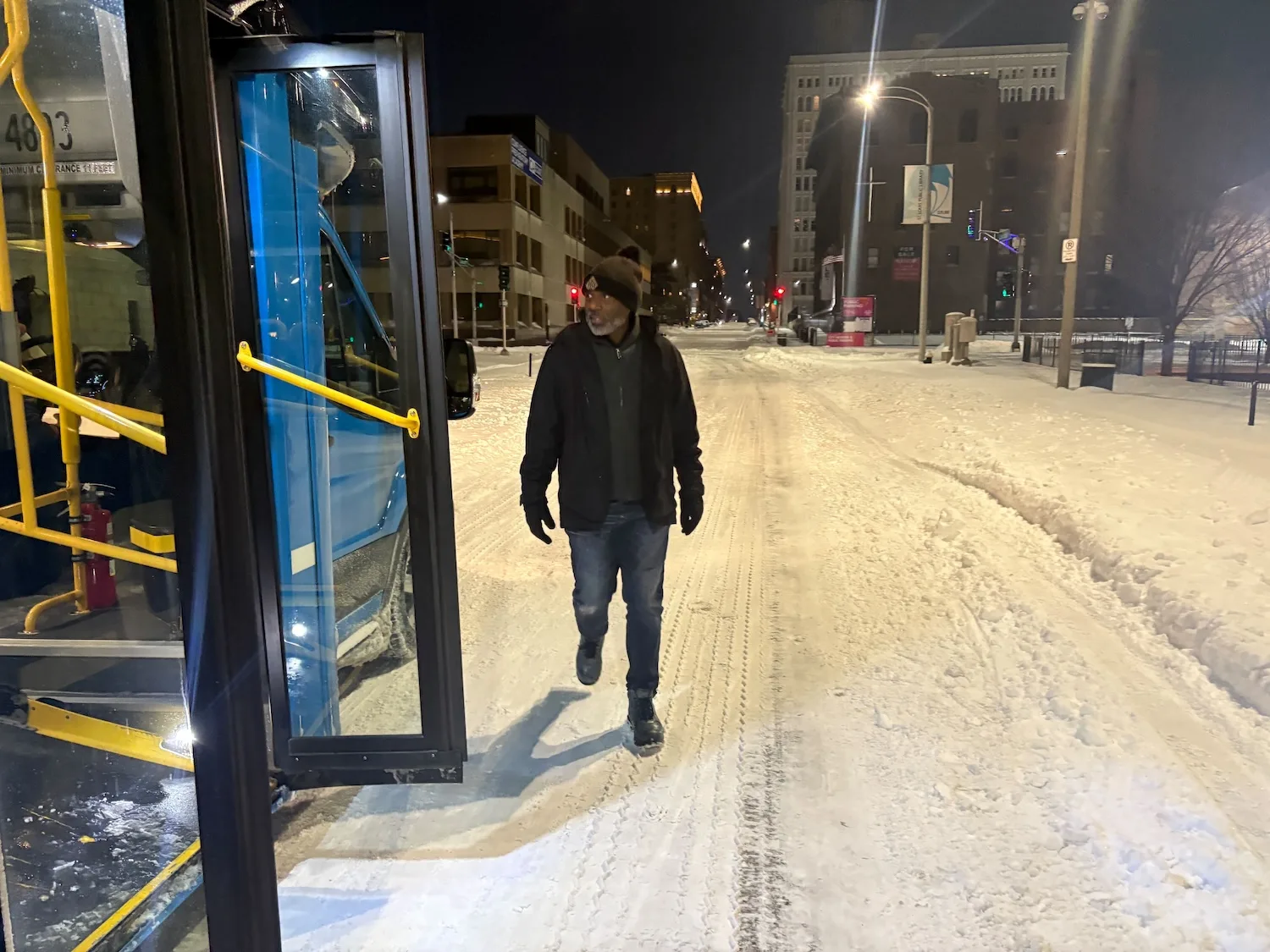
Gilbert ran the central route on the Sunday of the winter storm, circling from a rally point at downtown’s Centenary United Methodist Church to the Central Library, eventually north of Delmar Boulevard to Fountain Avenue, and back through the Central West End, among other locations. At each stop, Gilbert disembarked, tracking through the snow to howl “shuttle!” into the night, the word echoing through the empty streets.
Pearson attested to Gilbert’s shoe-leather dedication: “Mike is a life saver. He’s taken on all of the staffing and volunteer aspect of it, which has been great.”
Passing by the southeast corner of Fairground Park on that Sunday, Gilbert stopped to greet a woman standing at a bus stop he thought might need shelter. Calling herself “Buddy,” she declined shelter and directed Gilbert to a tent near the intersection of Grand Boulevard and Natural Bridge Avenue. Gilbert said his team has made repeated attempts to contact the man who lived in the tent, but he consistently refused to come to a shelter. Despite his refusals, they made efforts every time.
Gilbert tracked into the snow behind Buddy, who called out to him that the tent seemed stiff. Panicked, Gilbert rifled through the tent before determining that the man had either been picked up, or was taking shelter in the nearby gas station across Grand.
“That would’ve broke my heart,” Buddy said.
“Mine too,” Gilbert replied.
Throughout the rest of his quiet Sunday, Gilbert said that few people coming to them showed that the city had done its job: “When you got a night like this, that means it works. That means everybody’s in their beds, and we’re doing a great job.”
For the remainder of the evening, the central shuttle darted through the city as snow fell and the city was mostly free of motorists. It passed more than a dozen stranded vehicles in the snow, as some dug themselves out with shovels and other cars used the snow as an opportunity to drift on normally-busy streets. As some side streets remained coated in snow, Gilbert’s shuttle even briefly got stuck; he directed an operator to shift back and forward until some elbow grease freed it from the snow.
Gilbert has clearly grappled with the life-and-death nature of the work. The former firefighter reflected on the potential that some people might still fall through the cracks, despite the team’s best efforts. “You don’t never get over it,” he said, adding, “You just come out and keep doing it.”
Pearson and Gilbert said they are working on dialing in how to improve the program, both for the remainder of the winter and future years, which Pearson said is easier now that the Code Blue infrastructure is built. They also said the city is looking for non-governmental volunteers to aid the work.
“What we’ll need to work through with the Mayor’s Office and Board of Aldermen is making sure that we can still support the effort moving forward,” Pearson said. “I think that we have set a high bar for what these services look like. I think it’s going to be on a lot of people’s minds, what next year looks like. Is it going to be the same amount of support?”