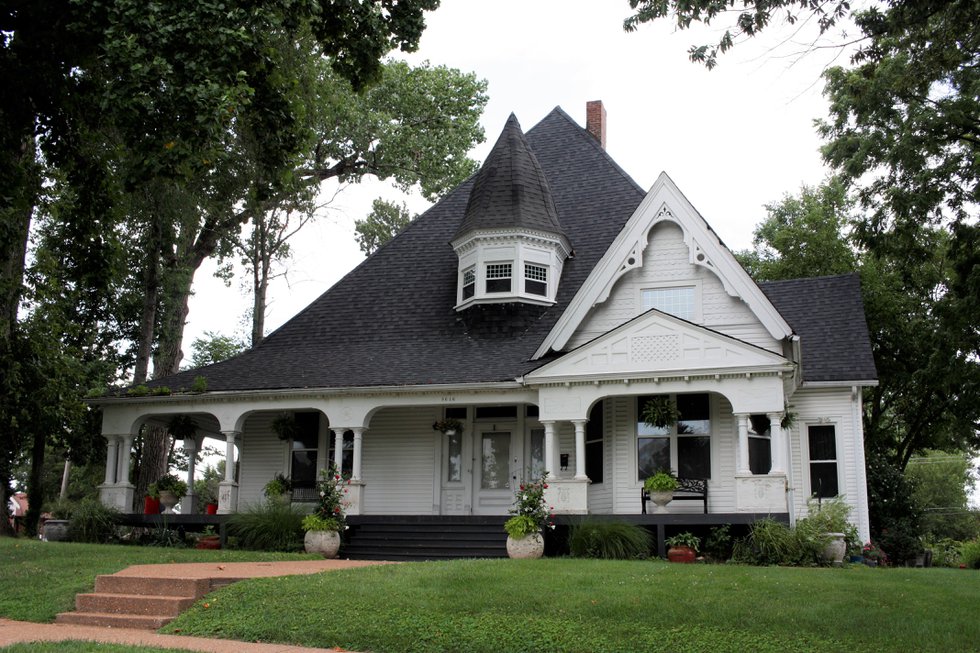
I wish more people knew about the North Pointe neighborhood of St. Louis. Located far on the north side, even north of Interstate 70, its borders are the City limits and Goodfellow Boulevard on the northwest, Riverview Boulevard on the southeast, and West Florissant Avenue on the southwest. It is shaped like a giant irregular pentagon. An almost-arrow-straight set of railroad tracks cuts it in half, north from south. Herzog Elementary School sits at the southern end, and Nance Elementary School lies at the other end, at Halls Ferry Circle. There is one small park, Vivian-Astra Park, created by the curving streets that swagger out into a tree-shaded boulevard in the southeast edge of the neighborhood near the intersection of Riverview and West Florissant.
North Pointe is a new neighborhood for the City of St. Louis; Compton and Dry from 1875 shows nothing but rolling hills and farm fields way out on the edge of its panoramic view of the rapidly growing metropolis. Except for the occasional country house—and some magnificent examples still survive—real development did not begin until the 1920s and ’30s. By this time, the first stirrings of the vocabulary of suburbia were beginning to crop up in newspaper advertisements, and the “North Pointe Addition” offered the latest modern amenities. On Friday, May 20, 1921, in the St. Louis Star and Times, the Beck Realty Development Company officially announced the sale of lots in the new subdivision, boasting that “Water, Lights, Sewers, Sidewalks, and Streets Graded All Included in Purchase Price.”
The advertisement assured potential buyers that since the development was in the City, they could be certain of police and fire protection, which at the time in the nearby St. Louis County was not guaranteed. For convenience, they also helpfully gave instructions on which streetcar line to take out from downtown: the northbound Bellefontaine car. Also of interest, a Globe-Democrat collection of real estate listings from October 4, 1921, reported sales from the North Pointe Real Estate Company to single women alongside married couples and single men. By 1924, the Star and Times was reporting the lots were selling well.
In a May 31, 1925, advertisement in the Post-Dispatch, the North Pointe Real Estate Company was now offering the opportunity to win a free pony for potential buyers. (No purchase necessary, of course, the fine print assured.) The Globe-Democrat reported the same year that additional sewers were being built to accommodate the new houses. By 1929, a real estate listing for a house on Summit Avenue, a four-room house with kitchenette, wood floors and tile, and garage was selling for $6,000.

For all the pony giveaways, the North Pointe neighborhood was built more slowly than perhaps its original developers had intended (it seems there were some tax lien problems in the early 1930s). But that is what makes this community so wonderful. Walking the streets of North Pointe is a beautiful mix of bungalows from the 1920s all the way up to the 1950s. The housing styles range from Arts and Crafts bungalows to Gingerbread cottages that would fit in down the street from Ted Drewes. And there’s even a street lined with a little ensemble of Colonial Revival houses that would comfortably pass for New England. Here and there are duplexes, where what looks to be a single house is actually two houses with a party wall down the middle. There is endless variety in the architecture, and it is all lovingly cared for by its owners.
Which brings me to what I really want people to know about North Pointe, more than just its amazing architecture and intact streetscapes. This is a neighborhood where things are going right. There are very few abandoned houses and little signs of neglect. Instead, I saw street after street of well-maintained houses with beautiful yards. I also had an opportunity to speak to several residents when I visited. One was a longtime resident, who was proud of her house and how it looked after her years of ownership. But I was particularly inspired by a young man we met who had just bought a beautiful historic bungalow; he was excited to get to know his neighbors and also still marveling at what a great house he could get for so little money in a healthy neighborhood. And yes, in case you were wondering, the crime rate is low in North Pointe.
What will North Pointe look like in 20 years, though? Will the leadership in City Hall remember the hard-working, proud people who have been investing in their neighborhood, and return the investment back up West Florissant Avenue? It’s a shorter distance from City Hall to the edge of Clayton than it is to the edge of North Pointe. I sometimes think stable neighborhoods are taken for granted in St. Louis, until they’re not stable anymore, and then everyone sits around wondering what happened.


