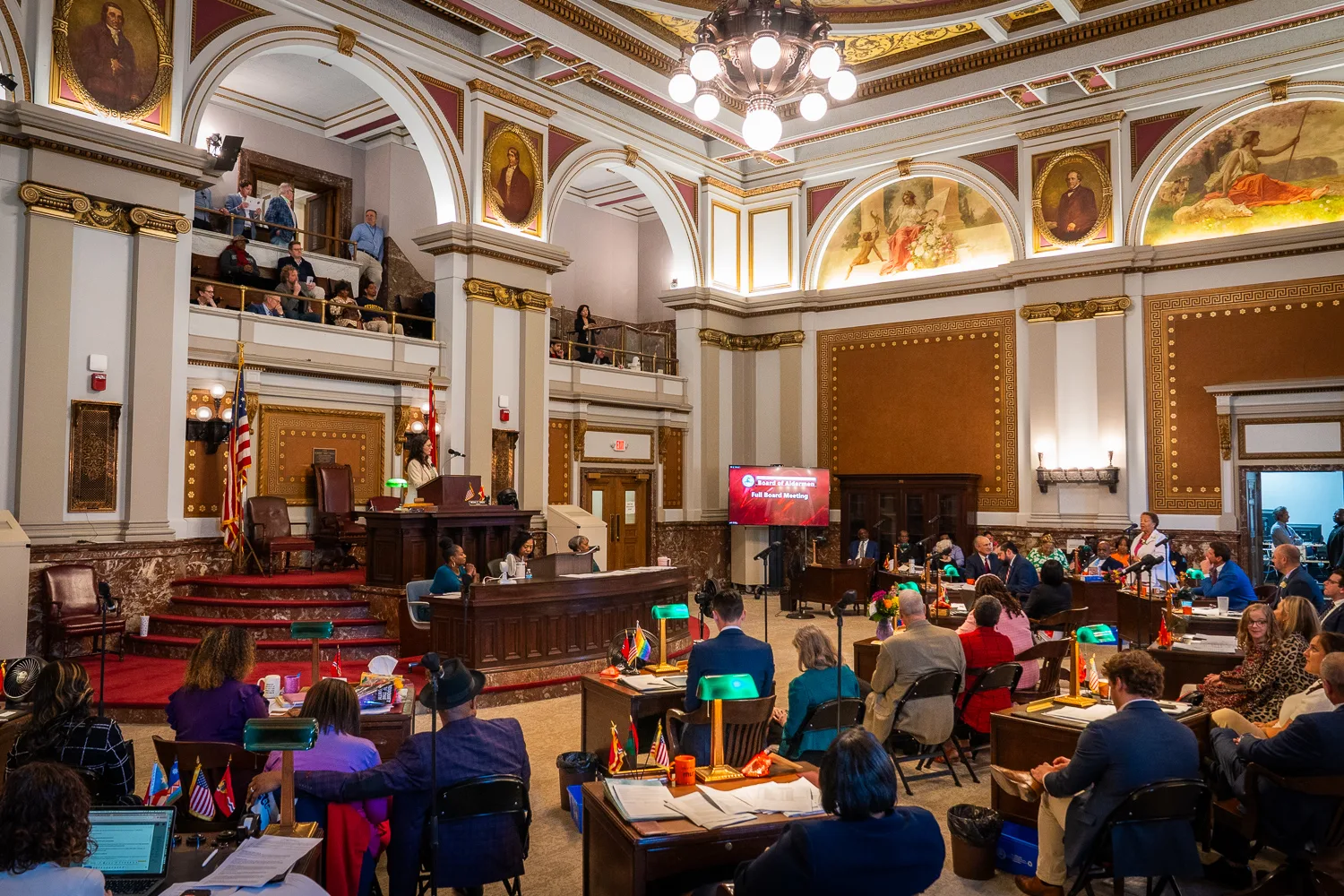
A bill designed to bring a cigar convention to St. Louis won passage at the Board of Aldermen today, but not without pushback from critics. Board Bill 167 won passage in an 8–6 vote after lengthy discussion and now heads to Mayor Cara Spencer’s desk.
Aldermen Rasheen Aldridge says he introduced the bill to help attract the Premium Cigar Association (PCA) to St. Louis. The legislation would exempt convention facilities from city-wide indoor smoking prohibitions for select events. But others are concerned it could open the door for other businesses to seek exemptions to smoking regulations and create public health concerns.
Get a fresh take on the day’s top news
Subscribe to the St. Louis Daily newsletter for a smart, succinct guide to local news from award-winning journalists Sarah Fenske and Ryan Krull.
Every year, the PCA hosts a trade show bringing together 250-plus cigar and paraphernalia manufacturers from across the globe. According to Aldridge, the convention would bring more 5,000 attendees to St. Louis, supporting 1,200 jobs and $465,000 in city tax revenue.
“[It’s] a very large revenue boom, especially as we’re in a concern of where our budget is going to be with the whole state takeover,” Aldridge says, referring to concerns about the growing police budget following the state police takeover.
The city’s Smoke Free Air Act, passed in 2009, prohibits indoor smoking in most public indoor spaces, including convention facilities. (Stanley’s Cigar Lounge and the Horseshoe Casino, both located downtown, enjoy two of the few exemptions.) Brian Atchison is chief sales officer at Explore St. Louis, which manages the America’s Center Convention Complex. According to Atchison, St. Louis has been “unable to effectively compete” for the PCA convention for several years due to indoor smoking prohibitions.
Aldridge’s bill seeks to change that. “This is not to allow ongoing smoking in the convention center on the regular. This is one convention that we’re looking at,” he stated at the aldermanic meeting on March 13. Aldridge also pointed to provisions within the bill that require facilities to separate smoking and non-smoking areas and install ventilation and filtration systems. In a follow-up to SLM, he adds that some downtown residents are proponents of the bill, which would bring more economic activity to the ward.
But critics say the bill text does not ensure that exemptions to smoking prohibitions would start and end with one convention. Even proponents acknowledge the possibility. At the Transportation and Commerce Hearing earlier this month, Atchison expressed interest in adding St. Louis to the mix of cities frequented by the PCA, which now include Las Vegas and New Orleans. “We would target every 3 to 5 years,” he stated.
To SLM, Atchison downplays the possibility of future opportunities to host. “As of now, it would be a one-time event, but if we perform well and we’re an enjoyable destination for their members, they could potentially request to connect for future years,” he says.
Alderman Shane Cohn, the lone no vote on Board Bill 167 in committee, believes the exemption represents a slippery slope. “What happens when the National Tobacco Association wants to have a conference in St. Louis. Are we going to exempt them?” he asks. Of the exemption for one convention, he says, “it’s opening up Pandora’s box. How are you going to regulate the exemptions going forward? I don’t think that we should be putting the public’s health at risk in that manner.”
At Friday’s aldermanic meeting, Alderman Michael Browning said that Board Bill 167 erodes the credibility of city-wide smoking regulations. “If we can provide an exception for ourselves, who are we to try to enforce public health in the rest of the city?” he asked. “We cannot be hypocritical and make exceptions for ourselves while telling private industries what they cannot do.”
Browning and Cohn, along with Alderwoman Sharon Tyrus, also criticized the bill for failing to define “convention facility.” Browning pointed out that Stifel Theater was first established as a convention facility, and the city is considering legislation to establish further convention facilities.
“There [are] other facilities either adjacent to or nearby that could host conventions and work with the CVC on conventions, hotels that have ballrooms, casinos that have ballrooms,” Cohn said.
Aldridge stated he believes it is clear the convention facility being referenced is the American Dome, even without a definition.
The bill provides for “the right of employees to opt out of assignment to smoking-permitted areas without penalty,” but Cohn is also concerned that opting out would cause workers, many working from paycheck to paycheck, to lose wages. “[The provision] is considerate of them, but I don’t think it’s actually a meaningful workaround,” he says. (Aldridge says the bill would not force workers to forgo wages, since they could opt to work in non-smoking areas.)
Yet Browning referenced a Washington University study concluding that “ventilation systems are not effective in removing secondhand smoke from the air. Therefore, no policy should be adopted that exempts establishments based on the presence of ventilation systems.”
“Smoking is a personal choice but secondhand smoke is not,” he said. “I can’t believe we’re having this debate in 2026 when we know the dangers of secondhand smoke.”
Several aldermen acknowledged hearing from constituents who oppose the bill. Cohn says they’ve raised concerns about the bill’s impact on disability rights, public health, and workers rights.
Aldridge tells SLM he does not believe the concerns he’s received reflect the bill text. “There’s a misunderstanding that by lifting this cap, we’re allowing smoking throughout the whole convention center or that we’re going to allow this [to] turn into a city that is smoke-friendly…it’s been kind of misinformation,” he said.
Cohn disagrees. “It’s disheartening to hear that [Aldridge and Sonnier] would just dismiss the public’s concerns around it, saying that they don’t understand the bill,” he says. “Some people have read the bill, such as myself, and have expressed those same sentiments,” he says.