It was a sight sketchy enough to draw the concern of a vape shop employee: a single mother in Jefferson County shoveling money into a Bitcoin ATM, her phone pressed to her ear.
The woman—whose name has not been made public because she was a victim of a crime—got a call from someone purporting to work for the Jefferson County Sheriff’s Office, a claim that was seemingly bolstered by the fact that the caller knew that the woman had been exempted from jury duty the previous August. The caller said that the woman had two warrants out for her arrest, both for missing jury duty in August and again earlier that March.
Get a fresh take on the day’s top news
Subscribe to the St. Louis Daily newsletter for a smart, succinct guide to local news from award-winning journalists Sarah Fenske and Ryan Krull.
But if she paid her fines, the caller said, the warrants would be deactivated. All she had to do was deposit $1,000 in a Bitcoin ATM at a nearby vape shop.
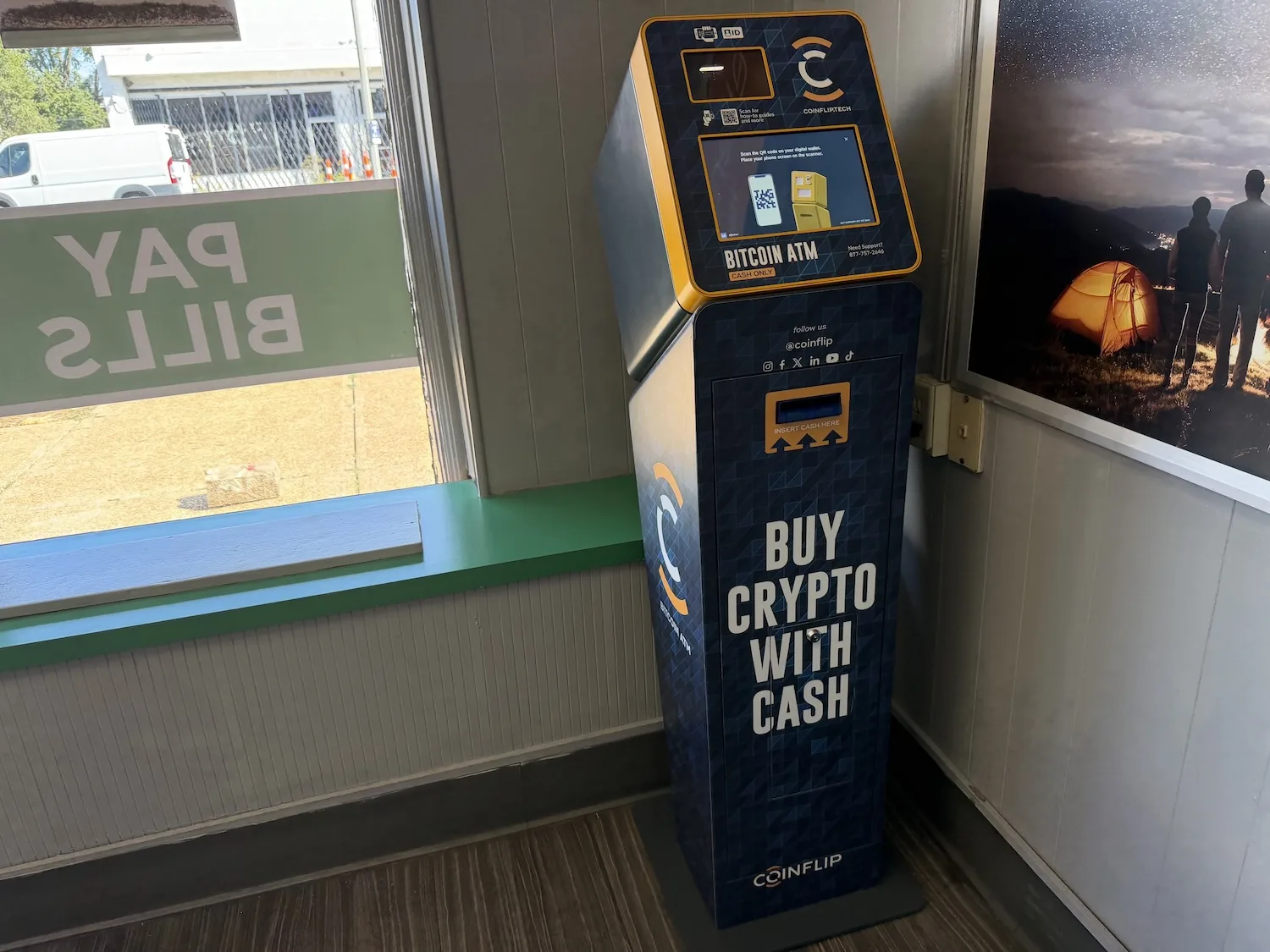
The woman withdrew $1,000 from her bank and headed to the vape shop. Inside was a CoinFlip ATM, a device that allows users to convert cash into Bitcoin and then send that Bitcoin to a third party. (“So Flippin’ Easy,” is the company’s slogan, delivered by actor Neil Patrick Harris.) It was after she put the bills into the device that the vape shop employee noticed the woman and asked if she knew who she was talking to and where she was sending the money. Her answers were not really and no. The vape shop employee told her to hang up because she was getting scammed.
The woman called CoinFlip ATM’s service line, trying to get the money back. The customer service representative said that before he could send her the documents, she’d need to file a complaint. He would text her a code that she would have to repeat back to him over the phone.
Feeling like this was yet another scam, the woman hung up, left the vape shop and went home. Ultimately, CoinFlip only refunded the fees associated with her transaction, which were a whopping 18 percent. She ended up being out a little over $800.

The swindle in Jefferson County is not an isolated one. A lawsuit filed by the Attorney General’s Office in May against CoinFlip details it along with a strikingly similar story from Boone County, where a woman who’d missed a court date was told she needed to pay to make the warrant go away. She realized she was being scammed the moment after she deposited $900 into a CoinFlip ATM, never to see the cash again. Both incidents could have been much worse. An elderly man in St. Charles County put more than $180,000 into a CoinFlip machine, selling his car and draining his legitimate investment accounts, duped into believing that the supposed investments would bring him a windfall.
The scammers themselves are almost always in foreign countries, says Lake St. Louis Police Chief Chris DiGiuseppi, who has dealt quite a bit with these scams. Local police departments like his as well as state law enforcement are now going after the machines.
“They really are the modern getaway car for fraudsters,” says Attorney General Catherine Hanaway. “It’s just a box where they’re collecting money.” Hanaway says that her office estimates, conservatively, $7 million has disappeared into the machines and into the hands of fraudsters.
Taking on crypto ATMs is the latest project of Hanaway’s “vice squad,” which in the past has gone after illegal gambling machines and 7-OH kratom derivatives. Conveniently, the crypto ATMs tend to be located at gas stations, vape shops and liquor stores, just like those products. Hanaway’s office says there are around 140 CoinFlip machines throughout the state.
Hanaway’s lawsuit accuses the company of violating the Missouri Merchandising Practices Act by failing to protect customers. It also accuses the company of charging usurious fees (including the 18 percent the Jefferson County woman was subject to).
CoinFlip, naturally, sees things differently. In its motion to dismiss Hanaway’s suit, the company argues that the Missouri legislature already passed the Virtual Currency Kiosk Consumer Protection Act, which regulated cryptocurrency ATMs as of August 2025. The company argues that it is abiding by the rules that state lawmakers laid out for it and that the “open-ended, general consumer protection” of the MMPA “cannot be reconciled with the industry-specific” legislation particular to crypto ATMs.
In a statement, a spokesperson for the company called Hanaway’s suit misguided, noting that the company “demanded” the passage of VCKCP and actively worked for regulations to “establish mandatory licensure, stronger compliance standards, and meaningful consumer protection requirements designed to protect Missourians from criminal scammers.” In other words, the company questions why Hanaway is punishing a good corporate citizen.
On a more technical note, the company also argues that the Missouri Merchandising Practices Act has a carveout for companies regulated by Missouri’s Division of Finance, and that the Attorney General’s Office needed to get that agency’s OK before filing suit—which it did not do.
There’s also the matter that the scammers here are using the CoinFlip machines the way that a bank robber—to keep with Hanaway’s getaway car analogy—uses a Ford Bronco. We don’t outlaw cars. But Hanaway argues that, unlike a car, it’s not entirely clear what crypto ATMs offer consumers.
“We can’t figure out what good they’re doing,” she says. “A regular ATM is a service. If I need some cash, I can go to one and I can get some. If I go to this, I get a number. I can’t spend it. I can’t do anything with it. There’s no need for these. We think their whole enterprise is false advertising.”
CoinFllip pushes back on that idea, with a spokesperson saying that more than half a million people use CoinFlip because they want to buy Bitcoin and other crypto currencies “with cash, quickly and in person.” The company compares its service to currency exchanges found at airports.
CoinFlip operates differently from popular cryptocurrency trading apps like Robinhood and Coinbase, where most users purchase crypto using money from a bank account. CoinFlip customers can purchase cryptocurrency with cash, without needing a bank account at all. The company says its customers prefer the physical ATM compared to using an app.
However, that also means that the scammers on the other end of the fraudulent transactions don’t need bank accounts, either—making them harder to track down.
Hanaway filed her suit in Jasper County, and CoinFlip wants it moved out of there. Media reports suggest Jasper County, which includes Joplin, has been hit by the Bitcoin ATM scammers. A hearing has not yet been set in the matter.
As CoinFlip and Hanaway prepare to battle it out in court, there is also a looming battle over money that victims put in the machines but that did not make it into the hands of scammers. That cash is right now in legal limbo.
DiGiuseppi, the Lake St. Louis police chief, says that his officers arrived at a Hucks gas station as a woman who believed she was on the phone with someone from Microsoft was putting money into a CoinFlip machine.
The Hucks gas station workers had already tried to dissuade the woman, who was in her 70s, from putting money into the ATM. When she wouldn’t listen to them, they called the police, who got there quickly because the police station is right across the street. “She wouldn’t believe the police,” says Joe McCulloch, the prosecuting attorney for St. Charles County, which includes Lake St. Louis.
The officers did eventually manage to convince her to stop feeding bills into the CoinFlip—after she had already lost around $45,000 to the scammers.
“We of course wanted to get the money as evidence,” says McCulloch. But, according to DiGiuseppi, historically it had been difficult to get a search warrant to open up the CoinFlip machines. The case of the woman duped by the fake Microsoft representative was different, perhaps because police actually witnessed her pouring money into the device even as they implored her not to. “We put all of that in the search warrant,” DiGiuseppi says.
They were able to get the money out.
But that money isn’t necessarily going back to the scammed woman.
McCulloch’s office is holding the money as evidence and says it will return it to her as soon as it can. But, McCulloch says, CoinFlip, however, hired a New York law firm, which contacted McCulloch’s office claiming ownership of the money, asking prosecutors not to release it until they have a hearing. The company has yet to file anything with the court, but McCulloch expects it to.
“They’re claiming that once the money goes into the machine, [that] it is their money,” says McCulloch. “No matter the circumstances.”
Earlier this month, the Lake St. Louis Police Department presented five Hucks employees with a certificate of appreciation for their work intervening as an elderly woman shoveled money into a CoinFlip. The recognition was particularly warranted, as that was the fourth scam-in-progress the gas station attendants had thwarted.
The Hucks no longer offers its patrons a CoinFlip.
Hear more about this story from Ryan Krull on The 314 Podcast.