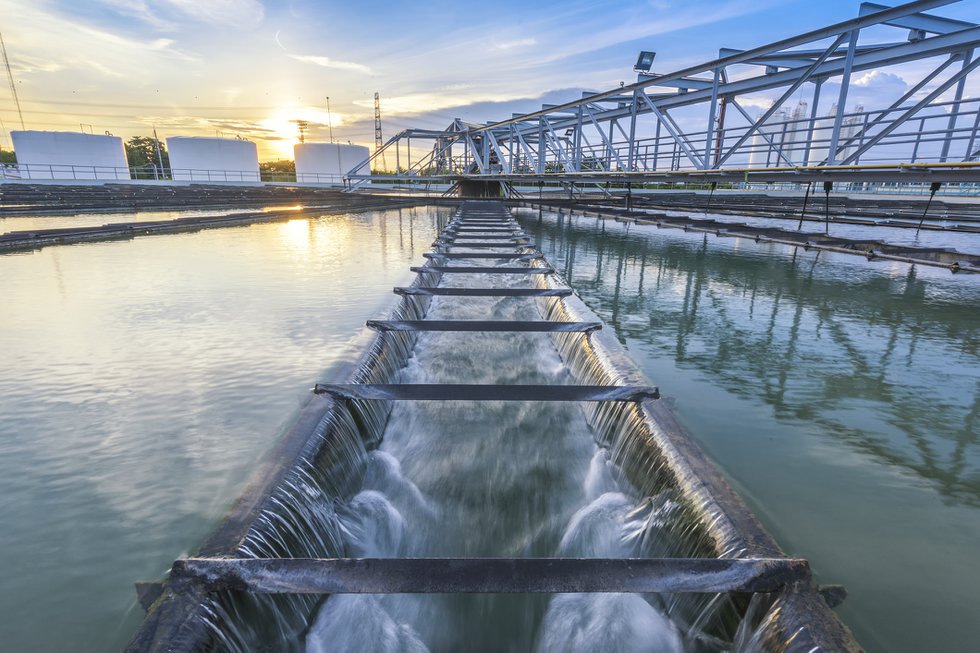
For centuries, humans have looked to water for answers. Ancient Druids used reflective pools for scrying, or predicting the future. Scientists searched for signs of water on planets to posit whether they once hosted life. So maybe it’s not surprising that researchers are looking to water for information about COVID-19. Er, make that wastewater.
Early in the COVID-19 pandemic, Jeff Wenzel received a perhaps unenviable work assignment. Wenzel is the chief of the state’s Bureau of Environmental Epidemiology within the Department of Health and Senior Services. At an annual conference, Missouri Department of Natural Resources employees had heard about countries like the Netherlands that were conducting sewershed testing for SARS-CoV-2. (A sewershed is an area that drains into a particular wastewater collection system.) Because the genetic material from SARS-CoV-2 can show up in human waste—often before symptoms present—researchers can measure the viral load in wastewater. If it’s high, it might indicate the start of an outbreak—or an outbreak that’s getting worse.
Get a fresh take on the day’s top news
Subscribe to the St. Louis Daily newsletter for a smart, succinct guide to local news from award-winning journalists Sarah Fenske and Ryan Krull.
In February 2020, the Netherlands’ National Institute for Public Health and the Environment began testing wastewater at Amsterdam Airport Schiphol, expanding to Tilburg and Kaatsheuvel. The first patient tested positive in the Netherlands in late February. The virus was detected in the water shortly after. The country expanded testing so that wastewater from more than 300 sites is sampled twice a week—meaning that the country surveills the waste from nearly every Dutch household. The country is also testing the water for new variants.
Stateside, the DHSS and DNR asked the University of Missouri–Columbia to convert a lab for the cause, and the three entities launched a pilot for The Sewershed Surveillance Project, a collaborative COVID-19 tracking tool, in May 2020. In July of that year, it expanded and now tests wastewater from more than 80 sites across Missouri. In the St. Louis area, samples are collected from wastewater treatment plants in the city, Florissant, Lemay, Fenton, Valley Park, Maryland Heights, and High Ridge, and farther west, in St. Charles. It is both one of the first and one of the largest projects to do this kind of testing in the country.
The samples can’t tell researchers, say, how many people within a community might have COVID-19. But they can measure how much virus is present. When Wenzel and his team see a spike in viral load, it typically correlates with a spike in cases. “We’re predicting cases about six days ahead of time, and we’re able to do that prediction with about 70 percent probability—so pretty good predictive ability,” Wenzel says. The Sewershed Surveillance Project then makes its data available to local public health agencies to inform public health strategies. It also updates a story map online, which is available to the public. In 2021, it began testing for variants.
But there are applications for this kind of testing beyond COVID-19, and that’s where Wenzel’s team is looking now. Wenzel’s team knows that there are a number of other pathogens that can be detected in wastewater, but the next step is determining whether they have the same predictive quality as COVID. “We know we can test it; we know we can find the pathogens,” Wenzel says. “But is it meaningful information? Similarly, we know we can find things like opioids, but then again, what does it tell us? Can it inform decisions? Can it be meaningful? That’s really the next step.”
From Fringe to Fore
Dr. Adam Gushari remembers the first wastewater epidemiology conference, held at the American Chemical Society’s National Meeting & Exposition in Boston in 2018. One night after the conference events, he met up with other wastewater epidemiology researchers for beers. “There were maybe 15 of us sitting around at the table,” Gushari says. “Today, if you were to get all the people doing wastewater epidemiology into a room, we’d fill a stadium. In a period of about three years, it went from this fringe science to a widely accepted and implemented method of health assessment, and this was entirely due to the COVID pandemic.”
Gushari is the CEO of AquaVitas, a company that collects and analyzes wastewater. Depending on what they find, the organization can then help clients—the federal government, state and local municipalities, private companies—plan targeted responses. AquaVitas is headquartered in Scottsdale, Arizona. Gushari’s cofounder, Dr. Rolf Halden, was Gushari’s professor at Arizona State University. Halden heads up the Human Health Observatory at ASU, tracking the wastewater of more than 220 cities and looking for things like exposure to toxic chemicals.
Because of the pandemic, Gushari has focused pretty much solely on SARS-CoV-2 detection. The biggest project that AquaVitas has taken on is partnering with the U.S. Department of Health & Human Services and the Centers for Disease Control and Prevention on the first phase of their wastewater monitoring program in January 2021. They studied 100 wastewater treatment plants and captured samples from about 10 percent of the United States’ population.
And there are other applications for this technology that could improve public health as well. COVID-19, Gushari says, was a proving ground.
While Gushari was a postdoc at ASU, in 2018, he and Halden—along with another colleague, Erin Driver—worked with the city of Tempe, Arizona, to track opioids. The trio created a public, accessible dashboard that tracked the drugs through wastewater. (Setting up this program to monitor opioids would prove valuable during the pandemic—Tempe city officials were able to pivot quickly and track the novel coronavirus because it already had the system in place.)
But, Gushari says, the key was the way Tempe used the data that his team provided. Once a month, the researchers met with the city to discuss the information. “It wasn’t just health officials,” Gushari says. “It wasn’t just the city officials, either. We had EMTs, the fire department, teams of lawyers at the table. What was really interesting is that they employed this multidisciplinary approach to take the scientists—us—and help explain that wastewater data in tangible terms and then utilize that to figure out, ‘What’s the best way that we can utilize this data in the city? [We focused on] EMTs—where are the hotspots of heroin and fentanyl so those locations can then be stocked with Narcan, so they’ll be ready to reverse those opioid overdoses at a very quick rate and ultimately save more lives. What can the fire department do to help with public outreach? Where are those hotspot areas that we’re seeing in the city that we can target, through this analysis, with education outreach campaigns to ultimately approach this problem from a preventative standpoint? This approach can also be applied to COVID-19 and, frankly, any other health crisis, be it a communicable disease or otherwise, that our communities could experience.”
Tempe, he says, is a shining example of how a city can leverage wastewater data to get the most return on investment from the program.
Gushari can also test for more than viruses. Carcinogens, bacteria, environmental hazards, and stress hormones are all on the table. Recently, testing expanded to include potential indicators of a biological or chemical terror attack. Gushari can differentiate, for instance, between narcotics that have been flushed down the toilet to evade the law and narcotics that have been passed through someone’s body. (If there’s a high level of parent narcotic in the wastewater but not a corresponding high level of the metabolite compound, he knows it was the former.)
Gushari gives another example related to stress hormones. He worked with an institute of higher learning in the American Southwest (confidentiality agreements prevent him from giving the name) to sample the wastewater every day over a period of three weeks: pre-finals, during finals, and post-finals. “What we saw was the wastewater levels of the stress hormones were higher than the baseline pre-finals,” he says. “They were at our highest level through the study during finals. After finals, those levels dropped back down to the baseline… This was really a great proof of concept. We can identify those times that we’re seeing a lot of stress in the community, and we can implement some sort of preventative measure to help alleviate stress.” In this case, the solution was to bring in puppies and kittens for students to pet as a stress-reliever.
Sewershed surveillance can also improve equity in health care. While the wastewater can’t replace PCR or antigen testing for COVID-19, disadvantaged communities—which are often at greater risk for getting COVID and might not have equal access to testing—can use the sewershed testing to get the most out of their funds, so they can target mitigation and prevention strategies, as well as launching education campaigns. In its work with the DHHS, AquaVitas tested about 10 percent of the population for COVID during a six-week period in 2021. At the time, there were about 7 million confirmed cases of COVID in the U.S.—which would mean about $1 to $2 billion spent on testing. (The range is large because negative tests are sometimes not reported.) Gushari’s tests were a fraction of the cost—about .02 percent of the amount spent on clinical tests.
And there’s an additional, perhaps unexpected benefit to the testing. “Our saying is the wastewater, the sewage, never lies,” Gushari says.“People lie all the time, but the sewage can’t lie.”