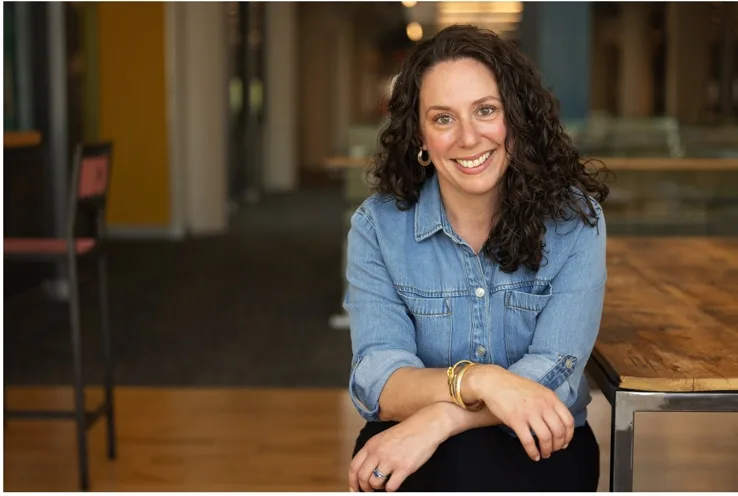
House Everyone STL’s newest leader, Megan Klenke-Isgriggs, grew up in nearby Franklin County. St. Louis was the “hub” for many activities, she says, as she came to town to visit The Muny or see a sports game.
More recently, when she gave a presentation to the board of the East-West Gateway Council of Governments about the work House Everyone will be doing in the near future, she found herself making some hometown connections.
Get a fresh take on the day’s top news
Subscribe to the St. Louis Daily newsletter for a smart, succinct guide to local news from award-winning journalists Sarah Fenske and Ryan Krull.
“I was sitting with some folks from Franklin County that were there, and we were doing six degrees of separation, which family members of mine they played softball with,” she says. “I was like, ‘Oh yeah, OK … the region is interconnected, and this is just one more proof of it.’”
At the helm of House Everyone, Klenke-Isgriggs is responsible for running an organization that deliberately takes a step back from the day-to-day work of operating homeless shelters in order to tackle big picture solutions. That entails looking at St. Louis as a region instead of disparate jurisdictions, each trying to address their own problems. That can lead to homeless people being swept out of one area, only to immediately face similar challenges in the next. By looking at the bigger picture, House Everyone seeks to make homelessness “rare, brief, [and] non-recurring.”
Klenke-Isgriggs started as House Everyone’s executive director in June, after years working at Community Solutions Inc., a national organization similarly dedicated to problem-solving for unhoused people. She’s also worked at the Missouri Foundation for Health, Chicago Public Schools, and as an intake specialist at St. Patrick’s Center.
She plans to draw on her past experience as a service provider in her new role.
“Coming from that frontline perspective, the helplessness that we feel that we can’t do something more in the moment to solve something for someone that we see in need,” she says. “People see it and they’re like, ‘We want to be able to do something. We want this to not be the situation.’ But, like, what is the path to like ensuring that that is real?”
Currently, House Everyone is focused on launching a series of pilot programs in partnership with the East-West Gateway Council of Governments called Bridge to Home. Those pilots, in three distinct parts of the region (St. Charles County, Madison County, Illinois, and a joint effort in St. Louis city and county) all are aimed at people who are “situationally homeless.”
These are people without shelter due to something sudden, like losing a job, in contrast to what are often called “chronically homeless” people, who have ongoing, untreated needs preventing them from stable housing. The goal is to catch people before they fall into longer-term homelessness.
“If we can reduce the folks that are moving toward crisis mode, then our hope is that the cities and the municipalities and the counties that are seeing the tip of that iceberg, they’re seeing that less, they’re feeling that less,” Klenke-Isgriggs says.
St. Charles County is indeed one of those counties, reportedly seeing triple the number of unhoused people in the past three years with an estimated 750 people “without stable housing,” according to FOX 2 report.
House Everyone was initially founded by a coalition of St. Louis homelessness service providers as a way to interface with the federal government for its funding as a “collaborative applicant” due to providers’ dissatisfaction with how the City of St. Louis was handling that role. The federal government rejected that plan, and Peter and Paul Community Service later won collaborative applicant status for the region.
That’s left House Everyone in a complicated situation: still aiming to do overall regional strategic planning work, but without the proverbial carrot to encourage coordination. The nonprofit provided grants in the wintertime for providers to do seasonal work. Another way forward has been through Bridge to Home, which has sponsorship from East-West Gateway and funding from entities including Greater St. Louis Inc. and Purina. By the end of the year, Klenke-Isgriggs hopes that her organization is within “striking distance” of launching those three pilot programs by securing relationships with landlords willing to help and raising funds for the project.
“One of the values of doing this regional kind of approach is that … the core components remain the same,” she says. “We need to have a pipeline to a permanent housing situation. We need to have the right level of support. But what that actually looks like, the adaptation of that for every county, for every jurisdiction, it’s going to look different.
“Being able to do this in a regional way gives us insight into what can be successful across very diverse kinds of geographies, very diverse types of communities.”