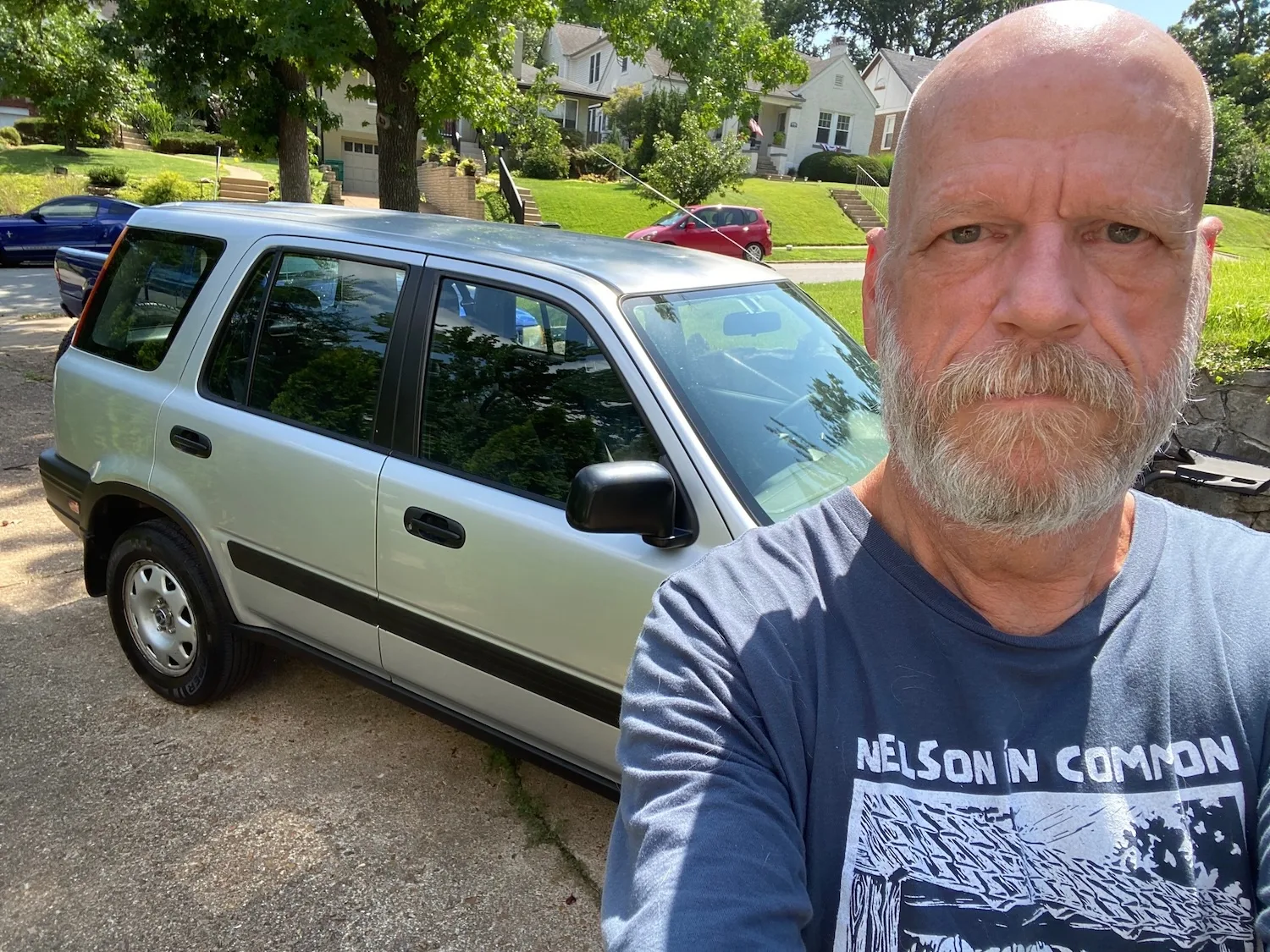
Jeff Truesdell got quite the surprise when he picked up his car after getting it serviced. He heard the problem before he saw it.
“It suddenly sounded like an entrant in a monster truck rally,” he said of the sound emanating from his Honda CR-V. “One of the technicians said to me, ‘Was your car making this sound when you dropped it off?’ And I assured them that it was not.”
Get a fresh take on the day’s top news
Subscribe to the St. Louis Daily newsletter for a smart, succinct guide to local news from award-winning journalists Sarah Fenske and Ryan Krull.
It quickly came to light that Truesdell’s catalytic converter had gotten swiped while it was at Honda of Frontenac—a dealership in a tony neighborhood, and not exactly the sort of place you might expect converter thieves to strike.
But strike they have. Frontenac Police confirmed to SLM that the dealership has seen four converter thefts so far this year.
Truesdell says that had he known this, he wouldn’t have kept his car there overnight, much less more than two weeks. Because the dealership had to order parts for the initial repair and he had a busy travel schedule, the car ended up staying there for about 18 days. “I think that their failure to alert me to what they know is an obvious record of thefts was disingenuous,” he says. He was also insulted by the dealer’s initial response—which included one staffer telling him it could have happened in his driveaway and then offering to do the work at cost, but only if he didn’t go through his insurance.
The dealership sees things differently. Acknowledging that the dealership is not responsible for anything lost or stolen from a vehicle is part of the service authorization paperwork customers sign prior to having their car worked on, they say.
But Truesdell was irritated by the prospect of a $2,921 bill for damage inflicted while his vehicle was on the dealer’s lot (and after he paid $1,800 for the repairs he originally came in for). A lengthy email back-and-forth ensued. Insurance agents were looped in. Truesdell finally agreed to pay 50 percent of what they settled on as the “at cost” price, a total of $500.
The dealership’s service manager, Shannon Beehn, told SLM in an email, “We take the security of our customers’ vehicles very seriously and make every effort to protect them while they are in our care.” Beehn added that the facility is equipped with monitored security cameras that automatically call police when they observe “after-hours activity.” The lot is also regularly patrolled by Frontenac police outside of business hours.
That said, catalytic converter thefts are incredibly difficult to protect against completely, primarily because a skilled thief can cut the converter out from the bottom of the car in a matter of minutes, before anyone is aware or police can arrive on the scene.
Back in 2022 and 2023, when these converter thefts hit a fever pitch in St. Louis and across the country, thieves were stealing them in broad daylight outside grocery stores in less time than it took to smoke a cigarette—which one particular thief was spotted doing as he committed the crime. Thefts were also reported at bakeries, from United States Postal Service vehicles, and even at the very scrapyards purchasing the catalytic converters.
The thefts died down in mid-2023. But there is circumstantial reason to think they may again be on the rise.
Converters are stolen because they contain valuable precious metals like platinum, palladium and rhodium. The price of platinum, for example, has risen sharply over the past year, from around $1,350 an ounce last August to briefly reaching nearly $2,800 an ounce in January. Right now, the price sits at around $1750 an ounce. Those commodity prices don’t represent what a thief can actually get for a stolen converter. Estimates put that closer to $250 a pop. But rising precious-metal prices make converters more lucrative targets, and past spikes in metal prices have coincided with increases in converter thefts. Indeed, converter thefts have seen recent upticks in other cities, like Houston and Minneapolis-St. Paul.
Where do all these precious metals from the pilfered catalytic converters end up? The answer is one that adds insult to injury for people like Truesdell. According to a New York Times investigation, those metals very likely wound up in a brand-new catalytic converter like the one Truesdell paid $500 for.
Hear more about this story from Ryan Krull on The 314 Podcast.