It’s become a mantra in recent years in St. Louis: We need to attract more immigrants and refugees to grow our population. But when Welcome Neighbor STL, a local group with a track record of helping refugees, sought to pair with a national organization, the International Rescue Committee, to bring more newcomers to town, it hit a roadblock. Paul Costigan, the state refugee coordinator with the Missouri Office of Refugee Administration, refused to consent to the group’s application, saying the St. Louis area doesn’t have the capacity for additional families.
Costigan is also a vice president at the International Institute of St. Louis, which has several initiatives to bring more refugees to town and touts them as critical to the region’s future. “St. Louis is losing population and has now dropped to 23rd in the ranking of the largest metro areas in the U.S.,” one of its recent Facebook ads reads. “This is an opportunity to change that—but we must act now.”
Get a fresh take on the day’s top news
Subscribe to the St. Louis Daily newsletter for a smart, succinct guide to local news from award-winning journalists Sarah Fenske and Ryan Krull.
Yet Costigan acknowledges that he advised against the IRC’s plan to work with Welcome Neighbor not over concerns about either organization but about local capacity and resources.
Costigan says that despite the International Institute’s goals, he has to put the needs of the community first. He also suggests that he wasn’t saying “no” so much as “not now,” even if that’s something that he didn’t spell out.
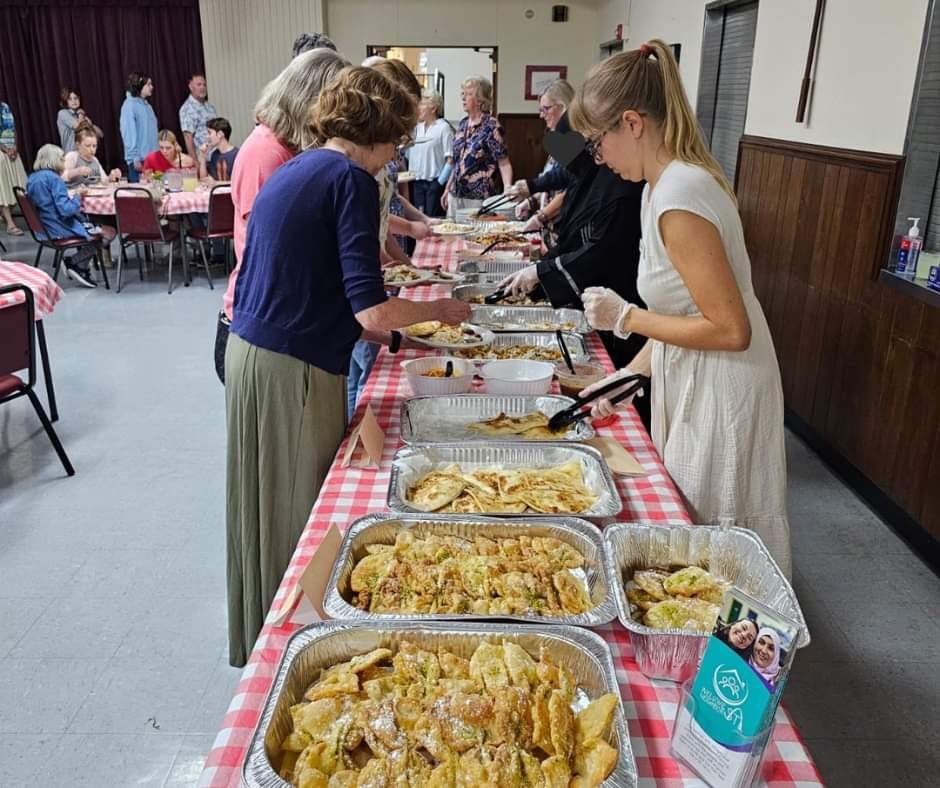
The Local Partner: Welcome Neighbor founder Jessica Bueler first got involved with local refugees in 2016, after reading news stories about Syrian newcomers struggling with roach-filled housing in North City. She quickly realized that the women she sought to help could make much-needed income (and connections) if she organized events where they could both serve home-made food and tell their stories. Welcome Neighbor dinners have become a feature in church basements and event halls—and one of the starting points for many St. Louisans to connect with refugee families.
Since those humble beginnings, Bueler has built Welcome Neighbor into a powerhouse. It pairs local refugee families with volunteers willing to “adopt” them, helping them navigate local bureaucracies, driving them to doctor’s appointments, and generally providing support. Currently, the organization is supporting 45 families in such ways.
“We’ve opened up a path where people can walk alongside the refugees,” says Bueler. “It’s an opportunity for people to learn and grow together.”
Increasing Capacity: Despite close ties to the refugee community, Welcome Neighbor has never been a designated resettlement agency that can draw on federal funds, as the International Institute does. Bueler says the IRC’s invitation to partner felt like a chance to take the nonprofit’s work to the next level.
IRC’s Remote Placement Community Partnership Program uses organizations such as Welcome Neighbor to increase capacity, helping as many refugees as allowed by law before any potential cuts to the number authorized under a new president. (In his presidency, Donald Trump slashed annual refugee admissions from 85,000 to 15,000.)
Welcome Neighbor’s plan to take on 22 refugees received IRC’s enthusiastic endorsement, and, by early spring, Bueler’s group thought it had a green light. The nonprofit was preparing to hire social workers and organizing volunteers.
Then, in May, came an email from IRC explaining that Costigan had stated that “they do not want us to form any new remote placement partners in St. Louis/Missouri at this time.” The email continued, “They expressed significant concerns over the capacity of STL to resettle more refugees, particularly highlighting housing concerns and the capacity of school and health departments.”
Costigan tells SLM that his concern was timing: Bringing more refugees so close to the end of the fiscal year, in October, could strain local resources. He says he wanted IRC and Welcome Neighbor to “not try to rush this in within the last quarter of this fiscal year, but have more time to be able to consult with the community and make sure that they have all their pieces in place.”
Costigan says Welcome Neighbor’s detailed plan to handle everything from schools to housing wasn’t something he saw; he simply advises on local conditions, and he thought waiting until October would be preferable.
Yet Costigan’s role is more than advisory. Without his support, the application was dead in the water. And nothing in his communications suggested that the state was saying yes but not yet. Costigan acknowledges that he didn’t tell the organization to come back in October: “Probably not in those words, I guess.” But he believes they should have realized his “no” wasn’t permanent. (IRC declined to comment.)
Others who have worked with Welcome Neighbor say they don’t understand why Costigan’s office would discourage the organization from bringing refugees here. “I am incredibly disappointed,” says Marie Kenyon, director of the office of peace and justice for the Archdiocese of St. Louis. “The need is there. We have the capacity.”
An Uncommon Structure: The federal government selected the International Institute to run Missouri’s Office of Refugee Administration in 2018, after the state withdrew from handling the work in-house. Missouri is one of a handful of states that contracts out the work. Costigan stresses that his mandate is to do what’s best for local communities, not his employer. “We maintain as much transparency and independence as we can,” he says.
Arrey Obenson, CEO of the International Institute, echoes that, saying Costigan operates so independently that even he didn’t know IRC’s plans had been thwarted until hearing about it from a third party. “We have been very conscious about the appearance of a conflict of interest, to the extent that we actually put them in a separate location from our office,” he says.
Yet Bueler is convinced that Costigan’s role at the International Institute, which she’s been critical of, is the reason that her group was blocked. “The only reason we can think of that he would deny us without even evaluating our capabilities is because he also is the vice president of the International Institute, and maybe he wants to keep control of the revenue,” she says. “The International Institute is a $25 million powerhouse with many organizations picking up the pieces when they are unable to fulfill their obligations to the clients they serve. It’s not right to direct the majority of federal resources to only the Institute while we ALL share the work.”
Both Costigan and Obenson dispute that. While the International Institute received Costigan’s blessing to resettle 1,300 refugees this fiscal year, Obenson says they only got there after back and forth. He agrees with Costigan that the school district and health clinics that serve refugees have capacity issues.
Ultimately, Obenson says, Welcome Neighbor is working toward a common goal. “The more people do this work, the better, because at the end of the day, it’s going to address some of the issues that we’re seeing in St. Louis,” he says. “If my opinion was asked about it, I would give a positive opinion and work with Welcome Neighbor to help them build capacity to be able to do it.”
A Missed Opportunity: If there’s one area where Welcome Neighbor has excelled, it’s harnessing the power of community. Take, for example, Ann Wittman, a stay-at-home mom in Ellisville who helped “adopt” an Afghan family through the nonprofit and quickly found her calling. She’s now personally connected refugee families with 50 cars, many of them donated. She’s also helped relaunch START STL, which coordinates more than 200 high school students throughout the region to assist refugee families and raise money. “Their parents get involved, the schools have chapters, and the teachers get involved,” she says.
Kenyon has witnessed that ripple effect through her role at the Archdiocese. (Fifteen of the START STL chapters are in Catholic schools.) “The model for refugee resettlement is that you have 90 days, and then you move on,” she notes. “It doesn’t work like that. Ninety days, when you’re in a community you don’t know, where you don’t speak the language? You don’t even know where the grocery store is in 90 days. Welcome Neighbor has made it very much a relational thing. Families are friends with families. Children are friends with children. As a result of these friendships, good things happen.”
Hearing that Costigan has opened the door to try again in October has Welcome Neighbor feeling hopeful. After learning from SLM about his stance, Bueler reached out to the IRC to see about applying again.
Kenyon, for one, is hopeful that it will happen, for the sake of the refugees who need a new home. “These folks are our sisters and brothers,” she says, “and all of our responsibilities.”