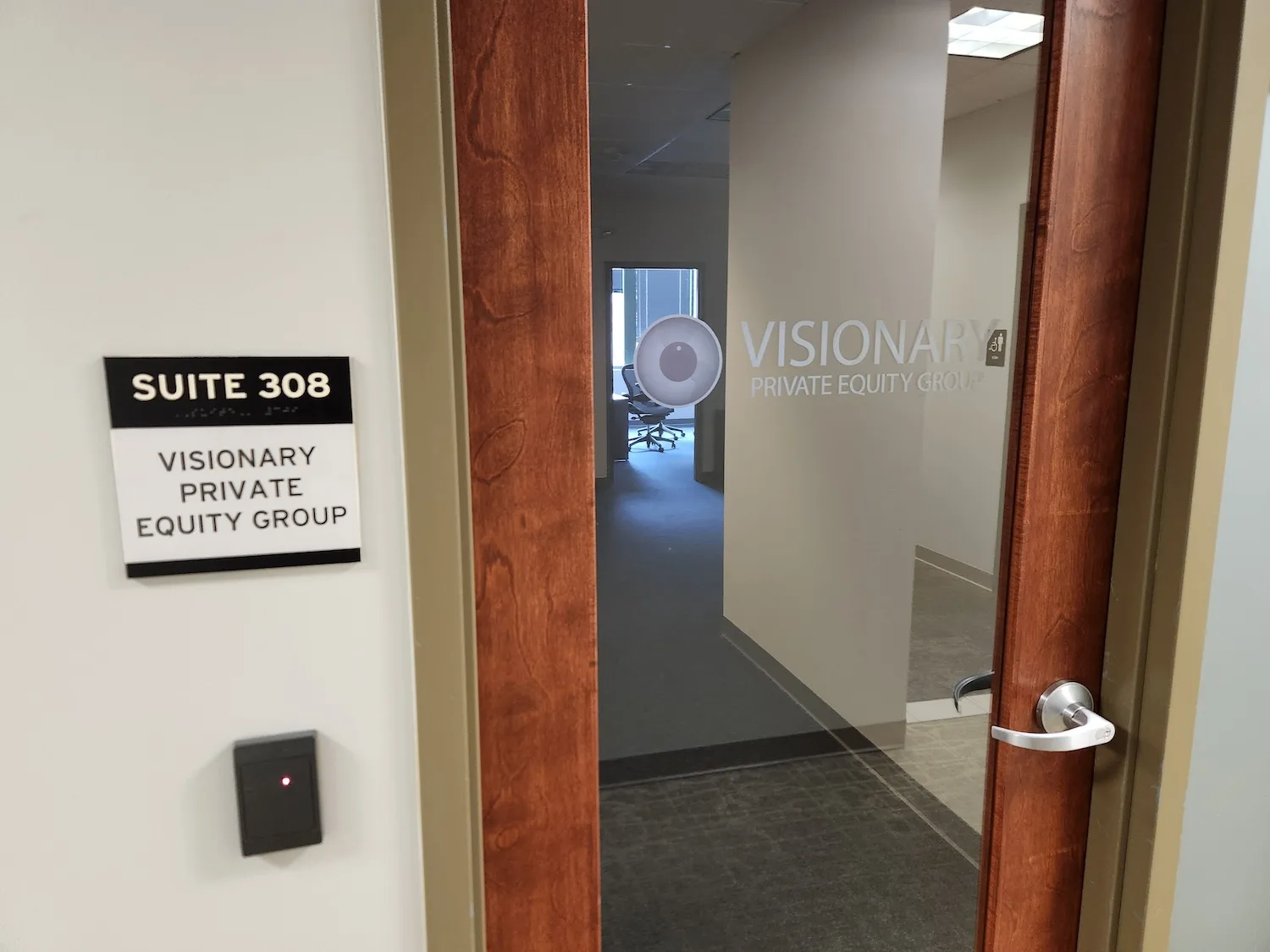
The main office of the Visionary Private Equity Group, on the third floor of a building in the Streets of St. Charles, was locked and dark on a recent afternoon. Its website was down. What has been described in court records as a fund into which 1,000 investors across 38 states placed a combined $90 million is now in receivership. The group once had a locally-based investor relations team, but its members recently said that after bringing in their own friends and family, they themselves were collectively owed hundreds of thousands of dollars in back pay—and feared for the retirement accounts they’d invested in the fund. And the federal judge overseeing a lawsuit brought by investors against the fund’s leadership recently said of the latter’s behavior: “It sounds criminal to me.”
Visionary was launched in 2010. Its founder and chairman, Ronald Zamber, was a University of Notre Dame alum who became an ophthalmologist in Fairbanks, Alaska, and founded a humanitarian nonprofit, International Vision Quest. The group’s legal counsel was Michael Cosby, a partner at Husch Blackwell’s law office in Springfield. Court records don’t reveal why they chose the St. Charles as their headquarters, and their attorneys did not grant requests for interviews. But they did set up an office there and hired a local independent contractor, Brigitte Bonetti, to staff it. According to her testimony at an April 28 hearing, she and her team ran Visionary’s day-to-day operations, but Zamber and Cosby controlled the money.
Get a fresh take on the day’s top news
Subscribe to the St. Louis Daily newsletter for a smart, succinct guide to local news from award-winning journalists Sarah Fenske and Ryan Krull.
Visionary’s pitch was that folks would put money in the fund and the leadership would invest in a portfolio of companies, which came to number more than 30. (One was Visionary Media Group, which listed the artist Tekitha Washington, formerly a vocalist for the Wu-Tang Clan, as a senior advisor.) Then all these funders, called “limited partners,” would receive returns after profitable exits from the portfolio companies. One distribution to limited partners did, in fact, occur in 2021, but Visionary documents in court files don’t agree on whether it totaled $5.8 million or $9.1 million. In a memorandum and order, U.S. District Judge Matt Schelp wrote: “the exact amount of funds distributed, when they were distributed, and to whom is unclear.”
One thing that is clear is that the Oliver family was a major investor. These are descendants of J.D. Oliver, the industrialist who made a fortune a century ago in South Bend, Indiana, manufacturing and selling the chilled plow, which was then an innovative piece of farm equipment. Not long after Visionary’s launch in 2010, the family invested roughly $11 million in the fund. Then, in 2022 and 2023, in response to statements from Zamber and an associate that the fund was just months away from monetizing some portfolio companies, the Oliver family lent Visionary $1.6 million in short-term loans.
But these weren’t repaid on time, so the family requested audited financial statements. They didn’t receive those, either, according to court testimony.
Meanwhile, Visionary stopped paying its bills: It fell behind on office rent, on its insurance policy for that space, and on its contract with a software company that ran its investor portal, which became inaccessible because of nonpayment.
Bonetti and her investor-relations colleagues said at the April hearing that they hadn’t been paid in months, and that collectively, they were owed nearly $400,000. Bonetti said that before being locked out of Visionary’s bank account, which had shown negative balances at several points, she printed out records indicating that Zamber had recently wired himself almost $1.8 million. (His attorney would say later in the hearing that Zamber had loaned the fund money and was repaying himself.)
Bonetti also said that at one point, Cosby, the Husch Blackwell attorney, told her that he had set up a bank account that Zamber didn’t know about so that Visionary could put funds there without Zamber spending them.
One colleague, Kevin Huss, testified that he finally left because Visionary’s director of capital development, Rob Grenley, asked him to cast his monthly operating reports “in a more favorable light” and on one occasion typed up a report for Huss to send out in his own name, but Huss refused. (Grenley and Zamber have the same lawyers, who did not respond to interview requests.) Huss also testified that in a recent Visionary annual report, one portfolio company—Visionary Vaccination & Health Services, which had been located in St. Charles—was valued at $1.7 million. “I believe it is an outright falsification,” he said. It hadn’t operated in about two years, he said, and to his knowledge, the clinic’s only assets were seven laptops, a fridge, and two freezers. Huss said he felt “scared to death that there are other walking dead in the portfolio, and I have $1.3 million invested in this thing.”
At the April hearing, one of the defense attorneys, David McCall of Austin, Texas, was asked by the judge: Why didn’t defendants show up in person? McCall said that, in his opinion, a jurisdictional dispute needed to be resolved first. But he also argued that the investors’ evidence wasn’t damning but rather “hearsay, circumstantial, and conclusory.” Private equity funds don’t generate cash flow, and capital markets were the worst they’d been in a half century. “That in itself,” McCall said, “is not evidence of mismanagement, fraud, or inability to manage the fund.”
But the St. Charles team sounded worried. One of its members, Patrick Lepski, said that between his IRA and cash accounts, he’d probably invested $1.2 million. “We haven’t been transparent,” he testified. “My reputation’s on the line with my friends and family, and we have done very little to make clear where we’re going and how we’re going to get there.” Bonetti said something similar: That both her parents had put the entirety of their retirement accounts in Visionary.
On June 4, the judge appointed a receiver, Jason Buhlinger, and ordered the defendants to turn over all their assets and information to his control. A dispute over their compliance seems to have delayed depositions of the defendants, which the judge also ordered.
The St. Charles team had all been in favor of receivership in this case. Bonetti said at the April hearing that she and her colleagues had remained positive when talking to other investors about it. “People want answers,” she said. “And I said, ‘Listen. You’ll get answers. This is a good thing.’” Whether they still feel that way wasn’t clear as of last week: Nobody was in the office.