Seven years after the failed Better Together plan to reunite St. Louis city and county, local leaders are again contemplating some sort of merger. Most recently, the Regional Business Council, which includes the area’s top 100 CEOs, endorsed the idea of the city reentering the county as one of 88 municipalities, maintaining its own mayor and governance but shedding some offices duplicated at the county level. Mayor Cara Spencer said she has “no doubt” the idea deserves serious consideration, and County Executive Sam Page himself endorsed it a few months ago.
But the three leading candidates vying to replace Page are much less enthusiastic.
Get a fresh take on the day’s top news
Subscribe to the St. Louis Daily newsletter for a smart, succinct guide to local news from award-winning journalists Sarah Fenske and Ryan Krull.

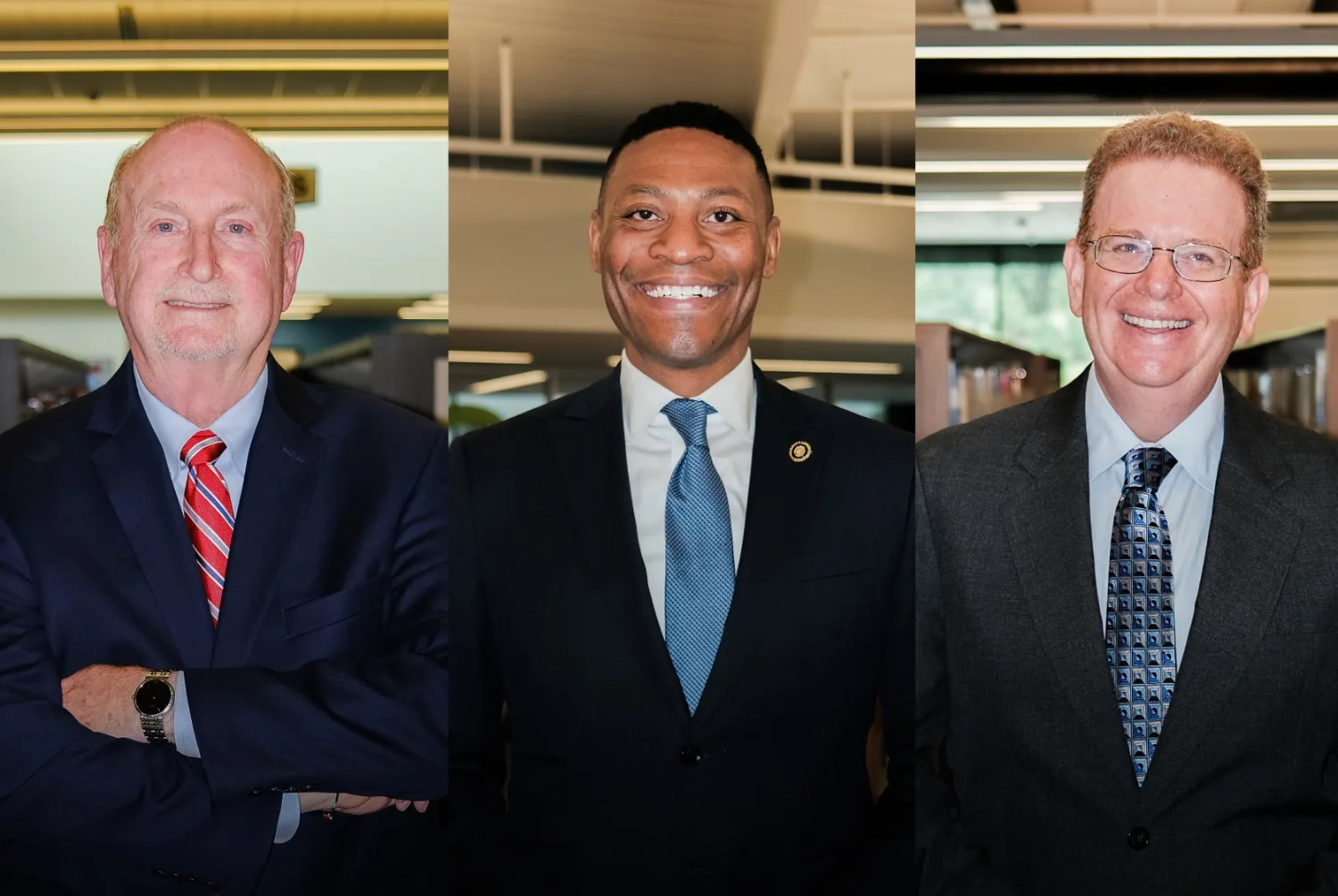
In interviews conducted by Nine PBS and St. Louis Magazine for the Citizens’ Agenda, which focuses on five issues identified by voters as important to them, state Senator Brian Williams (D-University City), County Councilman Dennis Hancock (R-Fenton), and County Assessor Jake Zimmerman all gave tepid responses to the idea, or offered major qualifications, instead of co-signing. (State Senator Angela Mosley, D-Florissant, who is also running in the Democratic primary, did not make herself available for an interview.)
Said Wiliams, “I think first my goal would be making sure the county is cleaning up its own home first.” Pressed about the specific idea of the city reentering the county, Williams was just as lukewarm, stressing the need to listen to community members. “I will say it does sound nice to be 1.2 or 1.3 million [rather] than 900,000 and something [in St. Louis County]. But right now, I think it’s about making sure that we get all of our leadership, and most importantly the region rolling in the same direction first.”
Hancock echoed this position, likening the county’s situation to an emergency on an airplane when oxygen masks drop from the ceiling. “We have to put our own mask on. We’ve got our own problems to solve. The city has problems to solve. I don’t think putting the two together is going to miraculously solve all the problems in the region,” he said. “I think we have to focus on our own problems, get those solved, and then maybe we can talk about doing some other things to help the rest of the region.”
Zimmerman’s answer was more discursive. “My litmus test is always, What does it do for our parks and what does it do for our potholes? Because I think there’s a lot of potential regional cooperation on the table that could save you a few bucks and get you better services. But if you look at it through that lens, then I think you’re asking the question that your viewers ought to be asking themselves and probably are—which is, what’s in it for me?”
He added that Better Together failed in part because it was a top-down plan. “A bunch of business leaders in a room have decided that this is what you should do, and we’re going to shove it down your throat,” he said. “That’s never the right way to do reform. So whether you talk about something like the city reentering the county as one more municipality, or duplicative fire services, as some of the cities in the county have recently talked about, or getting rid of the overlapping layer of thousands of taxing district permutations that we deal with in the county, I think if we focus it back on how can you save a few bucks while improving public services, ask the question that way, and I think the voters might give you an answer you’d be interested in hearing.”
Interestingly, Hancock, the sole Republican in the race, made clear that he’s looking west and south, not to downtown. “When we talk about the region, we also have to include areas other than the city of St. Louis. We have to include St. Charles County … we have to talk about Jefferson County. Those are the places where a lot of the jobs are going and a lot of the people are moving to. So let’s look at what they are doing and what they’re doing right. And let’s figure out how we can all work together on some of those things.”
As part of the first agenda item identified by voters, which focuses on growing the region and helping it thrive, the three candidates also shared their thoughts on what they would do to grow the region and make it more attractive to young people.
They were also each asked to share a time when they’d put their own parochial interests aside and worked for the betterment of the region.
Williams pointed to his work obtaining state funds for the demolition of Jamestown Mall project, which is not in his district, along with funds he obtained for the University of Missouri St. Louis and a regional police facility in Maryland Heights. “I recognized that I was sent there to be a regional leader, not a leader for one particular community,” he said of his work in the legislature. “Those are just some tangible examples that I’ve been able to do in a minority party, convincing my colleagues in Jefferson City that our region makes up 45 percent of the state’s GDP—meaning we drive the economy for the entire state of Missouri.”
Hancock mentioned his work after the Chrysler plant closed during his time as mayor of Fenton. “We found out after they closed, there was only one worker who worked at the plant who lived in Fenton,” he says. “Everybody else lived all across the region.” Now the site has been successfully redeveloped into an industrial park that hosts Amazon and other tenants. Hancock also talked about laying the groundwork for a bridge between Sunset Hills and Fenton.
As for Zimmerman, he stressed what’s become of his big talking points in the campaign: That he will do a boring job without drama.
“One of the mantras I’ve tried to live by is, You just do the right thing, even if it’s hard,” he said. “In all of those times when I have found myself in a high-profile fight, it’s always because of something about substance. … I save the fireworks and the theatrics for when it’s about something that matters. We have too much low-hanging fruit to pick to waste another second on the kind of nonsense that holds us back.”
Why It Matters: The St. Louis County executive represents nearly 1 million people. Their staff prepares the county’s budget, enforces county laws, and supervises departments like Public Works and Public Health. The executive also appoints most department heads and members of county boards and commissions. Some have argued that these responsibilities make the county executive the second most powerful elected official in the state after Gov. Mike Kehoe.
And this is a rare vacancy. When County Executive Sam Page opted against running for reelection earlier this year, it created the first true opening for the position since Gene McNary’s election in 1975. Other county executives since have been appointed to fill vacancies (H.C. Milford, Charlie Dooley, and Page) or ousted incumbents (Buzz Westfall and Steve Stenger).
What’s Next: Race for County Executive: The Citizens’ Agenda airs Monday at 7 p.m. on Nine PBS. You can also watch the livestream during that hour or find it later on YouTube. And we plan to hone in on the four other major agenda items that are important to voters in the next five days at stlmag.com and through our St. Louis Daily newsletter. Early voting is underway and concludes on August 4. After that, the Republican (Hancock) will face either Williams, Zimmerman, or Mosley in November.