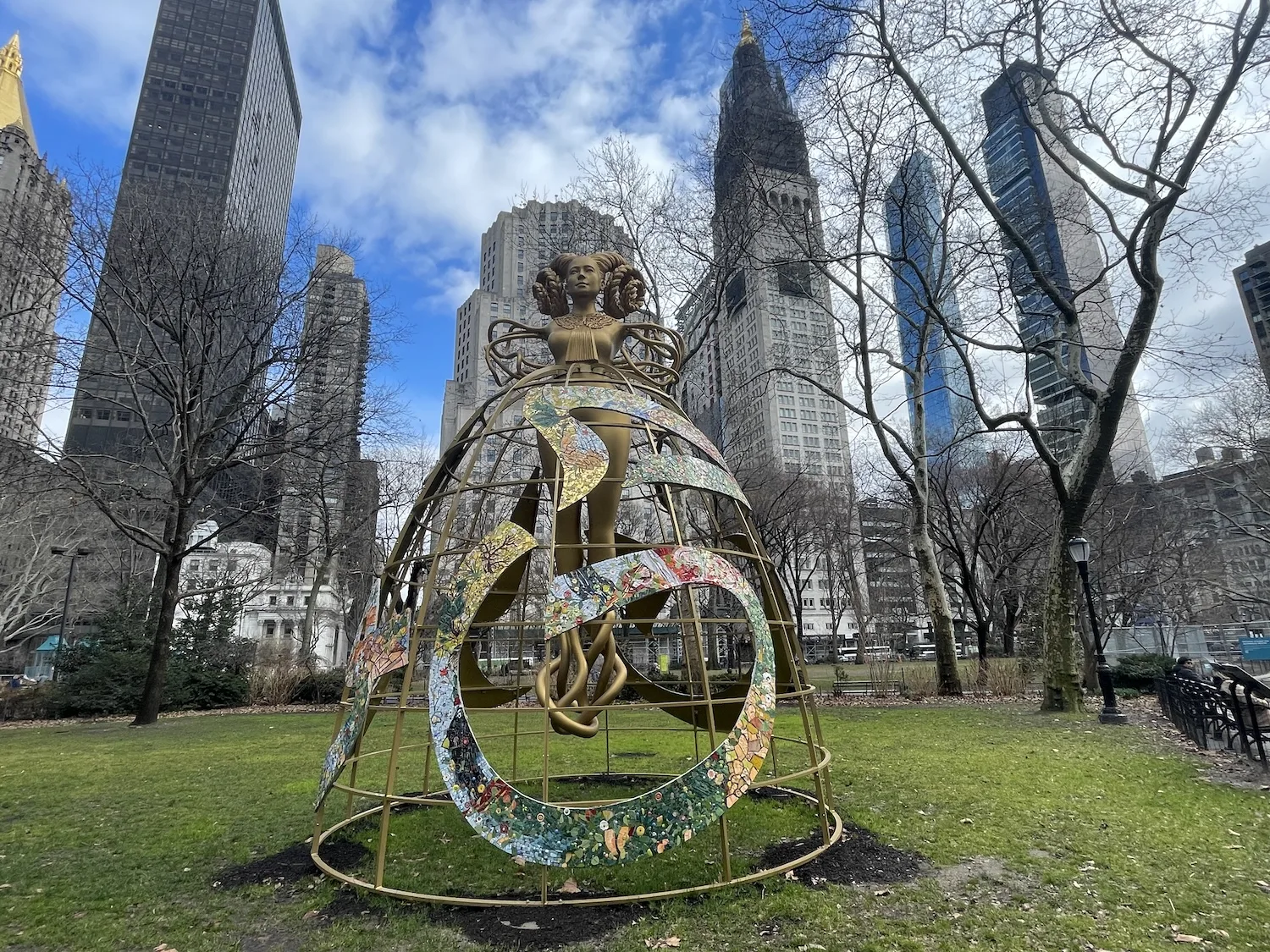
A sculpture titled “Witness” won’t begin installation at its new home in Fox Park until later this week, but it’s already caused a stir, even getting the attention of Missouri’s top law enforcement officer, Attorney General Catherine Hanaway.
The 18-foot l sculpture features a golden feminine figure with braided hair resembling rams horns and arms transforming into root-like appendages. Her collar resembles that of late U.S. Supreme Court Justice Ruth Bader Ginsburg.
Get a fresh take on the day’s top news
Subscribe to the St. Louis Daily newsletter for a smart, succinct guide to local news from award-winning journalists Sarah Fenske and Ryan Krull.
The sculpture is to be installed outside the building housing Rung for Women, a career accelerator and development center.
In a statement, a spokesperson for the organization said they were excited for installation and have been readying the landscape outside their offices since September. Rung for Women described “Witness” as a good match for its ethos in that it “perfectly reflects the strength, resilience, and determination of the women who walk through our doors, each on her own journey of personal and professional growth.”
Hanaway, and apparently some of the sculpture’s future neighbors, feel differently.
Some neighbors, according to a post made by the attorney general on social media, called the sculpture a “demonic affront to faith.” Hanaway’s post cited the fact that Shahzia Sikander, the artist behind “Witness,” said her inspiration for the piece was the “spirit and grit” of women “fighting for abortion.”
A spokesperson for Hanaway’s office declined to elaborate on how the sculpture got on their radar. However, one of Hanaway’s posts referenced its proximity to two nearby churches, one of which is the St. Francis de Sales Oratory, a traditional Catholic church that offers mass in Latin. As a rule, traditional Catholics are not fans of abortion. The church’s pastor did not respond to a message seeking comment Friday.
Sikander, a Pakistani-American artist, has stated that the work is a reaction to the rollback of abortion access following the Supreme Court’s 2022 overturning of Roe v. Wade and that she took inspiration from “the indefatigable spirit of women who have been collectively fighting for their right to their own bodies over generations.”
“Witness” previously drew controversy when it was installed at the University of Houston in 2024. Art News reported that February that on the eve of its unveiling in Houston, an influential anti-abortion group in Texas decried the work as promoting satanism. Texas Right to Life derided “Witness” in a press release as “a golden statue with satanic imagery meant to honor both abortion” and Ginsburg.
Following the controversy, a planned artists talk was cancelled. A few months later, someone beheaded the sculpture amid a hurricane, an act the University of Houston police said they believed was intentional. Sikander stated at the time she wished for the work to be displayed with its vandalization in full view rather than hidden beneath a tarp.
The sculpture is now on permanent loan to Rung for Women from the Gateway Foundation, a nonprofit that bolsters public art throughout town. The foundation said through a spokesperson they selected the work “foremost for its artistic merit and beauty, and secondly for its exploration of women’s autonomy, belonging, and representation in public art.”
The organization added that they felt the themes present in “Witness,” which was first installed in New York’s Madison Square Park in 2023, were a good match with Rung for Women. It will be one of only a few sculptures, statues, or monuments in St. Louis representing a woman who isn’t a historical figure, making it a natural fit for an organization that helps women “building the future,” the foundation said.
Hanaway has not said what, if any, specific action her office plans to take regarding this week’s installation of “Witness.” She wrote on social media that its arrival in Fox Park happened in secrecy. Before the sculpture is installed, she wrote, there should be community input and a process that does not occur “under the radar.”
Politically charged ire over public art has been a mainstay of American culture for the past several years, with statues of Robert E. Lee, Christopher Columbus and the like coming down across the country. Though these controversies have been at an ebb recently, they seem unlikely to go away any time soon. Earlier this year, Australian indie rocker Alex Cameron released the satirical “Statue Down” about this particular subgenre of the culture war. Last week, former talk show host Conan O’Brien opined publicly that all statues should be made of a “durable soap,” requiring society to decide every 10 years or so if a statue should be rebuilt after rainfall has turned it into suds.
CORRECTION: A previous version of this story misidentified the Catholic Church in Fox Park. We regret the error.