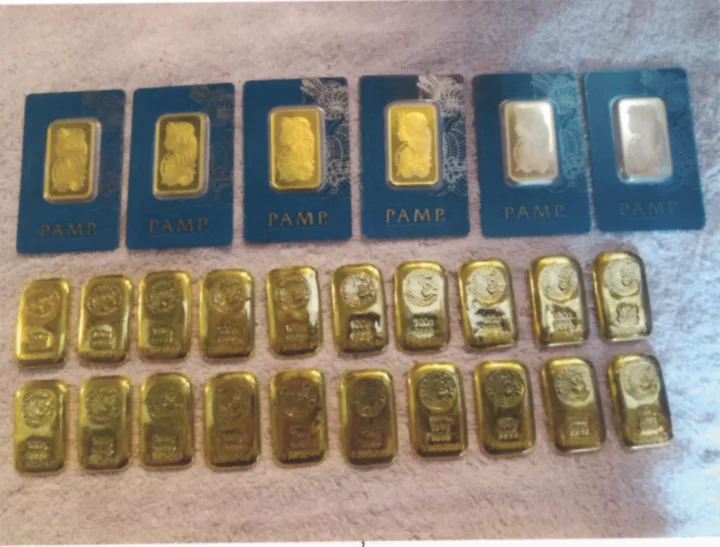
Two couriers who allegedly transported gold bars swindled from elderly victims will be at the federal courthouse in St. Louis today, where they will become the latest to be arraigned on charges related to a conspiracy that cost people across the country millions of dollars.
Elie Longueli and D’Mauriea Rogers are both facing charges of conspiracy to commit wire fraud. They were two of the U.S.-based couriers in a scheme run by a call center located outside of the country.
Get a fresh take on the day’s top news
Subscribe to the St. Louis Daily newsletter for a smart, succinct guide to local news from award-winning journalists Sarah Fenske and Ryan Krull.
The call center’s M.O. was to contact elderly victims and alert them that their accounts had been compromised and that they needed to hand over their money for safe keeping. The call center operators often held themselves out to be representatives of the government. They instructed their victims that a safe way to transfer their money was to liquidate their savings, convert their money into gold, and then hand the gold over to a courier. The call center operators gave the elderly victims a password that they could use to ensure the couriers were on the up and up—which, it goes without saying, they were not. Those couriers were then told where to transport the gold and were paid a fraction of the take after its delivery.
The breadth of the scheme, and the sums involved, are staggering.
Longueli allegedly picked up more than $1.3 million in gold from victims in Iowa and Illinois before being taken into custody in Illinois on October 29.
A third co-defendant, Ayeshbhai Khaterwala, completed seven runs to Texas and Louisiana, where he couriered back $900,000 in cash, gold, and silver. He was instructed to tell victims that his name was David MIller.
Meanwhile, Rogers couriered $900,000 in gold and cash from victims in Colorado, Arizona, Arkansas, Minnesota, and Oklahoma. After picking up $258,000 in gold from a woman in her 70s in Denver, Rogers texted his handlers saying, “This has been a thrill this better than my normal job ahahahahahahaha.”
One of his handlers texted back, “”They got mucho dinero.”
In fact, the woman in Denver did not have all that much dinero. She was a retired hairdresser who liquidated her savings as a result of the conspiracy and subsequently had to return to work to keep from losing her home.
The couriers’ handlers were two men named Elon Harper and Monarch Sachdev, both of whom were indicted earlier this year. Harper allegedly recruited Rogers and Longueli into the scheme.
Court documents paint Sachdev as something of a mastermind, stating that he personally retrieved proceeds from the frauds on 65 separate occasions, helping himself to $5.4 million. He also directed other couriers on at least 54 occasions, resulting in $4.2 million in losses. Sachdev maintained records of the conspiracy as well as coordinated the passwords between the couriers and the victims they met with, prosecutors say.
Sachdev entered the country in July 2022 on a student visa, which he overstayed. (Court files don’t say where he immigrated from.) He was residing in Houston, in the county illegally, when the scheme collapsed.
The indictment of Harper and Sachdev accuses them of swindling more $8 million from victims across the country in a sprawling conspiracy.
Among its victims were a 71-year-old woman in Cedar Hill, Missouri, who in 2024 was contacted by the conspirators and told that money had been sent to her via Paypal in error and that if she didn’t purchase $200,000 in gold she would have to pay income taxes on it. Sachdev dispatched another of his couriers, Raj Chauhan, to collect the gold from the victim in Cedar Hill.
Shortly thereafter, authorities intercepted Chauhan, presumably initiating or at least hastening the gold scheme’s demise.
Harper and Chauhan both pleaded guilty in October. Neither have been sentenced. As part of Harper’s guilty plea he admitted to picking up $73,000 from an elderly Texas man who had put the money in a package labeled as being for the “U.S. Treasury.”