The good news for North Siders whose houses lay in the path of the May 16 tornado: Recovery aid, both public and private, is there.
The bad news: Obtaining it can be tough if those houses are owned, on paper, by deceased family members.
Stay informed on the area’s civic issues
Subscribe to the St. Louis Solutions newsletter to learn about public problems and possible fixes.
In 2023, SLM spotlighted the problem of “tangled titles”: situations where homeowners die without any estate planning, so the legal rights to the property become unclear. By state law, ownership instantly fractures among surviving relatives, and the asset itself can then turn into “dead capital”—it can’t be rented or sold, an existing mortgage can’t be easily modified, and insurance proceeds can’t easily be accessed.
The tornado didn’t create this problem but has forced plenty of families to confront it, according to attorneys with Legal Services of Eastern Missouri, the nonprofit that has a unit dedicated to working on such cases pro bono. Peter Hoffman, who leads the unit, says that whereas before May 16, he and his colleagues took on 10 new cases a month, now that number is 20, about two-thirds of those clients coming from the city’s tornado-affected area. “It’s pushing the limits of what we can handle,” Hoffman says.
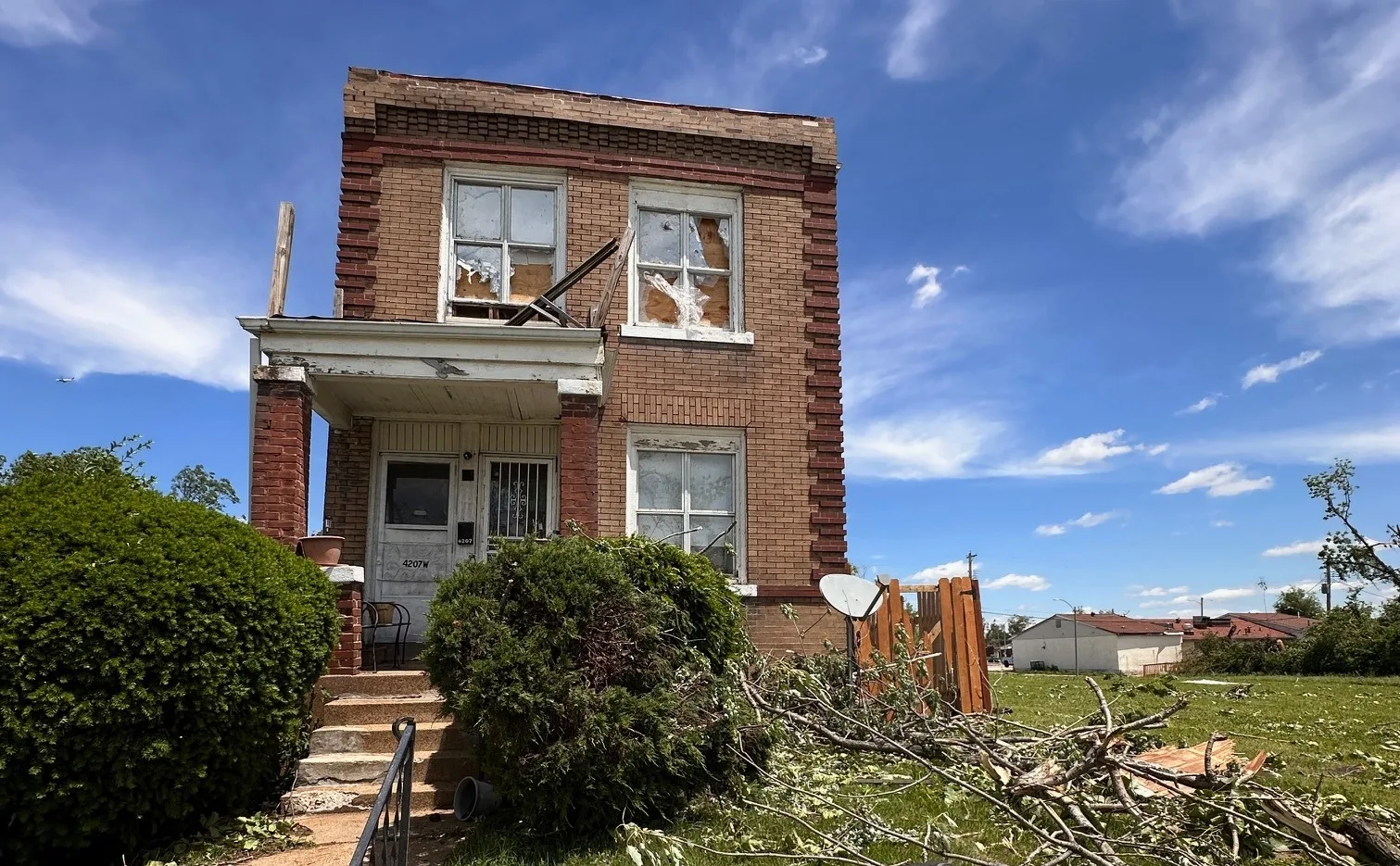
And some longtime St. Louis families find themselves in a serious bind. One of LSEM’s new clients, the Taggart family, has lived in the Greater Ville neighborhood for generations—thanks, coincidentally, to a previous bout of bad weather. Erika Brown says her grandparents, Rozell and Mary Taggart, had converged on St. Louis during the Great Migration, he from Alabama and she from Mississippi. After meeting and marrying here, they were displaced by the 1959 tornado and moved to the 4200 block of Lexington, near Fairground Park. Their two-story brick home became the “cornerstone” of the family: where Rozell would rest after hard days at his concrete and elevator-installation company, where Mary would tell stories and make her famous cha-cha (a Southern relish), where relatives from out of town would always sleep. But by the spring of 2025, both had passed away, and the only person living in the house was their 67-year-old daughter, Sandra Taggart, who is a retired teacher and partially blind. She was at home on May 16. Her own daughter, Brown, recalls racing across town to check on her. “You could hear people screaming, water running, electric lines snapping,” Brown says. “And my mom is standing out on the curb. She was in shock.”
The house’s roof and walls withstood the wind, but both porches were damaged, and certain windows blew in so hard that glass embedded into the wall, Brown says. They filed an insurance claim and received a check for thousands of dollars—but it was cut to Rozell and Mary, who despite being deceased are still the owners of record. So now LSEM is trying to help the family transfer the title to Sandra; this requires the consent of Sandra’s three siblings, one of whom doesn’t live in town and hasn’t yet responded.
On top of that, the insurance snafu has complicated the family’s application to the Federal Emergency Management Agency (FEMA), Brown says. FEMA pays for only those losses that private insurance doesn’t cover. So the very insurance proceeds that the family is having trouble accessing may, at the same time, be blocking their ability to get FEMA’s help.
For other families with tangled titles, the problem is one of awareness: They don’t realize that while FEMA conditions home-damage aid on an applicant’s proving occupancy and ownership, the latter can be established by handing over a property tax receipt or bill. The agency even began accepting, as a last resort, personal declarations that explain the tangled title, which is sometimes referred to as an “heirs property.” To Hoffman, that was a helpful move, but he says that it’s not clear whether such information is being well-disseminated to storm survivors. “We still get a lot of calls from owners who believe they need to formally update the title in order to get FEMA assistance,” he says. (FEMA has set up a trio of disaster recovery centers on the North Side and says they have collectively welcomed nearly 6,500 visits; the deadline for applying for individual assistance is August 26.)
And not every private charity or public-assistance initiative offers FEMA’s flexibility on tangled titles, Hoffman says. For example, the city has recently set up two new programs: one offering emergency stabilization, and the other, electricity reconnection, both at no cost to the resident. Julian Nicks, the city’s chief recovery officer, said in an email that in order to help out, the city must have the right of entry and a contract with the owner of record, “so, unfortunately, the occupant of the home would need to prove that they live there and get the property in their name.”
At the offices of LSEM, Hoffman says, he has been a part of some sad moments. “We’re having to have many tough conversations with callers about having to abandon property, because either the title issues are just too fractured, the family can’t reach consensus about how to proceed, or there aren’t sufficient financial resources to repair the property even if there was a legal solution to the title problem.”
As for Brown, she says she’s not giving up just yet on her family’s Lexington house. “We’ve never thought about getting rid of it,” she says. “My grandmother was a church lady. She would always say, ‘God is in control.’ So that’s what we lean on in this time. I don’t think it can’t be fixed.” To other families who own homes but haven’t done estate planning, Brown urges them not to wait: “Consciously think about how you want your family’s legacy to survive.”
For more coverage of St. Louis’ problems and possible fixes, sign up for our Solutions newsletter here.