This article first appeared in the Solutions newsletter. Click here to learn more about the newsletter and sign up.
St. Louisans remember the torrent. July 26, 2022: Twelve inches of rain in 12 hours—the most recorded here in a single day. So much water in certain spots that cars peeked from the surface like alligators, MetroLink tunnels looked like rivers, and the upper River Des Peres looked like a lake. The toll: Two deaths, more than 1,500 homes damaged, tens of millions of dollars in physical assets destroyed. In response, the federal government awarded the county $56.4 million and the city $25.8 million in recovery money. These governments now need to craft action plans to spend it. The county (which got hit the hardest) will probably contract out that task, according to official documents dated last week. The city, meanwhile, is asking for residents to weigh in. One eligible investment they can show support for is a study on the feasibility of “river restoration”—that is, the daylighting and regreening of River Des Peres.
Stay informed on the area’s civic issues
Subscribe to the St. Louis Solutions newsletter to learn about public problems and possible fixes.
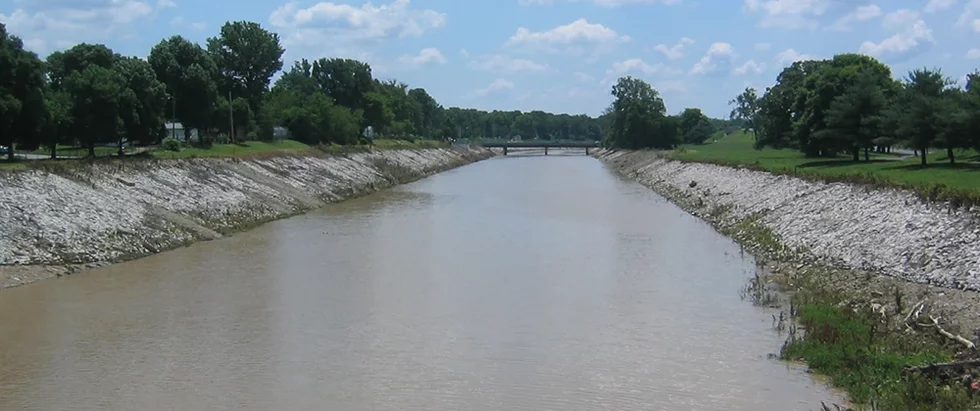
Yeah, I know: River Despair. A sewer runs through it. All that. It would be a heavy lift. But maybe not an impracticable one.
To daylight the RDP within city limits would probably mean, if nothing else, digging out the part that runs underneath Forest Park. (Consider this recent precedent in Tower Grove Park). To regreen the RDP within city limits would involve the open part, which emerges just southwest of the intersection of Manchester and Kingshighway and then traces a slow, backwards comma along the edge of South City to the Mississippi River. (And yes, it was at least partly green at one time.) Here we’d be talking about replacing the now-infamous concrete canyon with something more vegetative, permeable, and maybe park-like, complementing what Great Rivers Greenway has already laid down.
Whether it’s technically doable is the question for a feasibility study. The RDP drains 114 square miles of the region, and after a severe rain, big water will want to head in there, however lush and permeable the surface may be. There’s also the question of debouchment. Nahuel Fefer, executive director of the Community Development Agency—the city entity that’s handling the relief funds—tells me that any kind of RDP flood mitigation or green-infrastructure would require aligning with the U.S. Army Corps of Engineers, which manages the Mississippi. But assuming that the logistics get lined up: Would a project on this scale be politically doable?
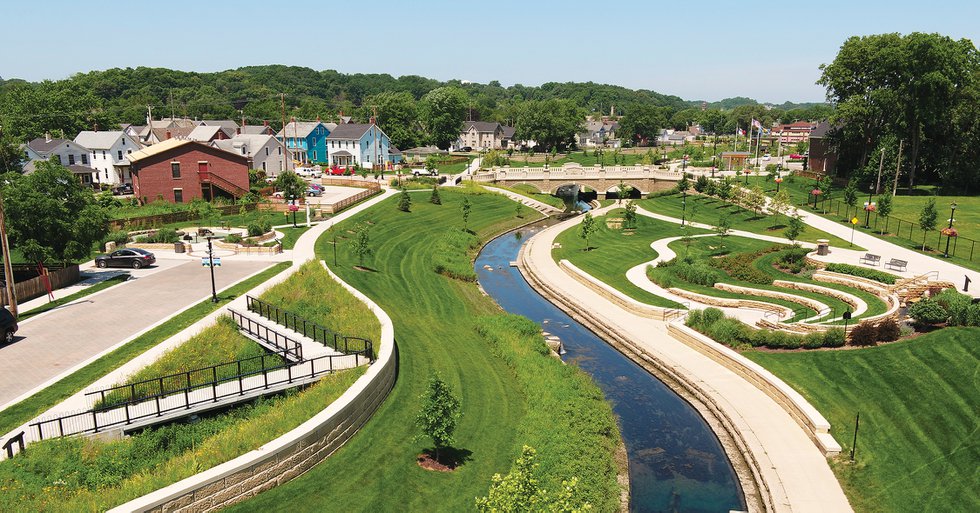
In December, a Board of Aldermen committee hosted Brad Cavanagh, the mayor of Dubuque, Iowa. He gave a presentation on what his town has done with its Bee Branch watershed—a rough analogue to St. Louis’ RDP watershed.
The short version is that by the late 1990s, Dubuque had a serious problem. The Bee Branch kept flooding. There were six disaster declarations from 1999 through 2011. But during that time, citizens began engaging in a flood mitigation effort and, in essence, turned that slice of land into an attractive recreation spot as well.
Here are three insights from Cavanagh’s testimony that could be useful when thinking about revamping the RDP:
1) Residents, not politicians, will get it done—or not.
The revamping of the Bee Branch has taken about a quarter century, Cavanagh said. It’s not even finished. (And the Bee Branch is much shorter than the RDP.) In a long game such as this one, Cavanagh said, electeds will cycle in and out. National political winds will shift and alter cities. But a city’s residents remain.
In Dubuque, he said, things started taking shape when they got involved—and stayed patiently ambitious: “Rather than saying, ‘Nah, that seems too difficult, I don’t think we should turn this into a park. Let’s just focus on the water’… People just kept saying, ‘Yes.’ People kept saying, ‘Why not? Let’s try it.’ Then they chased the funding for the why-not and were able to secure it and made it happen.”
2) Framing can clinch funding.
Dubuque did find dollars where you might expect. They passed a stormwater utility fee. They took advantage of state revolving loans and sales tax increment financing. They got money from various federal agencies. But they also looked at less intuitive sources.
For instance, the idea arose to build an arts amphitheater along the creek, Cavanagh said. But then they realized how it could be useful for a nearby school as an outdoor classroom—and not just for that school but for any educational group. And that framing opened the door to money from state and federal transportation agencies, of all places. Sometimes how you present an improvement, Cavangh said, is more important than why you want it.
3) Get used to baby steps.
Dubuquers wanted permeable alleys. These allow rain to percolate into the ground, thereby relieving pressure on storm sewers. Dubuque has identified 270 alleys it wants to greenify. It has only completed 80, with a few more scheduled soon. “This is one of the challenges of this project,” Cavanagh explained. “We were able to get quite a bit of funding to do this up front, but then some of the pieces of this project are expensive and difficult to do every single year, so we’re chipping away at it little by little.” (Perhaps not coincidentally, St. Louis city residents have been given the option to show support for green alleys in the disaster-fund survey.)
But how do you sell a 20-year project to begin with? That’s what committee chair, Alderwoman Anne Schweitzer of the 1st Ward, wondered aloud after the hearing. “It’s really easy to forget about disaster when everything is fine,” she told me, “but when we’ve had flooding like we’ve had, you have to care now.”
Mayor Tishaura Jones’ administration, for its part, has already identified its top priority for recovery funds: households who suffered losses. And Fefer told me that when it comes to mitigating flooding, the RDP is not the only consideration; the North Side “also got hit very hard.” But the RDP, he added, “is clearly emerging as a high priority.”
Schweitzer hopes so. Parts of her ward in deep South City have been “hammered” by flooding, she said. But she is heartened by the progress that GRG has already made and by how many people turned out after the hearing to hear Cavanagh speak at the Wine Down Café. “I don’t think we’re at Year One,” Schweitzer told me. “I think we’re at Year 10.”