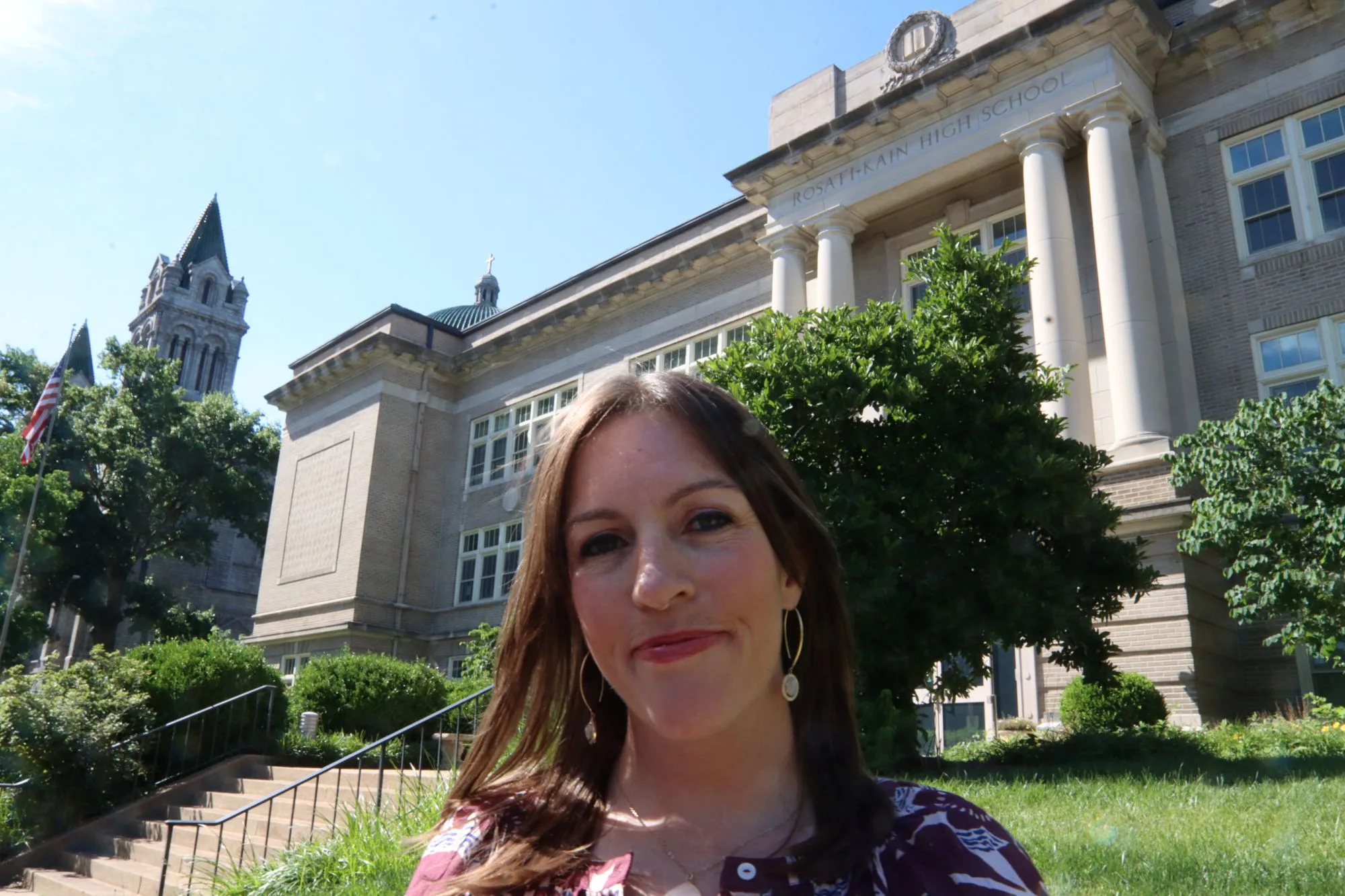
Michele Bildner did not know, as a senior at Rosati Kain High School in 1998, the meaning of the term “economic connectedness”—that is, the social mixing of people from either side of an area’s median household income. Nor could she have known that such mixing appears to benefit below-median-income people over time. Or that certain Catholic high schools in St. Louis are exceptionally good at fostering it, according to research by researchers at Opportunity Insights, a Harvard University–affiliated nonprofit.
She just knew that her ticket out of St. Louis (and away from a difficult home life) was a strong GPA at Rosati—and that Rosati made her work for it. “Some things came a little naturally but I definitely applied myself,” says Bildner. “Nothing was easy there.”
Stay informed on the area’s civic issues
Subscribe to the St. Louis Solutions newsletter to learn about public problems and possible fixes.
Eventually, Bildner would become the first in her family to earn a doctorate and become a tenure-track college professor. And she credits the culture of Rosati for giving her the tools she needed to make it happen. That’s all the more poignant given the hard times the school has recently experienced—and the glimmers of hope there, too.
Rosati, an all-girls school founded in 1911, was scheduled in 2022 for closure by the Catholic Archdiocese of St. Louis, which explained the move by pointing to low enrollment. Whereas most Catholic high schools operate as nonprofits that are independent of the Archdiocese, which then certifies them as being in accordance with the faith, Rosati was one of the few that received direct financial and administrative support from the Archdiocese. To avoid closure, school leaders and an active alumnae network decided in late 2022 to secure the sponsorship of St. Joseph Educational Ministries and try to survive as a Catholic nonprofit under a new name: Rosati Kain Academy.
If they succeed and Rosati endures, it could give future generations of girls the same shot at upward economic mobility as Bildner had.
Bildner grew up in Glasgow Village, which is in northeast St. Louis County, near the Chain of Rocks Bridge. At a very young age, she and her brother lost their mother to cancer, so they were raised by their dad, a propane-tank deliveryman who made a low hourly wage and struggled with substance abuse disorder. They, in turn, had to learn to navigate the resulting instability and neglect. But thanks to financial aid, Bildner was able to attend Rosati. “I always really liked school,” she says. “I think it was a coping mechanism.”
At Rosati, Bildner says, she made friends with classmates from various neighborhoods and wealth backgrounds. This kind of diversity is still evident today, according to school president Stephanie Boyd. While most students are city residents, many corners of the St. Louis region are represented. About two-thirds of the student body is non-white, she says. Household income is less than $25,000 for 11 percent of students; between $25,000 and $75,000 for about half of students; between $75,000 and $150,000 for about a quarter of students; and over $150,000 for 14 percent.
Back in the ‘90s, Bildner was surrounded by girls who, like her, had to learn how to exercise self-discipline in managing their time inside a modular scheduling system. “We had this free or unscheduled time,” she recalls. “And so it was like, well, what do you do with that? Do you goof off? Do you sit in the library? Do you sit somewhere else?” That, too, is true today even outside of school, says Boyd. “I do believe high school students in particular are very vulnerable to what their friends are doing,” Boyd says. “And it is that mindset that if you have the friends who are like, ‘Nope, I can’t go out and have fun tonight, I need to do this, this, and this,’ or ‘I need to work this job,’ or ‘I need to get this project done,’ you are more likely to do that too.”
Bildner took both the SAT and the ACT and also earned college credit through Saint Louis University. Neither her parents nor grandparents had gone to college, but at Rosati, and among those who grow up in above-median-income households, these endeavors were all common, and she had friends at Rosati doing it, too.
This kind of behavioral adoption may be why economic connectedness lifts the prosperity of people below the median income, according to Opportunity Insights director Raj Chetty, who presented some of his findings in St. Louis in October. A few years ago, Chetty and his colleagues set out to learn where in the U.S. economic connectedness was particularly high. Teaming up with folks from Meta and drawing on massive datasets from the IRS and the Census, they isolated an age cohort with a high Facebook usage rate—specifically, Americans who’d attended high school between roughly 1990 and 2015—and they wondered: If you were a below-median-income kid at a given high school in the United States, how much of your social circle would typically be filled by above-median-income kids? The high schools were then ranked. And as it turned out, Rosati scored in the 95th percentile nationally on this metric, making it one of the highest scoring schools in the St. Louis region. (Incarnate Word Academy and Chaminade College Preparatory School both scored in the 98th percentile; Christian Brothers College High School, in the 97th; and De Smet Jesuit High School and Cor Jesu Academy, in the 96th. To see the interactive map, follow this link, hit “Explore the Data,” and zoom into St. Louis.)
Asked why Catholic schools seem to score high in economic connectedness, Boyd says that it comes from what she considers to be an openness and generosity in the faith. “Individuals who are full-pay here don’t feel like they’re getting cheated because they’re full-pay and someone else is not,” she says. “I think they are more open to say, ‘Don’t give it to me. Give it to the person who needs it.’” (The Archdiocese acknowledged but did not respond to an emailed list of questions.)
Boyd also reports hints of a turnaround at Rosati. The 2025–2026 academic year closed with 82 students, she says, but in the fall, she expects that total to rise to about 100—which includes a freshman class that will have increased by about a third. The school’s 25-year building lease from the Archdiocese has also inspired confidence among prospective families, Boyd says. She adds that Rosati is still operating in the black, financially speaking, and still gives about 80 percent of students needs-based financial aid, thanks to donations from former students and others. “When the alumnae came in to save the school, they really felt it was so important to be able to ensure that any student be able to attend here,” says Boyd. She says Rosati’s long-term goal is to amass an endowment of $10 million, but in the nearer term, they hope to get back up to 200 students within five years.
As for Bildner, she graduated from Rosati in 1998, then earned a bachelor’s degree from Fontbonne University, a master’s from the University of Tennessee–Knoxville, and in 2025, a doctorate in public health in leadership from the University of Illinois–Chicago. She is now an associate professor in the public health department at Utah Valley University.
She’s also paying it forward, in a sense. Recently, a friend whose daughter was a senior at Rosati asked Bildner to be the girl’s alumna sponsor and help her navigate her final year. “I said, ‘Oh my gosh, that’s amazing,’” recalls Bildner. “‘I’m totally there for that. That school changed my life.’”