Save Lives Now! is still alive. That was a big takeaway from Wednesday’s meeting of the advisory council of this region-wide, evidence-based initiative to quell gun violence in St. Louis—an initiative that, despite leadership and funding challenges, is showing glints of progress.
There were reasons to doubt its longevity. Since kicking off in 2023 under the auspices of East-West Gateway Council of Governments, it has seen a new city mayor, Cara Spencer, take office; a governor-appointed board assume oversight of the St. Louis Metropolitan Police Department; and, most recently, the St. Louis County Council fail to act on County Executive Sam Page’s request to direct $1.7 million toward the initiative.
Get a fresh take on the day’s top news
Subscribe to the St. Louis Daily newsletter for a smart, succinct guide to local news from award-winning journalists Sarah Fenske and Ryan Krull.
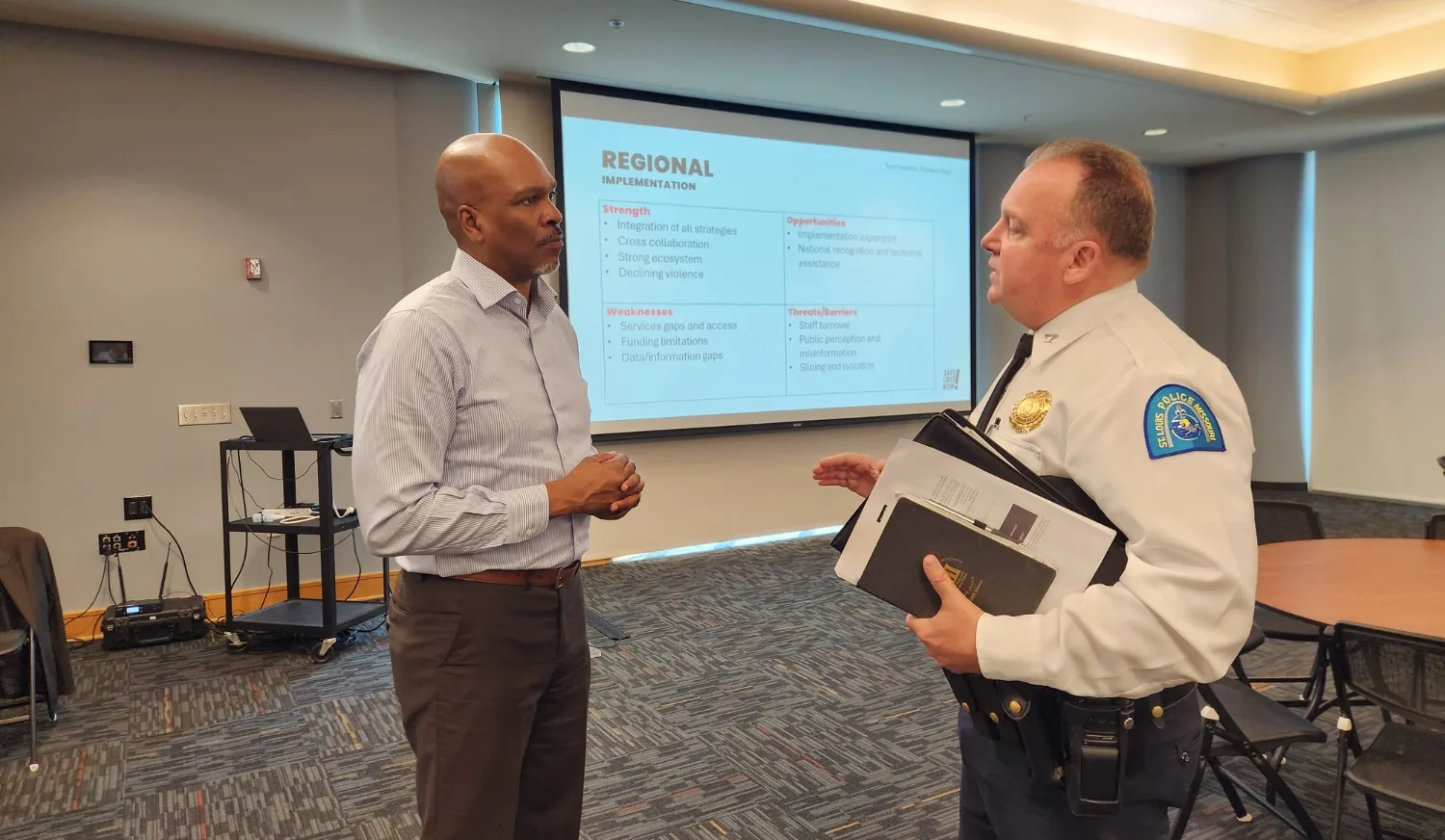
And certainly, at yesterday’s meeting, held on the campus of the University of Missouri–St. Louis, several attendees said they wished Save Lives Now! were further along than it was. But both Spencer and SLMPD Commissioner Robert Tracy voiced support for the effort, while officials from the Page administration beat the drum for the council to come through with its funding.
In the background, crime continues to drop in St. Louis. According to data released at the meeting, over the last three years, homicides have gone down 26 percent in both the city and county and 37 percent in East St. Louis. Non-fatal shootings are down 29 percent in the city, 44 percent in the county, and 49 percent in East St. Louis.
It’s still unclear how much Save Lives Now! contributed to these trends, given that violent crime has been falling nationwide since the pandemic-era spike of 2020. But it’s reasonable to suspect that the three prongs of the initiative’s strategy are helping at least a little because they’re all based on research about what has worked elsewhere.
One part of the strategy is focused deterrence. It’s based on the statistical observation that the vast majority of gun violence is committed by a relatively small number of shooters in a relatively small area. The idea is to approach would-be shooters with the message: We’re here to help you, but if you won’t let us help you, we’re here to stop you. The delivery of this carrot-and-stick message is called “custom notification.” Tom Crees, the county’s director of violence reduction, reported Wednesday that he and a colleague have attempted 14 of those, and 8 were successful. In the city, meanwhile, custom notifications are expected to launch by the end of October, said Brandon Sterling, director of Save Lives Now!
Another prong of the initiative’s strategy is street outreach, also known as violence interruption, wherein trusted messengers talk to friends and family of gun violence victims to prevent a revenge cycle from spinning out. A preliminary systematic review recently concluded that this kind of intervention appreciably reduces non-fatal shootings. That finding comes from the Violence Reduction Center, whose director, University of Maryland professor Thomas Abt, wrote the influential book Bleeding Out and has helped guide Save Lives Now! in St. Louis as an unpaid consultant since its inception. A slide presentation Wednesday showed that so far this year, street outreach providers—Show-Me Peace and Safe Streets Safe Neighborhoods—have done about 100 mediations in a handful of neighborhoods and hospitals, primarily in the city, and de-escalated about a third of them.
The third prong of the Save Lives Now! strategy is the diffusion of cognitive behavioral theory, which (in this context) holds that violence is caused by faulty thought patterns that can be broken. “Few interventions match CBT’s reliability and versatility,” Abt wrote in Bleeding Out. “Simply put, CBT works.” In St. Louis, thanks to Save Lives Now!, scores of street outreachers have been trained in this theory and a few dozen law enforcers have been, too, according to material disseminated at the meeting. The nonprofit provider for that training, Roca, will continue training people in St. Louis for another year, Sterling said.
The funding picture for all this is mixed. In St. Louis County, a lot is riding on whether the presumptive county-executive-to-be, Jake Zimmerman, makes it a priority and the council finds a way to “yes.” (The money would go toward street outreach there, Crees said.) In the city, meanwhile, the pandemic-stimulus funds used previously are running out, but Spencer said that she and her fellow officials have decided to direct some general revenue toward Save Lives Now. Regionwide, a new grant of $260,000 from the St. Louis Mental Health Board will help the initiative further CBT training and feed into a “flex fund” that will help connect high-risk individuals with support like therapy and relocation.
Multiple attendees used the word “silos” to lament the way in which St. Louis, despite this regional effort, was nevertheless still trying to tackle violence without coordination.
Sterling reminded those gathered that other metros have gone through this same messy process. “It’s not as simple as just choosing a strategy,” he said. “It’s about building the right partnerships, developing ways to get things done when work isn’t easy.” But he said that Save Lives Now! is entering into a new phase. For example, the city is on the cusp of being the first jurisdiction to be implementing all three prongs of the strategy. “It should not be understated the complexity and the amount of effort it takes us to get to that point,” he said. “This is hard work.”