Game time is over for gas station gamblers and the companies that profit off of them—even if few seem to realize it just yet.
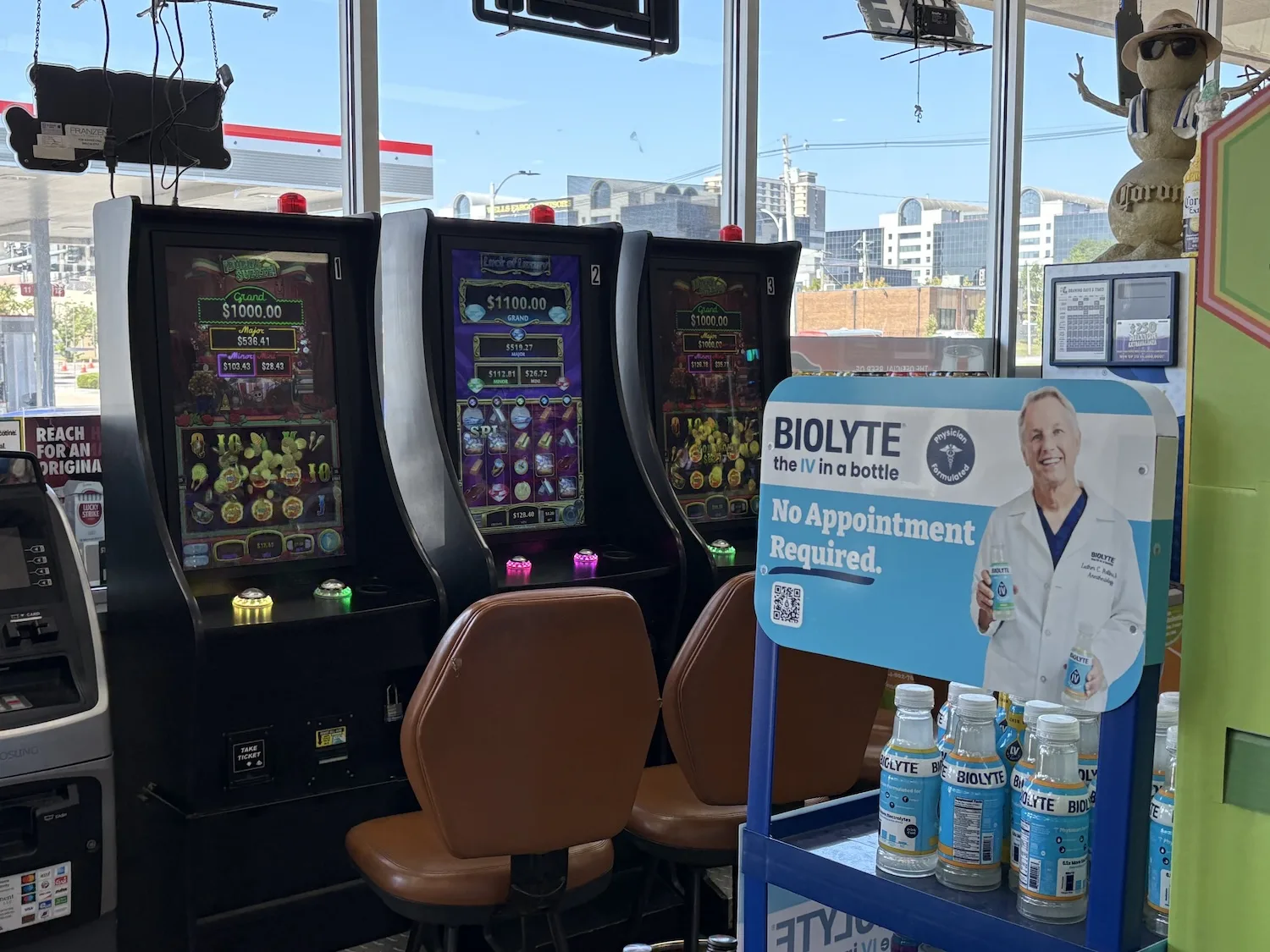
On Friday, a federal judge in St. Louis ruled that “no chance” slot machine-style games are indeed gambling devices and illegal anywhere other than in casinos. The machines have proliferated in recent years, becoming a common sight at gas stations and convenience stores across Missouri.
Get a fresh take on the day’s top news
Subscribe to the St. Louis Daily newsletter for a smart, succinct guide to local news from award-winning journalists Sarah Fenske and Ryan Krull.
But U.S. District Court Judge John Ross’s order appears to have gone little noticed by those most directly affected by it. SLM swung by a South City gas station yesterday where two men were trying their luck. Both seemed unconcerned by the news of the machines being declared illegal. One gamer shrugged and said he was just killing time before work and wouldn’t mind if the machines were removed. A clerk behind the counter said she might have read something about the court order on Facebook, but didn’t know any specifics for the three machines at her station. Majed Abusaid was likewise not particularly alarmed. He owns a number of Crown Mart convenience stores in the city and the county. When SLM talked to him yesterday, he said he was unaware of the court order. “I haven’t read about it yet,” he said. He indicated he was going to look into it and that if the machines needed to be removed, they would be.
St. Louis County Executive Sam Page, however, is looking to turn up the heat on county businesses housing these machines, also called video lottery terminals. He signed an executive order yesterday saying that businesses can lose their liquor license if they have a no-chance machine on their premises.
“They meet the statutory definition of gambling in Missouri,” Page said at a press conference prior to signing the executive order. He called the no-chance machines an “addictive form of gambling.”
Page’s order affects approximately the 400 businesses in unincorporated St. Louis County that have liquor licenses. He said he didn’t know how many of those had gaming machines on site. He added that the county is amending the application for a county liquor license to have applicants attest that they won’t have the gambling devices on their premises.
Ross’s order stems from a trial last October in which the maker of nongambling touch-screen games took Wildwood-based Torch Electronics to court. Torch, a politically-connected enterprise, argued at trial that the gaming machines they manufacture aren’t gambling devices, despite their apparent similarity to slot machines. A jury disagreed, hitting Torch with a $500,000 penalty. Ross stopped short of declaring the machines illegal—until Friday.
The judge’s order follows years of the machines taking advantage of a potential legal gray area—or perhaps simply flouting the law—while authorities seemed unwilling, or incapable, to shut them down. The company’s ability to long occupy a gray legal area surely wasn’t unrelated to its generous political giving. Torch gave $250,000 to a PAC associated with Governor Mike Kehoe; prior to that, the company as well as the parent company of a gas station chain hosting many of the machines cut checks worth $350,000 to PACs tied to lobbyist Steve Tilley, a longtime ally of Kehoe’s predecessor Mike Parson. Torch’s attorney at October’s trial was Todd Graves, brother of Missouri congressman Sam Graves.
Recently, state Attorney General Catherine Hanaway recently filed a lawsuit against five liquor stores and mini-marts in the Bootheel that house gaming machines. There is currently a proposal making its way through Jefferson City that would create a state-run system of video lottery terminals. KSDK reported that State Senator Jason Bean (R-Peach Orchard), who sponsored the bill, raised alarm about lobbying efforts arrayed against it, including text messages to lawmakers warning that if they vote for Bean’s bill they could wind up in the attorney general’s crosshairs as well. He compared the threats to those more often employed by organized crime.