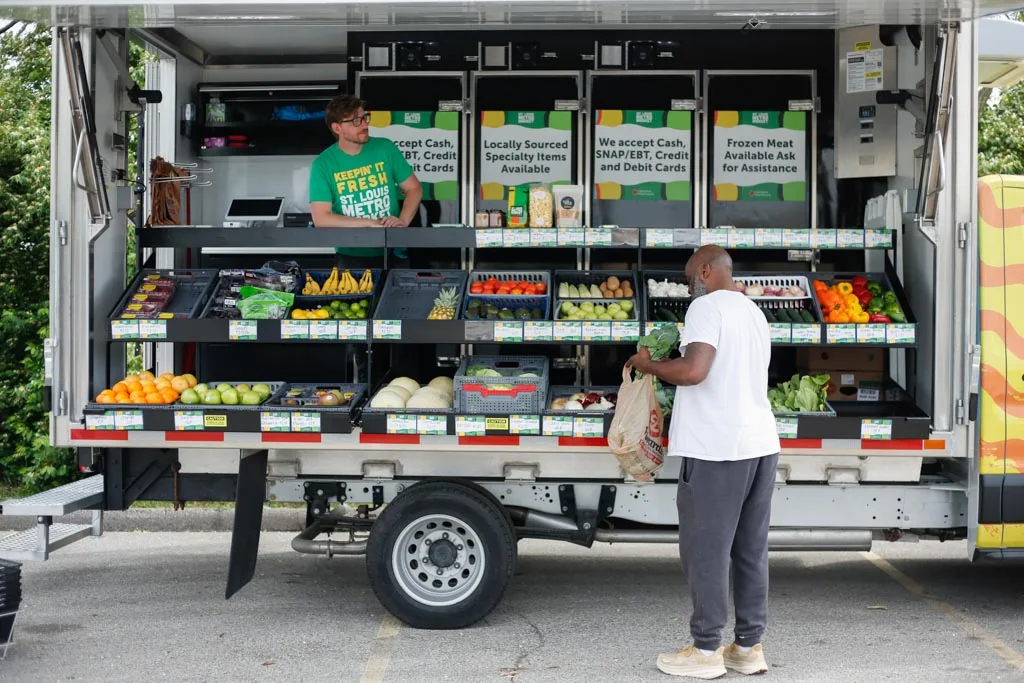
A St. Louis program bringing fresh farmers market finds to food deserts will cross a big divide this Friday: the Mississippi River. That day, Operation Food Search’s MetroMarket will make its first official stop in Illinois thanks to a new partnership with the Jackie Joyner-Kersee Food, Agriculture, Nutrition Innovation Center in East St. Louis.
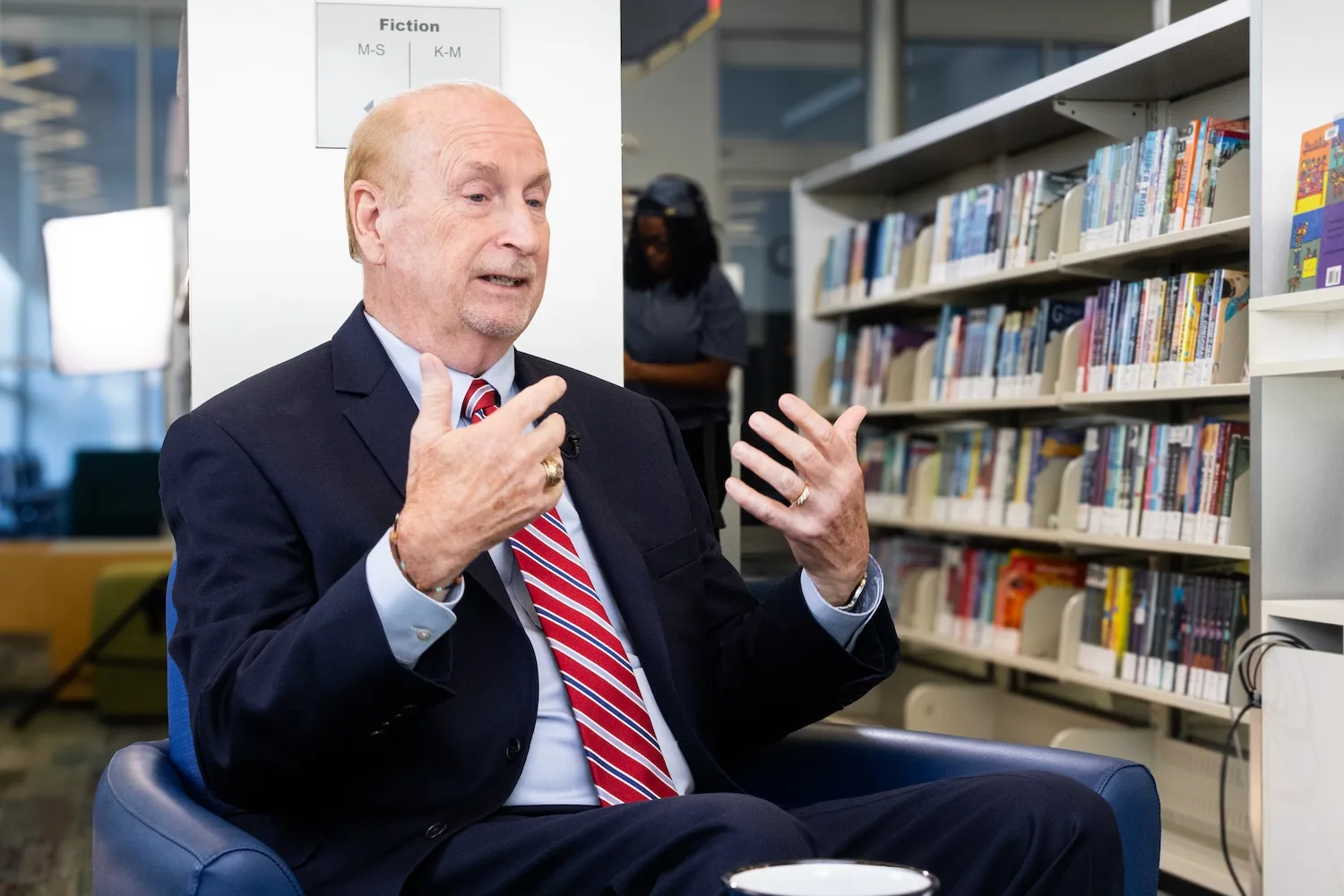
Operation Food Search COO Carlton Adams says the JJK FAN will become a regular stop for the organization’s rolling farmers markets. “When their academy gets out on Friday evening, we’ll be there from 4 to 6 p.m.,” he says. “Parents are coming to pick up kids and those types of things. And even if you’re not there to pick up kids, you can shop on the MetroMarket.”
Get a fresh take on the day’s top news
Subscribe to the St. Louis Daily newsletter for a smart, succinct guide to local news from award-winning journalists Sarah Fenske and Ryan Krull.
The project has its roots in a project by some WashU grad students. About 10 years ago, they got Bi-State Development to donate two MetroBuses on the verge of being retired. The group formed a nonprofit to retrofit those buses with refrigeration and other necessities and turn them into a sort of mobile market able to visit areas without good access to fresh produce.
But for all its good intentions, the project hit headwinds. By the time Operation Food Search acquired the nonprofit in 2021, Adams says, it had become clear that old buses had no business being used to transport food. It proved costly to retrofit the first bus (nicknamed “Elvira”), and then servicing it became an issue. Says Adams, “They are fleet vehicles that are built for fleets.” The second MetroBus never did make it into service, Elvira was officially retired, and Operation Food Search started over with small trucks built specifically for that purpose (an enterprise called Farmers’ Truck, which formed around the same time as the St. Louis-based nonprofit, is now in the farmers market truck business). Says Adams, “The bus served a great purpose. It’s a lovely program that we have updated.”
Now Operation Food Search has a series of regular stops (or markets, in their parlance) around town where its two MetroMarket trucks pull up at a regular time to sell fresh food. Prices are below cost to keep it less expensive than a traditional grocery store. SNAP cards are welcome, but so are customers who don’t qualify. “We’re not turning anyone away,” Adams says.
Adams acknowledges that he had once thought of roving options like MetroMarket as a stop-gap solution until full-service groceries would move in to serve the St. Louis region’s food deserts. But he’s now realizing they may have to be a more permanent way to approach the problem. As reporting by ProPublica has shown (using Cairo, Illinois, as an example), merely opening a grocery store in a desert doesn’t solve the problem, in part because larger chains benefit from pricing advantages that small outlets struggle to compete with—and there seems to be little appetite to enforce federal antitrust laws in a way that changes that. And as Kansas City has learned, even government subsidies aren’t enough. It poured millions into a grocery store, only to see it fail.
Says Adams, “I came into this believing that a program like MetroMarket was a bridge to when the P-and-L dynamics of not being able to function in the food deserts sorted themselves out through public-private partnerships and the like. I don’t see that anymore.” He adds, “I think that projects like this may be more a part of complex solutioning on a long-term basis than I would have thought before.”
For Operation Food Search, then, the JJK FAN stop seemed like a natural expansion. The nonprofit already has a partnership with the Danforth Center, which includes food being grown in East St. Louis by program participants. Some of that food will now be sold at the MetroMarket events.
As for MetroMarket’s Illinois debut this Friday, Adams says the emphasis is less on having a huge turnout on the first week—and more about instilling a weekly habit year-round. “We have publicized this, and so I’m sure we won’t have no traffic,” he says. “But especially since this is our first time in Illinois, how much do people know to plan to shop the MetroMarket? Day one, it could be phenomenal. It could be just a lot of folks come in to look and see, even if they aren’t planning to shop in that moment. But we are very optimistic about the long-term capabilities for a thriving partnership.”