Zack Stahr comes from a long line of St. Charles County residents. He grew up there; his parents and grandparents did, too. “Left and came back, left and came back,” he says of the generations of his family that have lived in the area.
Stahr, 27, feels like he’s been a renter “forever.” He prefers the denser part of the county, which has been booming with growth: “I’ve always said I wanna stay St. Peters or eastward.”
Get a fresh take on the day’s top news
Subscribe to the St. Louis Daily newsletter for a smart, succinct guide to local news from award-winning journalists Sarah Fenske and Ryan Krull.
But over the years, he’s watched his friends move away. St. Charles County has been getting harder for them to afford, he says.
“Most of my friends from growing up, basically, when they finally started to move out, they had to move way out,” he says. “A lot of them ended up in Imperial or Arnold, places that are just so much farther away, because those are where they could afford to rent.”
He notes that he’s also paying more than he’d like for an apartment in St. Charles’ city limits because he wants to be there, even though the building is 75 years old: It’s close to work and the area he grew up in.
St. Charles County is one of the few parts of the region that’s growing, recent Census data shows, but a chart shared by Saint Louis University professor Ness Sandoval shows that, from 2020 to 2025, the vast majority of growth came from people aged 60 or older. There are more senior citizens in St. Charles County than children under 15, he says. Stahr’s friends’ experience suggests more young people would like to live there; they just can’t afford it.
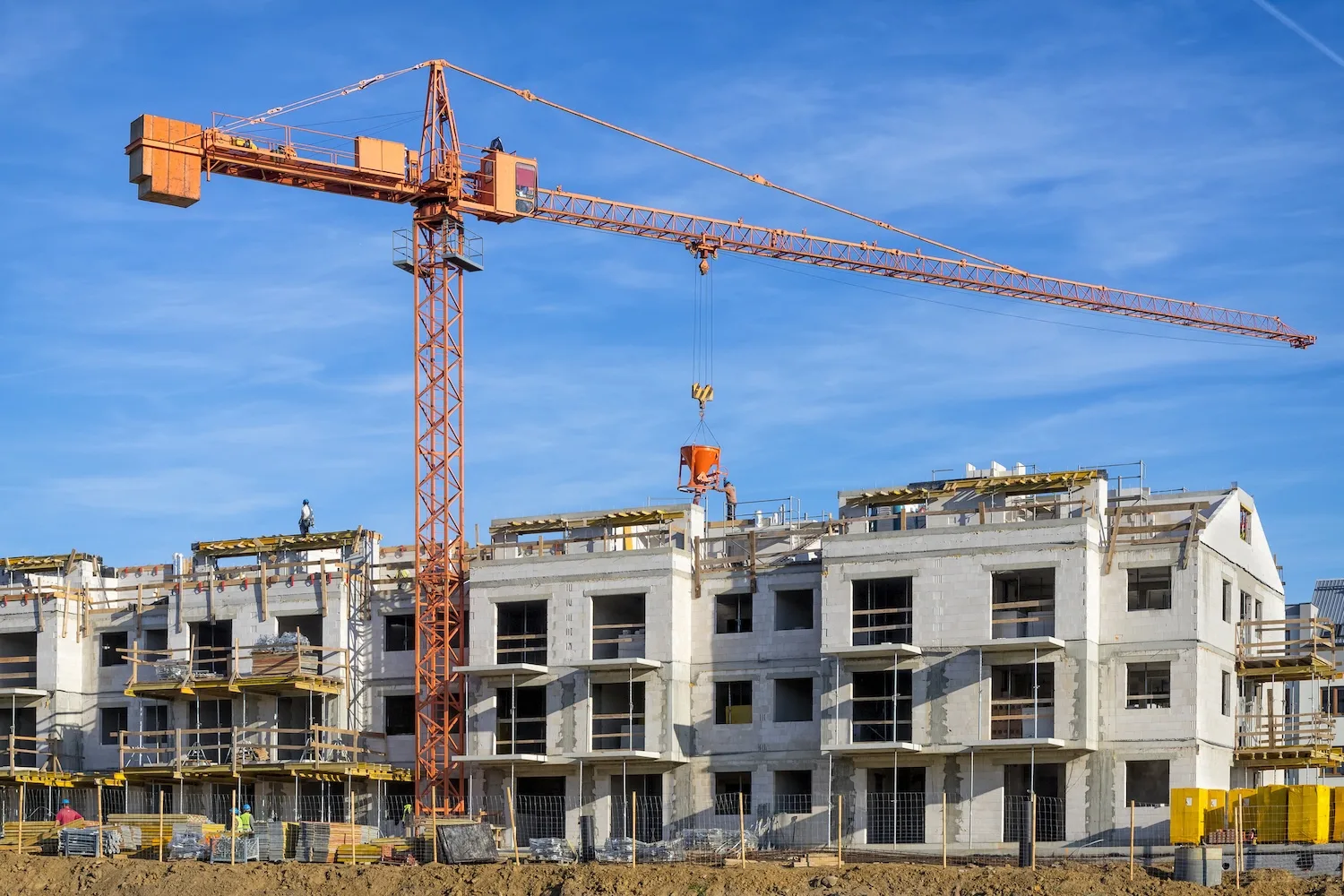
To meet the interest in living in the area—and do so affordably—density is likely the name of the game, typically multifamily dwellings or apartments. But the coming election for St. Charles County executive seems to have highlighted a unique wedge issue among voters: new apartments.
“It’s a top three issue” among voters, says the aptly named Jason Law, a lieutenant colonel with the St. Louis County Police Department, the former mayor of Lake St. Louis, and Republican candidate for St. Charles County executive. “I didn’t think it would be, but it is. … We’ve found [the top three] to be taxes, crime, and apartments.”
Some of the new developments popping up around St. Charles County are multifamily dwellings and some are new single-family homes. But most of the ire seems to be directed at apartments.
Bill Eigel, the former state senator, runner-up in the 2024 Republican gubernatorial primary, and fellow county primary candidate to Law has made apartments a key issue in his messaging. (Eigel’s campaign did not respond to multiple requests for comment.)
His social media posts stress that he’s concerned about “overdevelopment,” slamming incumbent Steve Ehlmann for supporting “MORE APARTMENTS. MORE DENSITY. MORE URBANIZATION.” The post with that text also has a seemingly AI-generated picture of Ehlmann over a dark, cloudy background, hovering above new, luxury apartments. “Is this the St. Charles County future you want?” it asks. Eigel says he wants to “protect single-family neighborhoods, stop apartment urbanization, require infrastructure before development, make developers pay the full cost of growth” and “put homeowners—not developers—first.”
But Law says he’s actually the guy who inspired the recent wave of legislation seeking to put the brakes on new apartment complexes. Proposed bans or moratoria have been introduced in Dardenne Prairie, O’Fallon, the county itself, and elsewhere. Outside of St. Charles County, Ladue is also among the cities considering moratoria on apartments or multifamily construction.
Four years ago, when he was mayor of Lake St. Louis, Law championed a moratorium on new apartment construction, an issue he credits for giving his campaign “a lot of momentum.” When he first looked into these issues, Law says, he noticed schools in Lake St. Louis were experiencing crowding and that overall infrastructure wasn’t keeping up. Residents also complain of traffic congestion.
There’s been no shortage of barbs traded between Republican hopefuls for the nomination in the race, and Eigel has attempted to use apartments as a frequent cudgel against Ehlmann. At a candidate forum in early June, the three Republicans were asked about affordability and apartments. Eigel said that, in the past 18 years, the county had seen more than 10,000 new units come online, which was “changing the dynamics” of what had been a largely suburban area. Ehlmann seemingly concurred and said the county was awash with apartments at the start of the 2020s, but noted that the number of new complexes had actually decreased in recent years. The apartments that are there aren’t affordable, he added, arguing that the county needed to focus on building new homes.
Ehlmann’s office provided SLM with a spreadsheet of new multifamily units broken down by year and municipality, which buttressed those claims. Multifamily units made up around 41 to 42 percent of the total residential units built in 2020 and 2021. In 2025, they dipped to a little short of 17 percent.
Investor interest in apartments in St. Charles County appears to be substantial. A report from the St. Louis Business Journal in late July noted that a “a 381-unit garden-style apartment complex” saw dozens of offers and sold for $70 million. Some of the consternation in St. Charles County seems to be that developers are opting for expensive luxury apartments at the expense of more affordable single-family homes. At the June candidate forum, Ehlmann himself expressed that sentiment.
“I was able to purchase my first home when I was 29 years old, and I had to wait that long because the interest rate was 18 percent,” he said. “Today, we need more homes for our kids and grandkids. We need those starter homes where people can buy something they afford and then move up. That’s how I think most of the people in St. Charles County have done it. And I just feel sorry for those kids that are stuck paying rent cause they can’t find a house that they can afford at this early stage in their careers.”
To audible cheers from the audience, Eigel was quick to reframe the problem.
“Steve, I’m glad you keep recognizing the problem, I just wish that you’d offer a solution to actually doing something,” Eigel said. “Instead of feeling sorry for young homeowners that can’t afford a home, let’s get rid of their personal property tax and take that off their bottom line.”
The two have disagreed about how the county executive could implement something like a multifamily moratorium, or a tax rebate, with Ehlmann contending the county wouldn’t be able to do either. St. Charles County can only pass zoning laws regulating the unincorporated parts of the county, meaning any apartment moratoria, like the six-month one passed in early July, do not apply to cities like St. Charles proper and O’Fallon, which govern their own zoning. Unincorporated St. Charles County—where the county government can make an impact—has always been relatively apartment-free: there’s only been one multifamily project in unincorporated St. Charles County in 19 years, Ehlmann contends.
Ehlmann stressed in a June conversation with SLM that he was particularly concerned with a threat Eigel made about enacting some of the more difficult parts of his campaign promises by “leveraging the cities” to compel them to create apartment guidelines. “You want to get them to get in line, you threaten the money,” Eigel said at the debate.
Ehlmann says that, practically speaking, this would mean threatening a long-standing county-wide program: the “Road Board.” Through sales tax money, a board of representatives administers funds for local infrastructure projects. The largely independent setup, made up of stakeholders from many of the larger cities and a rotating cast of smaller ones, has worked for decades as a function of government that can transcend political differences. As Ehlmann puts it, withholding those funds to compel cities to change their ordinances would be crossing a hitherto-uncrossed rubicon.
“Every recommendation that the Road Board has made, the county executive has adopted and sent to the county council,” Ehlmann says. “We have kept politics—and the city/county disagreements about other things—we’ve kept that out of our transportation.”
Though they quarreled at the debate about how they’d do it, and have continued to online, the Republican candidates seemed in agreement that something needs to be done about apartments. As MidRivers Newsmagazine, which helped organize the June forum, summarized it, the disagreements between the candidates were tactical, and they “largely agreed on several of the county’s most pressing issues—expressing support for lower taxes, greater scrutiny of data center proposals, and a slower pace of multifamily housing development.”
Some places have become a flashpoint for the apartment debate, like Highway N in the unincorporated part of St. Charles County. A draft study of future road improvements, paid for by the East-West Gateway Council of Governments, set off anxiety about the possibility of a development anchored by apartments that could eventually strip the few remaining farmers of their land, the St. Louis Post-Dispatch reported in June. East-West Gateway said there were no such plans and that the draft was just designed to win transportation grants, but residents were furious about potential changes to the rapidly changing stretch of the county.
Among the few people willing to speak in favor of apartments is David Veneziano, who’s running as a Democrat for county executive. On the subject, he says, if he wasn’t married he’d “probably still be living in an apartment.”
“That was kinda my jam growing up,” he says.
Debates about apartments, and density and infrastructure concerns, are legitimate, he says. But, those arguments have been missing the forest for the trees. People want to live in St. Charles County, he says, and there need to be options for them.
“I’m not saying that the argument is completely unfounded, but it’s also not really addressing the root cause, which is, we have a lot of people who want to live here, and do they really have the means to live here at all?” he says. “It’s not just an affordability issue, but it’s also, some people just don’t want to live in a single-family home with a lawn that they have to tend to.”
Michelle Woods, executive director of Habitat for Humanity of St. Charles County, refers to the county as suffering from “missing middle housing,” a term for housing that sits between massive complexes and single-family dwellings, including duplexes and four-unit buildings. Those can provide a way for people to live affordably, she says.
She sees the issue less as the area being overrun with apartments, but an attitudinal one.
“I actually think it’s more to do with people wanting things to stay more as they are,” Woods says. “They want the suburban feel to where they live. I think they’re worried that an apartment is going to change that in some way, and I don’t believe it would, or does at all. … We have great apartment communities that have no more issues than any neighborhood with detached homes.”
Woods’ nonprofit has steadily built homes for St. Charles County residents since the late 1990s and just dedicated its 100th in June, Woods says. They’ve mostly done single-family ones, with the occasional duplex. Especially since the COVID-19 pandemic, they’ve been hearing about the increased need for affordable housing in St. Charles County, which has seen the number of homeless people double from last year to this one.
Of the vitriol towards apartments, she says, “It really does make it sound like we don’t want people who don’t make enough money, and I sincerely hope that is not the desire.”
It’s clear one factor driving the discussion is an affection for how things are in St. Charles County. Some cite its proximity to major roadways and thoroughfares a plus, others its ecological diversity, suburban identity, or neighborly appeal. Some even say the traffic isn’t so bad.
Andrew, a St. Charles County resident since 2020, who asked to be identified only by his first name, says the commute he used to make from the county to Scott Air Force Base is a fraction of the time of his earlier commute in Washington, D.C. His 50-mile trip from St. Charles County to the Metro East took less than an hour, instead of the three hours it took to traverse a much shorter distance in the nation’s capitol. “They really do a great job of being able to manage regional growth,” he says of St. Charles County and the overall region.
“If you’re used to the roads being empty at 7 a.m., and all of a sudden you have to sit and wait for two cycles to get through a light, that can be frustrating,” Andrew continues. “But, yeah, I personally find it very, very well managed, and it doesn’t concern me, even during rush hour.”
Still, he’s noticed more rental and apartment units coming online, when there should be more starter homes that could create more “owners” invested in the area. Andrew is one of them. “I’m absolutely putting down roots here,” he says. “I love that it’s central. [It’s] 20 minutes to the airport, so if I ever do want to go visit somebody, or see something, it’s not a problem.”
The primary election takes place on Tuesday, August 4, and while that may bring an end to some of the more outspoken anti-apartment rhetoric, it won’t be an end to the issue for locals. Veneziano, for one, believes how the county handles this issue could shape its future.
“Our growth is like a water faucet: you can turn it off, but it may not be very easy to turn it back on,” Veneziano warns. “So, a moratorium to address this in the future and just take some time to really get a master plan up and running, I’m not so hard against. But, we start having a permanent ban, it gets a little bit troublesome for me. … It may not be something that turns back on.”
As for Stahr, who still loves where he grew up, he notes that even the new apartment buildings that crop up in St. Charles County—many of them “luxury” ones—are qualitatively different from urban apartments. These prioritize cars, and can feel more isolated than what you’d get in a dense metropole. That restricts people, in lieu of a robust public transit system, to their cars.
“You’re in a parking lot island,” he says. “All these suburban apartments are just in a sea of parking lots, and you have to drive to get in and out.”
Bigger picture, he isn’t holding his breath for any major progress in the way St. Charles County thinks about renters and transit users.
“I don’t see a ton of change happening anytime soon,” he says. “I’d like to be proven wrong, but I would really hope that, someday, they start investing again in the people who need the help getting to and from areas.”