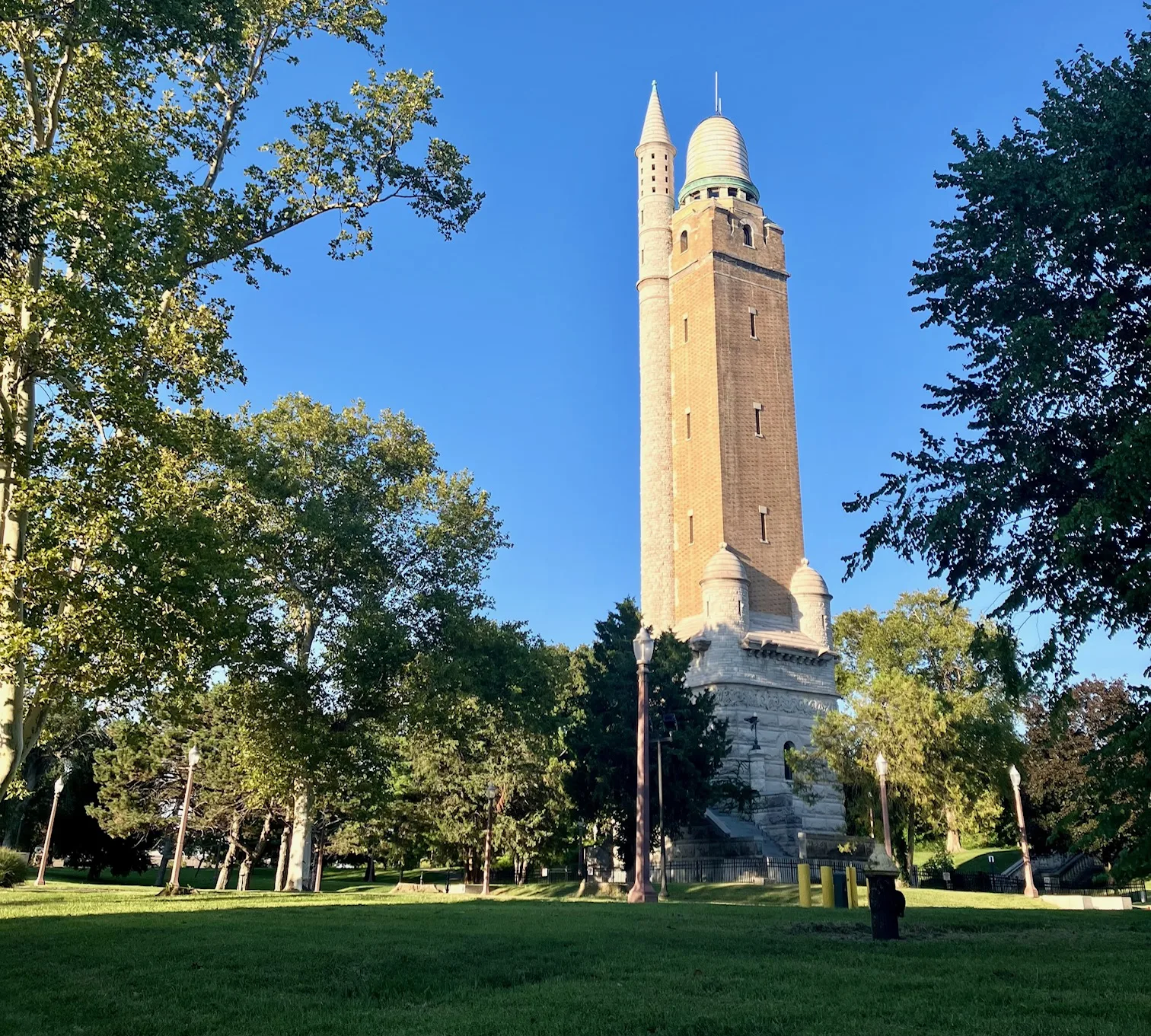
For decades, the reward for climbing the Compton Hill Water Tower’s 198 steps was one of the best views in St. Louis. Standing at a high point near the corner of Grand and Russell, the 179-foot Romanesque tower offered visitors sweeping views of the city below.
But those views have been off limits for years due to deteriorating masonry and falling debris. Restoring access is expected to take years of fundraising, millions of dollars, and significant restoration work. The longer repairs are delayed, the more dire the outlook.
Get a fresh take on the day’s top news
Subscribe to the St. Louis Daily newsletter for a smart, succinct guide to local news from award-winning journalists Sarah Fenske and Ryan Krull.
The Water Tower & Park Preservation Society is preparing for what it expects to be a three-year effort to raise approximately $8 million to restore the 128-year-old local landmark. The group will host a town hall on Tuesday at 6:30 p.m. at Power Creative (3221 Oak Hill) to outline the structure’s worsening condition and its effort to save it.
Keith Wolkoff, a board member with the Water Tower & Park Preservation Society, says multiple structural analyses in recent decades have made two things clear: The tower’s condition is getting worse, and the problems are accelerating. If action isn’t taken soon, the cost of saving the structure could eventually become too great.
“Raising $8 million is going to be a tough lift,” Wolkoff says. “I think everybody wants to see it done, and that’s awesome. We’ve had some initial commitment of interest—maybe not dollars yet. But you start putting other numbers behind that with what’s happening every year, and at some point, you just say it can’t be done and the tower comes down. I’d hate to lose that. It’s a beautiful piece of architecture that can easily be saved just by having the right people lean into it.”
One of only seven surviving standpipe towers in the country, the Compton Hill Water Tower was completed in 1898 at a cost of roughly $48,000. Although the tower itself was decommissioned in 1929, the city still owns it and the surrounding park. Within the past two years, the City of St. Louis Water Division has commissioned multiple inspections of the building, including a drone survey that captured hundreds of high-resolution images to see where masonry is coming undone. In August 2025, a more hands-on inspection revealed several problems.
Wolkoff says the assessment showed vertical cracking in the tower’s façade, which may actually stem from a defect dating to the original construction. The cracks provide an opening for water, and during the city’s frequent wintertime freeze-thaw cycles, moisture seeps into the structure, freezes, and expands, damaging the tower’s masonry. Repairs made in the late 1990s may also be to blame. Not only have some of the nearly 30-year-old fixes reached the end of their useful life, but Wolkoff says some of the materials used for those repairs may not have been appropriate for the historic structure.
The tower has been closed to visitors since the pandemic, with deteriorating masonry and falling debris preventing it from reopening. A fence was eventually installed around the building to keep curious visitors safe. The threat of falling pieces of the façade, however, is merely one of many concerns.
“It continues to deteriorate every winter,” Wolkoff says. “It’s literally tearing itself apart over time. Unfortunately, it’s accelerating with every cycle.”
Before any larger restoration effort can get underway, the preservation group faces a more immediate fundraising challenge. They need approximately $500,000 for preconstruction expenses, such as grant writing and fundraising assistance, as well as a detailed set of construction documents that could allow the project to move toward soliciting bids.
The Water Tower & Park Preservation Society aims to raise the necessary funding through a mix of donations, philanthropic support, and public funding. But exactly how much the city might contribute is not yet clear. Niraj Patel, St. Louis’ Director of Public Utilities, says the city is committed to supporting a restoration effort and is pursuing grants and partnerships, but has not yet identified or appropriated funding. Although the Water Division’s financial situation has somewhat improved following a recent rate increase, Patel says, the department’s infrastructure needs still far exceed its resources.
“They obviously recognize it as a need, and are quick to say there are many competing needs, which is absolutely true,” Wolkoff says. “That’s why the [Water Tower & Park Preservation Society] has to make a compelling argument and unite neighbors, corporate philanthropy, and public support. And that’s not neighborhood support. That’s St. Louis support to elevate it on the priority list so that those conversations can go beyond Yes, it’s important to Yes, this is how we can get it done.”
For now, the group hopes Tuesday’s town hall in Tower Grove South will bring more St. Louisans into the effort. In addition to sharing details of the assessment’s findings and outlining possible restoration plans, board members are hoping to use the meeting to recruit volunteers with experience in fundraising, grant writing, design, and construction.
Finding the right people—and money sources—might just one day give St. Louisans the chance to climb those 198 steps again.