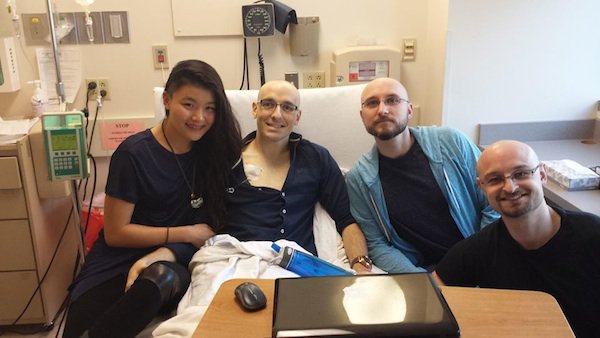
Sam Coster was recovering from his first round of chemotherapy when decided to build the video game that would keep him alive.
A few years earlier, Coster had convinced his brother Seth to drop out of law school, move to St. Louis, and join him in building video games full-time. But things were different now. In October 2013, two weeks of biopsies, tests, scans, and more tests revealed that Non-Hodgkins Lymphoma was consuming Coster’s body.
Your guide to a healthier, happier you
Sign up for the St. Louis Wellness newsletter and get practical tips for a balanced, healthy life in St. Louis.
“It was in my spleen, my liver, my bones, just everywhere,” Coster, 25, tells SLM.
Coster, a Washington University alum now living in University City, and his brother were supposed to be working on a new game called Slothcycling, where rabbits ride sloths like motorcycles across a lava flow, but his diagnosis had changed how Coster saw the game. Instead of a straight-forward racer, he imagined building a “wild world, full of interaction and absurdity,” a world he could escape to when his bone pain and nausea became too much.
So Coster looked at his brother and said matter-of-factly, “Seth, I don’t want Slothcycling to be the last game I make before I die.”
And it won’t be. Instead, Coster and his brothers, Seth and Adam, are teaming up to build Crashlands, one of the most anticipated games of 2015 and, as Coster describes it, “the game that kept me alive.”
At first glance, Crashlands—an epic, two-dimensional, action-role playing and crafting game—seems delightfully and purposefully silly.
Players take the role of an interstellar delivery woman named Flux who crash-lands on a planet full of absurdly nightmarish animals on her way to deliver a package. To survive, Flux must explore the world and build herself a shelter and weapons while discovering a race of pretentious bubble owls, a healing hot dog made of larvae, green-glowing glutterflies, and more along the way.
Coster calls Crashlands his refuge, his catharsis, and “the biggest ‘f–k you’ to cancer we can muster.” In a blog post on the video game news site TouchArcade, Coster says he and his brothers have built a game that “stands as my family’s translation of adversity into something that will spin joy for thousands of people for thousands of hours…and soon, you’ll get to play it.”
Coster describes Crashlands as a refuge from his disease, but really, every detail of the game is a reminder—of going to or coming home from the hospital, of chemo, of transplants, of living through pain and nausea. Even the game’s villain Q, Flux’s megalomaniacal boss who pops up every few minutes just to mess everything up, reminds Coster of the cancer that keeps interrupting his life.
“For me, each one of those pieces of [the game] has this little, tiny story attached to it,” Coster says. “When I play it in the future, I’ll know each one of those things was a great personal touchstone for me.”
The Coster brothers still aren’t sure how players will win their game, which is scheduled to be released this spring or summer. Will Flux build a new spaceship and escape the planet? Will she battle Q and defeat him? Who knows.
They’re also not sure how Coster’s latest treatments will work. Coster is completing more chemotherapy, radiation therapy, and two stem-cell transplants after the first round failed to get rid of the cancer. The treatments are scheduled through September, and Coster plans to marry his fiancee a year later, in October 2016.
But no matter how it all ends, Coster and his brothers are building the world of Crashlands together as a place where they and other video-game fans can find refuge from the hardships of life.
“It’s been a very good thing to build, as far as providing shelter for myself and my family,” Coster says. “[Video games] have a powerful way of making you forget all the other stuff going on.
“People need something to escape to sometimes.”