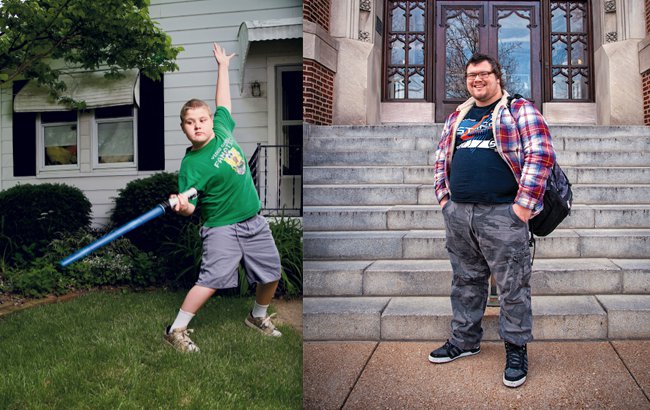
Hello, I hope this email finds you well. I write you this email because on this day, May 5th, eight years ago an article came out in STL magazine called “Worlds Apart.” It was about Autism, and two specific case studies of children with Autism in the STL area. Now, I’m sure you’re wondering why I’m emailing you on this subject. Well, it’s because I was one of those two case studies. I was the “10-year-old boy with a formidable mind and flash-fire temper.” Anyway, I send you this email because of a specific line in your article. “But I can’t help wondering what will happen when he’s older.” It’s been eight years and I’m planning to attend Webster University in the Fall…
That first interview with Tanner Craft is as vivid as yesterday, because it had been maddening from the start. He was as self-absorbed and intractable as some wildly eccentric, reclusive celebrity, impatient with questions, his mood kaleidoscoping from delight to fury to intense concentration to a cackling glee. All he wanted to do was play his damn video game. For a solid hour, I hunched forward on a low chair next to him while he kept up a running narration: “It’s a goo thrower. A goo thrower. Why am I repeating it?… I call it a blowy tunnel… The ghost gets blown up. Happily blowy after…”
Discover fun things to do with the family
Subscribe to the St. Louis Family newsletter for family-friendly things to do and news for local parents, sent every Monday.
I tried every trick that day—matching enthusiasm, commiseration, flattery—but I couldn’t find a way to move us beyond the game. I had no idea what was happening inside this kid’s head. I couldn’t connect with his intense, zigzagging emotions; I couldn’t unlock the door between us. Was this how it felt for him?
The following week, we spent a day at his school. Tanya Craft had insisted that her son be mainstreamed, and there were just a few accommodations—he had an “office,” for example, where he could regain composure.
That day was better, because I could just watch while he interacted with the other kids. And interact he did—with a goofy charm leading the girls in a dance routine on the playground and an explosion of frustration over a minor change in the day’s schedule. By nature, he was an affectionate and happy child, but he needed a routine that ran like Mussolini’s trains, and any variation could set him off.
Eight years later, he sounds like a completely different kid. I dig up the story and, with a flutter of nerves, try to reread it from his point of view. Why did it never occur to me that the imperious young gamemaster would grow up and read, with hurt or shame or fury, what I’d written? At 10, he was living in a world all his own.
Now here he is, entering mine.
We meet at a café in Kirkwood the week after Tanner’s high school graduation. I select a quiet table, remembering how much noise bothered him. Soon a tall, bearish young man with an engaging smile walks in. Wavy brown hair, a stubbly beard, glasses, a Star Wars T-shirt. I feel that little jolt of passing time that other people’s children provide: Oh my, he’s all grown up!
We start with small talk, and he’s far more adroit at it than I’ve ever been, funny and quick, conversant in politics, psychology, pop culture. It’s tempting to just keep going; he’s insightful, thoughtful, polite. Finally, steeling myself, I bring up the article. Did anything in it trouble him?
So much could have. Tanya had wearily described his daily meltdowns; she told me he never got invited to birthday parties and had asked her why not; she said a gentle-voiced custodian sat with him at lunch so he wouldn’t have to eat alone. I’d quoted a psychiatrist saying, “There is no more profound mental disorder than autism.” And I’d listed characteristics often found in children on the autism spectrum: “problems paying attention, communicating, interacting socially, interpreting and considering others’ feelings, modulating their own feelings. They insist on sameness, relate better to objects than people, can be both physically and emotionally awkward, crave some repetitive sensations but can easily feel barraged by noise, bright or flickering lights, even human touch.”
I wait, holding my breath.
Tanner just shrugs. “It seemed balanced.”
All he remembers about the day “the newspaper lady” came to interview him is which computer game he was playing: “Nick Tunes United.” But he definitely remembers me coming to his school.
“Those girls adored you,” I say.
“Yeah, that was the case. That didn’t happen as much when I got older.” It’s perfect dry sarcasm. “I don’t dance, really, anymore,” he continues. “As I grew older, I realized my moves were…janky, I think that’s a word. I would dance to the music because my social skills weren’t as developed as they are now; that was a way I could connect to people.”
“So you did want to connect?”
“I did. I always wanted to connect to people.” A wry smile. “There goes another myth about autism. Even children who are nonverbal want connection. Their brain is functioning fine; it’s just the output, I guess, that’s broken.”
He still struggles with social situations: If somebody deadpans, voice flat, he has to ask, “Was that sarcastic?” He also has to remind himself to communicate with his mom about what he’s doing: “I’ll forget she doesn’t know what I know. I forget that other people have a point of view other than mine.”
Just being able to articulate that puts him ahead of a lot of folks, I remark. “How did you get so far so fast?”
“Middle school was much, much more—they didn’t really take crap from me, when it came to my meltdowns. They were just like, ‘Yo. You need to calm down.’ And over time, that worked. In sixth grade I had maybe 10 meltdowns. Seventh grade, probably one. And none—at school—since.”
Should the grade-school teachers have been tougher on him? He doesn’t want to criticize. “To be fair, they were always experimenting. They would usually put someone in a special classroom setting, and my mom was insistent that I be put in a regular classroom.”
He’s fervently glad she was; separating children with disabilities, in his opinion, “borders on segregation.”
Even in a traditional classroom, he sometimes felt left out. “I think it’s because for as long as I can remember, I’ve known I had autism. I hated it a lot at first. There were times I’d be crying—why am I like this?”
“What did ‘like this’ mean to you then?”
He takes a spoonful of soup and holds it in midair, thinking. “All I knew was different. I didn’t know why. They still don’t—all they know is that there are more and more of us. But I don’t think it’s ‘an epidemic,’ as the leader of Autism Speaks describes it. I have my differences with that organization anyway.”
“Such as?”
“I don’t think a cure for autism is possible. I think they put too much money into researching it and less into helping people who are ‘less functioning’ than me.” He grimaces. “I hate that term, but I don’t know how else to put it.”
Tanner doesn’t even like the word “cure,” because it implies there’s something wrong. People with autism are different, he says, but there are strengths to that difference, too. “I like to think I think like a computer. There’s more clarity. And I always start out thinking outside the box.”
“Because you’re not worried about what other people will think?”
“That may have something to do with it, because I don’t get embarrassed. I literally do not give two cares about what other people think of me. I’m able to take a risk because I’m not worried about being judged for it.” He meets my eyes. “It’s a perspective I think shouldn’t be eliminated.”
What should be eliminated, he adds briskly, is the assumption that people with autism are “slow.” “That’s something that upsets me, because I’m a smart person.”
What helped Tanner become more social, he says, was interacting—in the video game world—with a boy in Wisconsin whose autism was worse than his own. Also, “back in sixth and seventh grade, I was much more introverted, because I was afraid that I might outburst, and I was afraid people wouldn’t like me. But there was this YouTuber I found, chuggaaconroy. He was like me, very happy, overly enthusiastic. He actually had amazing charisma, which I think I’ve developed now. And he had hundreds of thousands of followers. I thought, ‘If people love him, who’s to say they won’t like me?’ So in eighth grade I explored talking to people. The only D+ I ever got was in art that year. Talking was like a new skill, a new power, and I kept using it, and I never got anything done!”
He’d like to see iPads given to every child who’s having trouble communicating. “Or an Android tablet, which is cheaper,” he adds quickly. “A kid with autism has trouble talking but can type just fine. A touch screen is less rigid; it feels more comfortable. There’s a company that can analyze a person’s face and try to read the emotion. Used as a camera, a tablet could help so much to read people’s faces. Something like Google Glass, even though that technology failed miserably.”
Tanner still gets frustrated, but now it’s a momentary irritation instead of a volcanic eruption. He hates it, for example, when he’s Skyping with his girlfriend and the audio stops working. “‘I can’t hear you anymore’—it’s those words. They make me so angry.”
“Like there’s a wall between the two of you?”
He nods, then says “wall” reminds him of Pink Floyd’s album, one of his dad’s favorites. His brain still makes rapid-fire associations, but now they don’t derail him.
“So what’s your girlfriend like?” I ask.
“She’s 17. She’s a year behind me in school. She’s really nice, kind of the quiet type.”
“How’d you meet?”
“Tumblr, my literal haven. She had been following me for quite some time.”
“Have you met her yet, in person?”
“I’m going to this summer. She’s coming to St. Louis in July.”
He already knows she’s special. “I just might marry her,” he says, then adds a quick caveat: “I’m young; I’m not sure. But I really do love her.”
Does he want kids someday?
“Three at the most. I don’t want to kill myself.”
We email back and forth over the summer, and in the fall, I visit him at Webster University. His dorm room smells like teenage boy—stinky socks and hormones, old food and the sweet, tinny scent of all those empty Pepsi cans. I count 12 in the immediate vicinity of his roommate’s elbow.
The roommate removes his headset for a shy introduction, then fixes his gaze on his computer screen again. Behind a closed door I hear loud laughter and yelling.
“Why are our suitemates screaming in the bathroom?” Tanner asks rhetorically.
“The noise doesn’t bother you?”
“Nah. It’s just funny.”
We head toward the lounge for his roommate’s sake, so we don’t “just keep talking newspapery stuff in his ear,” Tanner says. On the way, he points to a door: “These are cool people. They’re on the baseball team.” He points again. “Those two are not cool. They are always drinking. That is their choice. But once I walked into the hall and I smelled the distinct smell of burning herbs. It’s like someone burnt a bunch of marshmallows. It’s weird, and I don’t like it.”
When the two cool baseball players emerge from their room, Tanner introduces me. “He’s very good at video games,” Kyler Kent says of Tanner. “He’s killed me. There’s no correlation between playing sports and being good at video games!”
We approach another door. “Luke and Joe, these are two of the friends I’m closest to,” Tanner says, banging on the door. “Hey, you losers, are you home?” They are, and together the three tell me the story of Luke’s nickname, bestowed by Tanner on their first night in the dorms. “Joe had left to go dance among the people,” he says dryly, “and I was doing my old-woman comic routine…” He points to a chair: “That’s my designated chair in this room. I farted in the other one and they said I could never sit there again.”
“You can never sit in my chair,” Joe reiterates, making it a solemn pronouncement.
“You guys are going to be famous now,” Tanner tells them as we leave. “You are going to be St. Louis–famous, which means very little.”
When we’re seated in the deserted lounge, I ask if he met his girlfriend in July as planned.
“Oh, I did meet her! Yes, it was awesome! I have photos!” Actually, she has photos—he doesn’t have his organized—so he texts and asks her to send them. He’s apparently done this more than once, because she replies, “OMG, Tan, just save them in an album or something.” But she sends them promptly.
I swipe through. He’s kissing her cheek in one, they’re hugging in another; they look adorable together. “Was she what you thought she’d be?”
“Ab-so-lutely. I still care about her. I still love her. So—” He gives me the thumbs-up sign.
“She’s cute,” I say.
“Yes, I know, right?”
His phone rings; someone from Career Planning & Development. He looks puzzled but answers her questions with old-world courtesy. “My semester is going fine,” he says. “Yes, that is correct, I’m a first-year student. Yes, ma’am, I am in West Hall… Very nicely. It’s much cozier than I expected.” I can’t help smiling—earlier he told me he couldn’t believe how small the rooms were. Tanner has perfected the art of diplomacy. “I actually like my roommate,” he adds, “which I was afraid I might not.”
I lean closer to hear her questions. Has he had a chance to get involved? “Yes, I have. I have participated in the Chain Link Improv Club.” Any challenges she can help with? “Um…that you specifically can help with? No. It’s a much heavier workload than high school, but I’ve been adjusting fine so far.” He walks to the window to watch the train, which was stalled, begin chugging past. “Yes, I’ve heard about the numerous resources available to me, which is very nice to know about.”
He says goodbye, and I take up the questioning: “Other than the workload, what’s hard?”
“Motivation to get started on the workload! I have a five-page essay due on Wednesday. But it’s literally just talking about myself, and I know quite a bit about myself, so”— he’s slipped into a Southern drawl—“I reckon I will be fine doin’ that paper.”
“What’s different on a college campus?”
“Everyone’s liberal! Everybody’s liberal. Where are all the people supporting the tangerine with the toupee?”
Over the summer, I wondered if the noise and stimulation of a freshman dorm would be too much for someone on the autism spectrum; if Tanner wouldn’t be flexible enough to adjust to a variable college schedule; if he’d be homesick.
All needless worries.
“I am forced to go home every Sunday for dinner,” he says with a grin. “It’s not necessarily that I don’t want to, but once I get used to living at a place, I don’t like leaving said place.”
In 2008, I’d written, as a common characteristic of young people on the spectrum, “Their interests are narrow and intense, and there’s a fundamental disconnect that forces them into constant negotiations with the world around them.” But Webster divides incoming students into learning communities, hoping they’ll befriend each other and study together, and Tanner chose the diversity community. So in addition to his computer programming and math courses, he’s taking a Diversity in the U.S. class, Issues in LGBTQ Families, and a Black Lives Matter philosophy class. (“That’s the only one that’s particularly challenging, because I’m a white guy; I’m on the outside looking in.”)
Tuesdays he also takes Webster 101, “which was optional but highly recommended. I took it but so far I have been regretting that decision. It’s things I figured out two weeks ago.” He plans to major in computer science. “I was going to be in acting, but I didn’t get into Webster’s program.”
“Acting?” I feel suddenly nervous for him. “But if reading people’s emotions is hard…”
“Oh, I can do that now. Growing up, I’d try to understand an emotion by replicating it. I’d see my friend upset, and I’d get upset. I kind of forced myself to do that.” Years of counseling helped, too; he says he needed a mediator, a translator to explain what other people might be thinking or feeling in a given situation and show him how to recognize the clues.
“None of us are born with empathy,” he points out. “We’re all very selfish when we’re born. But we have the ability to develop it, and I think people with autism just have more trouble doing that. We have trouble reading faces, understanding emotions and, therefore, interacting with people, so we don’t get those other viewpoints as often. It’s a circle. It’s a circle that can be broken.”
Computer science is a practical choice, and he’s very, very good at it, but his real goal is “to be the youngest man ever to win the Best Actor award.” He’s already sussed out the likeliest roles: “I love Shakespeare, but I’m not good at performing it. I think I’m a born comic actor. I could be the next Adam Sandler, but an Adam Sandler that doesn’t get bad. Or, even though I said not Shakespeare, Dogberry in Much Ado About Nothing. ’Cause he’s just dimwitted, and I feel like I would nail that.”
Plan C is to be a stand-up comic, adds the young man who once had to regularly ask his parents why they were laughing. “And if that doesn’t work, maybe I’ll be a teacher. I plan on minoring in education.” He grins. “And if all else fails, I say screw it and I run for Congress.”
The Daily Show hooked him on politics, and he’s wearing his Bernie T-shirt today, loyal without hope. “I don’t like capitalism,” he explains. “It’s not inherently broken, but it just goes there. Same with communism. I think socialism would be the perfect mediator between the two.” He pauses. “I guess it’s because I’ve been the little guy, I’ve been on the bottom, and since I’ve felt like an outsider, I don’t want other people to feel that way. We need bus drivers and cleaners—why should they be paid so little?”
It’s begun to rain, and Tanner asks, brow furrowed with genuine concern, if I’ll be okay getting to my car, if I need an umbrella to stay dry. Touched by his chivalry, I assure him I’ll be fine.
Earlier, in his room, I noticed a row of pop figures standing guard above his computer. “This is called a Big Daddy from game world,” he said, pointing as he introduced each one. “Then there’s Mycroft Holmes. The BFG from Big Friendly Giant. My favorite ghostbuster from the new movie. There’s little Yoda, and you know Superman.”
In the middle was his favorite superhero of all: Spiderman.
“Peter Parker, the man behind the mask, has a kid who was kind of the outsider; he didn’t really fit in,” Tanner explained. “So it’s easy to put myself in his shoes: ‘I could be Spiderman.’ I mean, sure, I can’t climb up walls. But he kind of proves that anybody can be a hero.”