The day-old pullets travel 25 to a box from the Cackle Hatchery, snuggled close to keep each other warm. This spring, Bill Ruppert ordered Speckled Sussexes. They’ll lay brown or tinted eggs, which he’ll gather along with his broody Ameraucanas’ pale blue eggs and his Barred Rocks’ pinkish-brown ones. His Kirkwood neighbors will line up with baskets and crumpled dollar bills, eager to replace their deflated, dried-out supermarket eggs with thick whites and huge, rich yolks the color of Buddhist monks’ robes.
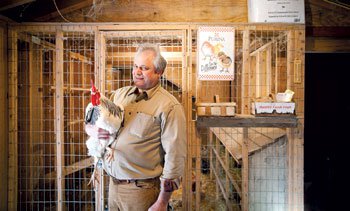
The hens lay happily; their coop is an architectural marvel. It even has the lookout tower Ruppert longed for as a boy. He planned every detail while driving around for his day job in horticultural sales. Then, in 2005, he called Donna Boxx, the architect who’d just finished extending his home, and said, “I bet you’ve never done a chicken coop before.”
Get a weekly dose of home and style inspiration
Subscribe to the St. Louis Design+Home newsletter to explore the latest stories from the local interior design, fashion, and retail scene.
Boxx slanted a screen roof over the enclosed run, so he could grow gourds—but the chickens ate them. And Ruppert started with 2- by 4-inch mesh, but a mink squeezed through and killed 24 chickens. “That was a rough day,” he says. “They don’t even eat the chicken. They just cut the head off and suck their blood.” He shudders. “Now, we’re Fort Knox.” Half-inch mesh foils the minks, and concrete floors stop bandit raccoons from tunneling in.
The cost of feed keeps going up, and Ruppert teases his rooster, Ike (above): “You do nothing to support this coop!” Still, the urban-chicken trend grows. He’s seen coops built on tractors (to move that magic manure around), in the shell of an old Volkswagen, under a trampoline, and in a chest of drawers. Sam’s Club now sells coops ready to assemble, and OK Hatchery Feed & Garden Store sells about a ton of chicken feed every week.
The Humane Society ends up with urban foodies’ impulse buys, just like it got all those Taco Bell Chihuahuas and Vietnamese potbellied pigs. But many gardeners do a great job with chickens. “People want access to their food,” says Ruppert, who’s done seminars for the Saint Louis Science Center, the eco-savvy Franciscan Sisters of Our Lady of Perpetual Help, and wistful residents of Town & Country, where chickens remain verboten. Gardener P. Allen Smith featured “the Coop de Rupe” on one of his public-TV shows, and Diane Sawyer’s ABC news team showed up during a salmonella outbreak.
But Ruppert’s blasé about media; he’s more psyched for his chicks to arrive.
He says Charlie Hoessel, former director of the Saint Louis Zoo, “mentioned the Bird & Animal Swap Meet in Monroe County,” an event held the last Sunday of every month, at the cock’s crow. “But we like watching them grow.” In just a week, all that yellow and reddish-brown fuzz will give way to feathers. He’ll watch over the youngsters like a father hen, because pecking order is real and harsh, and the grown-ups steal the chick feed. Mizzou, a black-and-gold hen high in the hierarchy, is a repeat offender. Sweet Barbie, Ruppert’s favorite, is not. She’d rather meet him at the coop’s gate for a cuddle.