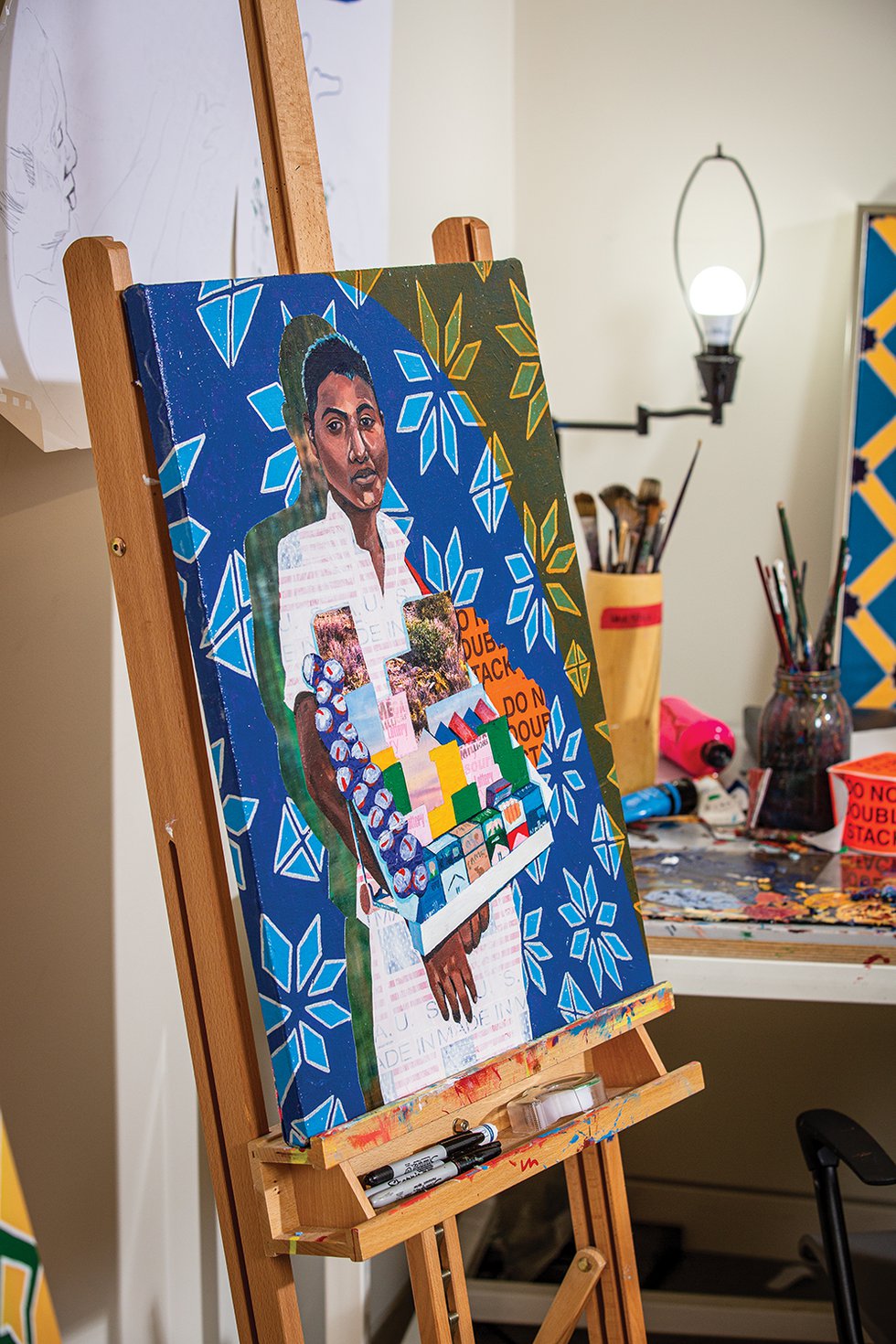
Artist Quinn Antonio Briceño’s most recent painting, La Cortadora de Café, depicts a scene from ordinary life in the mountains of Nicaragua. The artist captures a young woman, basket in hand, harvesting coffee beans for sale. In his work, Briceño employs a mix of materials, such as “Made in the USA” stickers that form the underlayer of the subject’s pale-blue jacket and the expired Missouri Lottery tickets that are shaped into a pink bandana covering her dark hair. Like much of the 28-year-old’s artwork, the painting is steeped in personal experience. It underscores the dichotomy of growing up between two cultures, which Briceño did as the American-born son of a Nicaraguan father and Irish-American mother. “La Cortadora de Café reflects the duality of my heritage both through imagery and materials,” he says. “My dad’s family used to own a coffee company. There was a small roasting plant in the back of my abuelito’s house. When I got the chance to visit my family in Nicaragua, coffee and its aroma became nostalgic to me.”
Quinn Antonio Briceño was born in 1993 in St. Louis to a Nicaraguan father and Irish-American mother. His paintings reflect the complexities of his upbringing and the challenge of straddling two cultures and feeling like an outsider in both. “Since I was little, I’ve always felt like an other,” he says. “When I lived in Nicaragua, my nickname was Chele, or Whitey. When I moved to the United States and visited Nicaragua, I became a gringo because I had lost Spanish, my mother tongue.” This loss of language, he says, rescinded his license to claim his heritage: “It’s like a loss of identity.”
Get a weekly dose of home and style inspiration
Subscribe to the St. Louis Design+Home newsletter to explore the latest stories from the local interior design, fashion, and retail scene.
Art, however, has been a constant. Briceño can’t remember a time when it wasn’t within reach in the form of visits to the Saint Louis Art Museum with his grandfather, or hours spent drawing alongside his grandmother. Briceño’s paintings explore the richness of life, and the juxtaposition of elements is a vivid exploration of his upbringing.
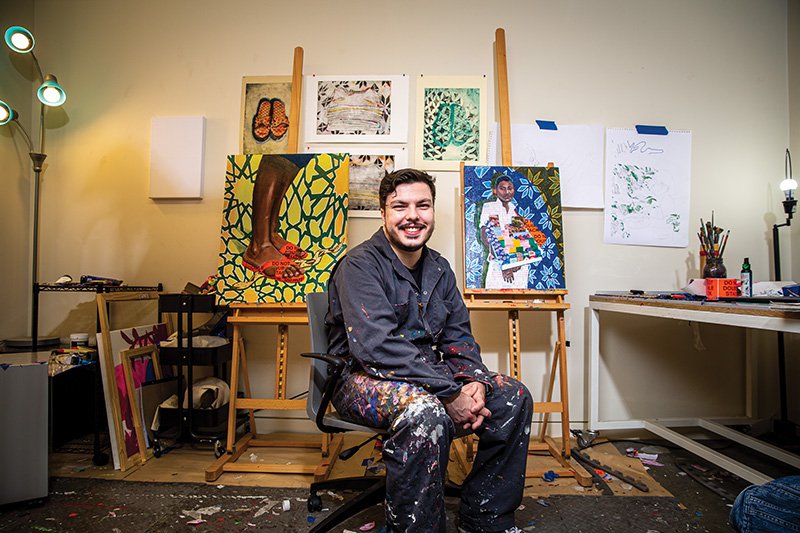
When did you start painting? I did a little painting in high school, but I loved to draw. It wasn’t until college, first at St. Louis Community College and later at the San Francisco Art Institute, that I began to paint. Now, most of my work is painting and collage.
Tell us about your use of collage. I use a lot of found material. I work in a [picture] frame warehouse. We use packing and “Do Not Double Stack” stickers. They’re eye-catching but also have this working-environment component. A lot of the materials reference Americana, like the “Made in the USA” stickers, which connect my work to my background. In Nicaragua, I’m not looked at as an American, and here I’m not seen as an American.
Do you paint over the collage? Yes, it feels more integrated that way instead of standing out. With paint on top, the “Made in the USA” stickers feel like an underlying element, like it’s my identity, but there’s also a surface on top of it.
Where did the idea of painting on bean-stained paper on top of canvas originate? I had an idea to use food-based items, and bean juice was a part of it. I found it interesting, so I went further with it and decided to use the actual bean to stain the paper. It connects to being Nicaraguan, and also goes with the whole racial epithet “beaner.”
How has your work changed over the years? When I moved back to St. Louis [from San Francisco], I was struggling with where to go with my work and how to connect to my heritage. I began painting working-class people and using tile patterns in the background that relate to the style of floors [seen throughout] Latin America. This past semester, [at the Sam Fox School of Design & Visual Arts] I’ve been playing with color. I used to be scared of color; I only used earth tones. I think a lot of that has to do with not accepting my own heritage. Growing up in the Midwest was difficult. Spanish was my first language, and I’d speak it with my mom and get looks. I eventually ended up losing most of it. I think I felt that using more muted tones was more American. As I accepted myself, I started to use brighter colors. Latin America is super bright. There are great colors everywhere: houses, fruit, everything. It’s been liberating.
Who are the subjects of your paintings? I only paint the working class. It helps give a voice to people who wouldn’t normally be talked about. If you go to any major art institution, it’s rare that you’ll see paintings of people of color or the working class. It’s important for me to do that.
Where do you get the ideas for your paintings? Family photographs, through experience, searching the Internet. When I’m in Nicaragua, I take as many pictures as I can; then I use Photoshop to manipulate them into something that I want to paint.