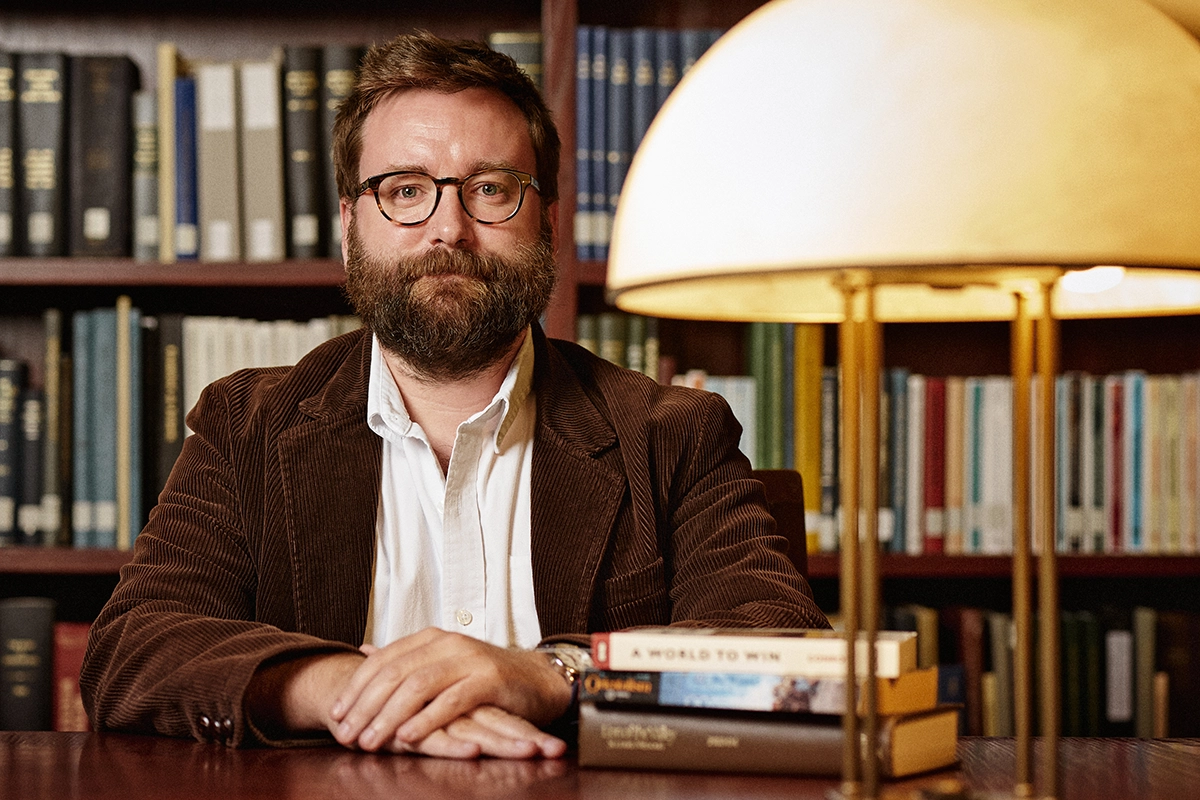
The St. Louis photographer known on Instagram as @sekondtry sees things you don’t. His eyes crave the city’s secret geometries—its lines and patterns that edge into shadow—especially during a snowfall. In the street-photography tradition of Robert Frank and Vivian Maier, he also takes candid shots of strangers: a child in a stroller, a homeless person sleeping near a vacant parking garage. Yet Sekondtry, who asked that we not print his real name, snaps many of his photos in forbidden places: inside MetroLink tunnels, on the roofs of high-rises, beneath bridges. A practitioner of urban exploration, or “urbex,” he has developed a subspecialty in shooting abandoned buildings—everything from shuttered churches and malls to schools and theaters. These structures are called “bandos” by the urbex photography community, of which Sekondtry appears to be the most prominent member in St. Louis, with 15,000 followers.
Not that he’s counting. Such metrics are irrelevant, he says. For Sekondtry, who captures his images with a Canon EOS 5D Mark IV and then uploads them, the photography is the drug. “There’s a build-up, and then a release,” he explains. “You get in, find the spot, shoot, and then when you get home and see that photo and edit that photo—it’s a fix.”
Stay up-to-date with the local arts scene
Subscribe to the weekly St. Louis Arts+Culture newsletter to discover must-attend art exhibits, performances, festivals, and more.
Sekondtry grew up in Dellwood. In 2016, after a bad breakup, he found an unused GoPro his ex-girlfriend had given him. He began exploring the city with it, both to distract himself from the pain and to keep track of his life. GoPros have wide-angle lenses; he found himself drawn to large cityscapes, he says, “to fill the frame.” Then, after some digging online, he realized that he wasn’t alone. “I felt like I was in a secret society of people doing this.”
On weekends, he began shooting photos for a nightclub to fill its social media feeds. During the week, he traveled to Chicago, New York, and elsewhere to conspire with like-minded photographers—and, while there, always sported his Cardinals hat.
“If there’s one thing that would stand out for me about [Sekondtry], it’s that he is proud to represent St. Louis photography,” says Graham Roper, known as @kilograham, a veteran urbex photographer in town. “He enjoys playing that ambassador role.”

Roper says Sekondtry’s work grabs viewers because his editing enhances shots without seeming heavy-handed. It looks more polished than, say, the work of pioneers such as Oliver Clark, (a.k.a. @stlouisfixie), one of the first urbex photographers in St. Louis to post on Instagram when it launched, in 2010.
Back then, Roper recalls, the scene was tiny. Today, he estimates, there are “hundreds” of creatives hunting for forbidden spots to shoot, with the help of vastly improved smartphone cameras. The result: saturation, and the irony that the more people try to showcase St. Louis’ obscurity, the less obscurity there is to showcase.
Without a doubt, it’s an avocation that entails risk—and some blowback. Some property owners wish that urbex photography would stop. A spokeswoman for the St. Louis Metropolitan Police Department warns that photographers like Sekondtry “could possibly face a trespassing charge.” He says the city police have never arrested and booked him for that offense, but if they did, he wouldn’t necessarily fault them for doing their job.
The worst injury he’s sustained so far while shooting, Sekondtry reports, is a foot punctured by a rusty nail. Others haven’t been so lucky. In 2018, an urbex photographer shooting inside a storm drain in Philadelphia died when swept away in a flash flood. The year before, another fell to his death from the roof of a 20-story hotel in Chicago.
“Photography in unauthorized areas along the light rail system is strictly prohibited,” says a spokesman for Metro Transit, adding that it’s “extremely dangerous.”

Though Sekondtry’s feed abounds with daredevil shots and some commissioned portraits, he prefers the solitude and silence of bandos, especially during winter. (In the summer, he notes, black mold makes it hard to breathe.) He says he enjoys feeding St. Louisans images of their own city they’ve never seen.
But why these images? Maybe it’s that, as Australian scholar Siobhan Lyons has observed, modern urban ruins offer a preview of human extinction—“an image of our own death while we are still alive.” Or maybe we’re hypnotized by their open-endedness, as another scholar, André Jansson of Sweden, has suggested: They’re neither tidied up and researched like heritage sites nor scheduled for demolition at a precise date. Rather, they’re in between and therefore “offer us a sense of freedom to explore, fantasize, and lose ourselves in alternative pasts and alternative futures.”
Certainly, Sekondtry feels protective of his favorite bandos. He’s a full-time freelancer now, and though urbex prints don’t sell as well as mainstream prints of the Arch, the locations were hard to find and capture.
Is there a “whiff of exploitation” in such photography, as some cultural observers suggest? James Griffioen, a Detroit-based photographer, has condemned some urbex photography as “ruin porn”—imagery of decay shot by photographers who ignore its root causes, seeking instead to capitalize on economic struggle to which they are themselves immune.

Art critic Richard B. Woodward, for one, dismisses that concept. Western artists have long been captivated by shattered cities, he argues, going back to the Renaissance era’s fascination with classical antiquities. The concept of ruin porn, in his view, functions as a purity test that would “do away with a sizable chunk of pictorial and written history.”
Sekondtry—who freely shares his images on Instagram—sees himself as a historical witness: one who is more interested in preserving the visual present than chasing down the written past.
“It’s like hallowed ground,” he says of the bandos. “Somebody probably made a living or supported a family or made a career in these buildings. Now they’re desolate, thrown out to the curb like trash. But I see them as a treasure. This is really the way St. Louis looks now.”
Michael Allen, a historic preservationist and senior lecturer in architecture at Washington University, says that whether Sekondtry and other urbex photographers realize it or not, their work is a reality check for the city.
“These guys are showing us that a lot of it still is crumbling,” says Allen. “They’re implicitly asking, ‘Why did this happen?’ and ‘What’s next?’”