As our country approaches its 250th birthday, the Saint Louis Art Museum is marking the occasion by inviting visitors to contemplate the complicated and changing nature of democracy and freedom through Picturing Independence, on view June 12 through January 24, 2027, in Schoenberg Gallery 236.
Curated by Andrew W. Mellon Foundation Associate Curator of American Art Amy Torbert, Picturing Independence consists of around 30 objects that interpret the history and symbolism of the United States. Torbert spent the past year narrowing down items primarily from the SLAM collection to tell a story that both celebrates the American experiment and offers moments of reflection and conversation about the ways in which it has been unsuccessful.
Stay up-to-date with the local arts scene
Subscribe to the weekly St. Louis Arts+Culture newsletter to discover must-attend art exhibits, performances, festivals, and more.
“I’d been talking to our director and chief curator about ideas for the 250th, and 18th-century American art is my area of greatest interest,” Torbert says. “Last summer, it just all came together, like, Yes, we’re gonna do this.”
The result is a compact exhibition that highlights artists from across generations all interpreting the concept of American independence, from early whispers of it in the court of King George III, to World War I, to the Bicentennial, to a contemporary meditation on music and meaning.
“The goal of the show is to explore how artists conveyed ideas about American independence across these 250 years,” Torbert says. “And then the visual vocabularies that were established in the 18th century, which is kind of where we’re starting here, how do artists keep playing with them and changing them? What symbols carry ideas of independence, both then and now?”
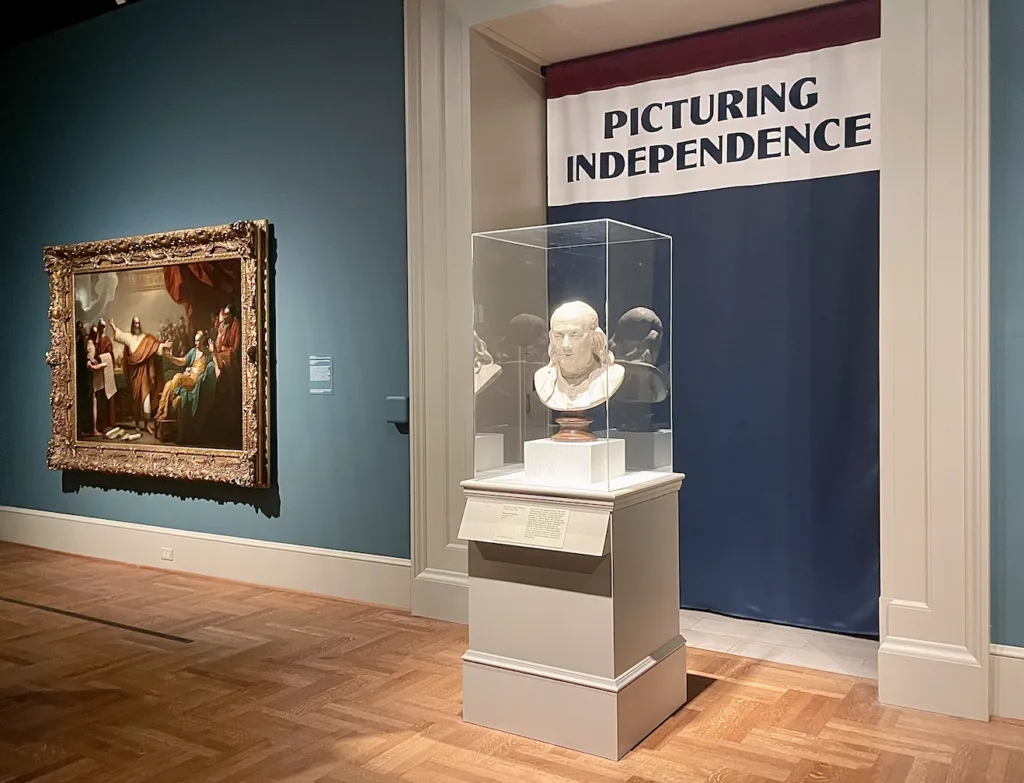
Visitors are welcomed into the exhibition space with familiar names and faces, including a stunningly lit Houdon bust of Benjamin Franklin and one of Rembrandt Peale’s many portraits of George Washington. The only non-collection piece in the exhibition, a silver tankard crafted by Paul Revere, glimmers nearby. Together, they and a handful of other objects ask visitors to consider how art participated in and crafted ideas about independence in a section dedicated to revolution.
Beyond this introductory gallery, ideas blend and exist in conversation with one another. Signage explains themes of democracy, our flag, and other national symbols, but they act more as thoughtful prompts than distinct sections.
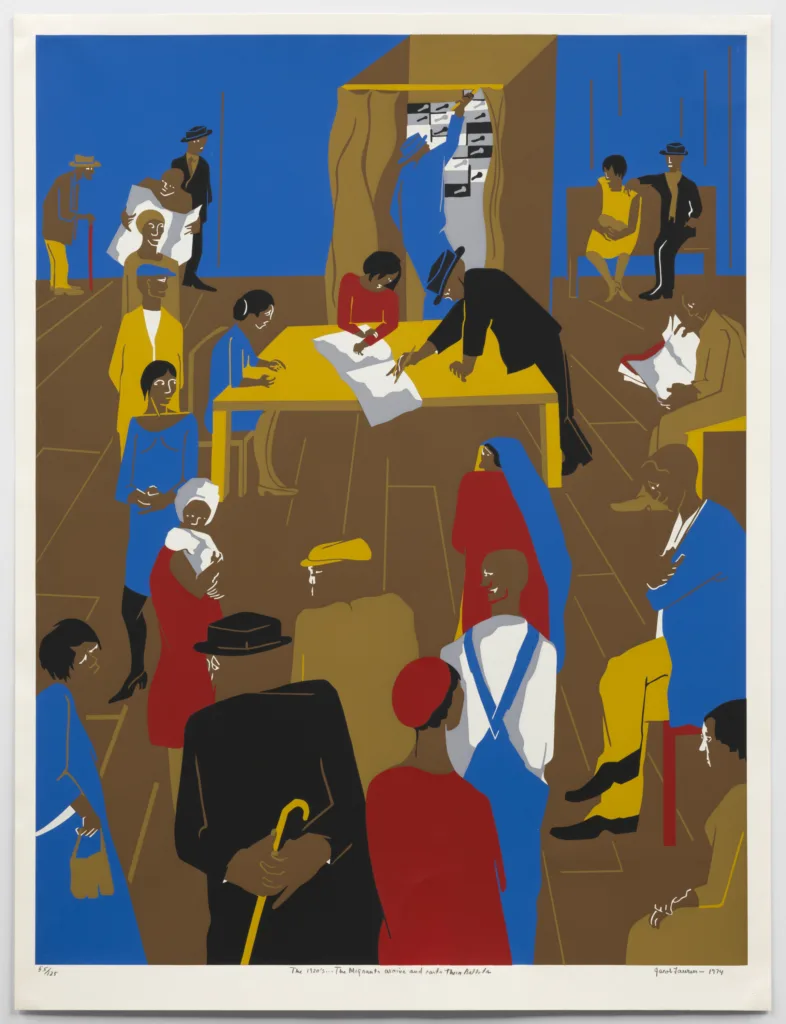
“The 1920’s … The Migrants Arrive and Cast
their Ballots,” from the “Kent Bicentennial
Portfolio: Spirit of Independence,” 1974;
screenprint; image: 32 x 24 7/8 inches; Saint
Louis Art Museum, Gift of Lorillard, Inc.
52:1976.5; © 2026 The Jacob and Gwendolyn
Knight Lawrence Foundation, Seattle /
Artists Rights Society (ARS), New York
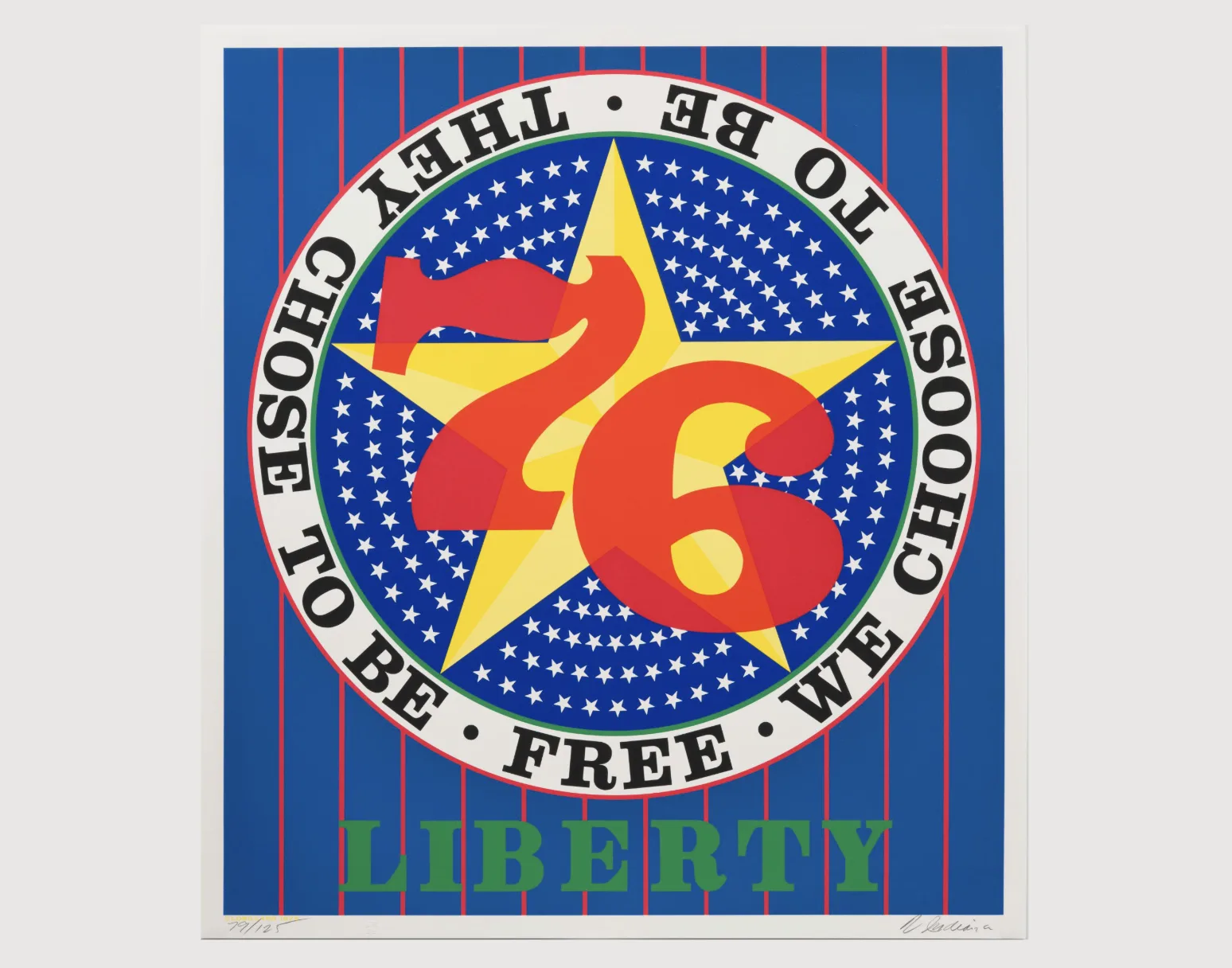
A never-before-displayed weaving by a St. Louis artist hangs alongside popular prints from the Kent Bicentennial Portfolio, a 1975 project that invited a dozen contemporary artists to interpret independence on the eve of America’s 200th birthday. Casual snapshots of real women taken in front of flags look out at propaganda pieces meant to inspire craft public opinion. On each side of the doorway separating the two areas of the gallery, images dedicated to voting—George Caleb Bingham’s iconic imagery on one side, a Harlem community center and suffragettes surrounded by vibrant color on the other—express who has and has not possessed the power to influence democracy across our history. The juxtapositions invite questions and tell fascinating stories.
READ MORE: 10 art exhibits to catch this month
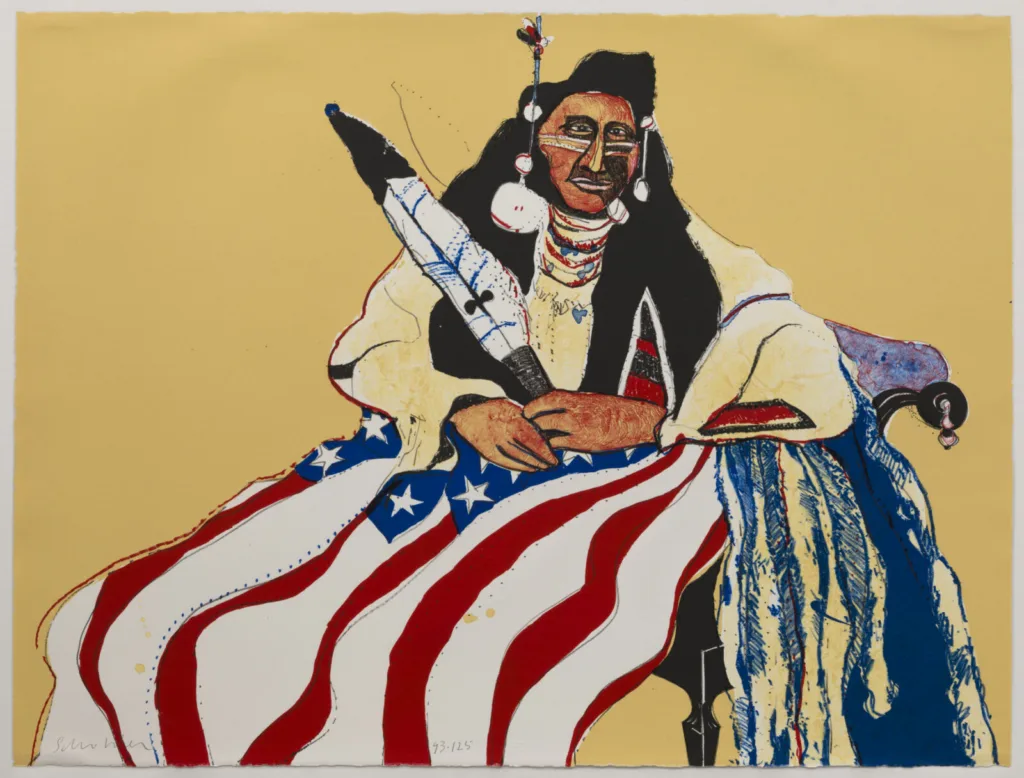
Some of the most striking pieces in the collection wrestle with our country’s treatment of Native American communities. On one wall, an intricately beaded child’s vest offers a window into the ways that tribes co-opted Americana in order to celebrate their own traditions while they were actively being suppressed by the U.S. government. On another hangs Fritz Scholder’s contribution to the Kent Bicentennial Portfolio, a bold, colorful screenprint titled “Bicentennial Indian,” in which a Native American elder sits with a surplus flag draped around him, a defiant eagle feather held tall and proud.
“That feather that he’s holding upright is a pretty significant symbol of resistance, of overcoming the oppression that many were facing,” Torbert says. “This isn’t the first instance of Scholder working with this subject and topic, but it’s certainly an early one, and he went on to create a whole series of paintings that he called ‘Bicentennial Indians’ that have these elements and kind of different arrangements.”
At the center of the second gallery, a sitting area offers visitors a space to consider the works and offer their own thoughts on independence through an interactive activity. Cards invite visitors to write or sketch their thoughts on what independence means to them, what questions they would ask artists to respond to today, and what role art plays in creating a more just society. The hope is that, over the course of the next six months, SLAM can gather and display diverse perspectives on how independence can be interpreted at this significant moment.
Picturing Independence was, after all, curated with the “constant refrain that each generation of artists—or people, period—remakes ideas of American independence for their own needs,” Torbert says.
Several events are planned over the course of Picturing Independence’s run to celebrate and supplement the exhibition. The festivities kick off on June 12 with the public opening featuring gallery talks, music, and drinks in Sculpture Hall. Additional experiences include themed lectures, family activities, and SLAM Underground–REVOLUTIONARY on August 28.
Picturing Independence is on view at the Saint Louis Art Museum, Shoenberg Gallery 236, from June 12 through January 24, 2027. The exhibition is free and open to the public. For additional event information, visit slam.org.