Since 1993, the Museum of Contemporary Religious Art (MOCRA) at St. Louis University has been a haven for exploring the intersections of art, religion, and spirituality. Now, St. Louis is preparing to bid MOCRA farewell, but not before a celebration of its legacy through Liminal, a final exhibition of works by 47 artists.
David Brinker, director of MOCRA and lead curator of the exhibition, described his goal for the collection as representing the growth of MOCRA over the past three decades.
Stay up-to-date with the local arts scene
Subscribe to the weekly St. Louis Arts+Culture newsletter to discover must-attend art exhibits, performances, festivals, and more.
“What are you going to do to mark the end of three decades of the museum? That’s a lot of weight to put on an exhibition…[We were] aiming for a selection that would give not exactly a chronological survey, but a good sense of the many different sorts of exhibitions we’ve had over the years—different themes, different types of work, artists from different backgrounds,” Brinker says.
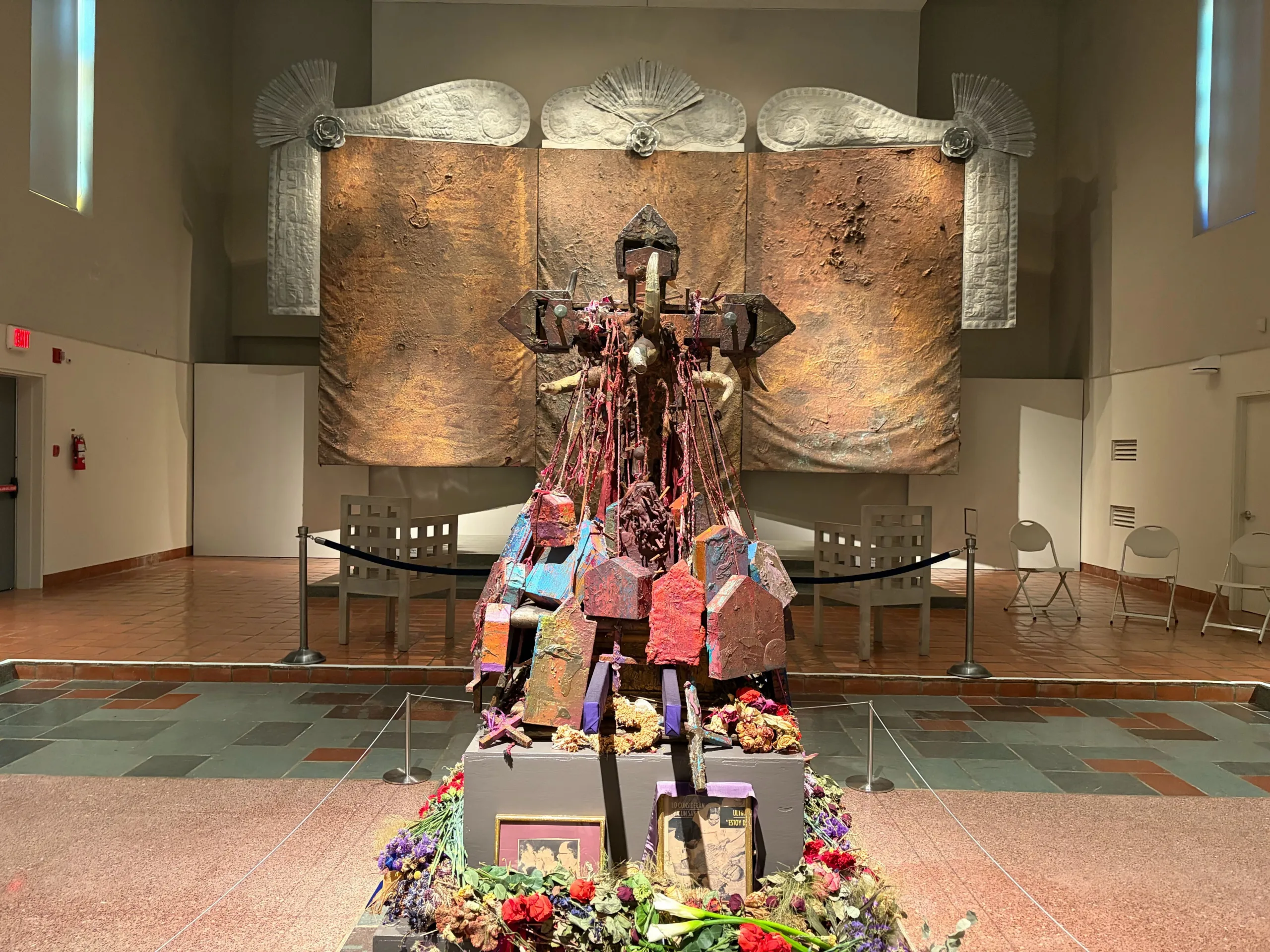
Opened as an interfaith space in the 1990s, MOCRA is defined by an “expansive and inclusive” approach to religion and spirituality, according to Brinker. In a quick walk through the gallery, viewers will see the cross, Star of David, excerpts from the Quran, and Buddhist motifs.
“I don’t know that [MOCRA] would happen anywhere else but St. Louis. It’s not just like a SLU story, but it’s a St. Louis story…St. Louis has a really rich tradition of interfaith networks and cooperation,” Brinker says.
More than 140 St. Louisians attended the opening reception for Liminal on March 1, ranging from first-time visitors to long-time supporters. The exhibition runs through May 31, after which MOCRA will permanently close.
“I knew I had to give people an opportunity to say goodbye, possibly to works that had become very dear to them, or just this space where they have so many memories,” Brinker says.
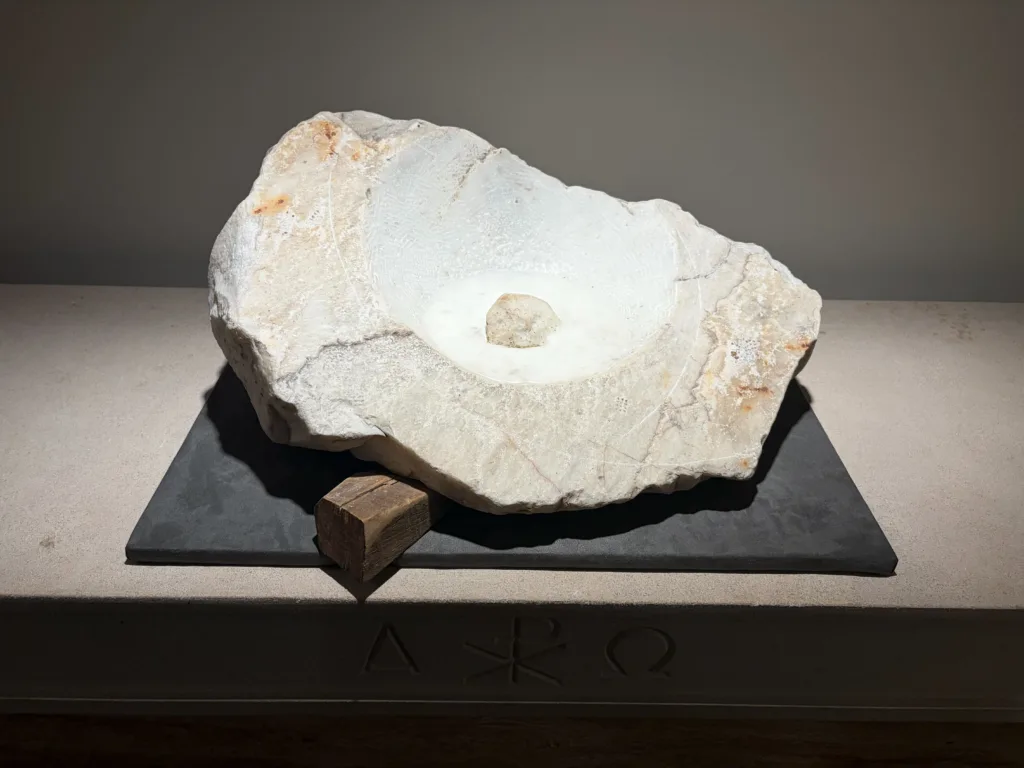
“Nativity Stone: Mother’s Milk,” a marble sculpture featured in Liminal, is one of the 40 works from MOCRA’s permanent collection coming to the gallery space for the final time. Seeing the marble, made from pure calcium carbonate, artist Steven Heilmer saw “milk in solid form,” inspiring the work.
“That’s what started the idea of carving a bowl of milk with a meniscus. If you give it light, you’ll see the shine, which appears to want to spill over,” Heilmer says.
The work appealed to Father Terrence Dempsey S.J., the founder of MOCRA, and became a part of the collection in the 1990s. For years, MOCRA has been a space for Heilmer to explore spirituality and religion in non-traditional ways, including through many horizontal depictions of religion symbolic of femininity.
“I see [MOCRA’s closing] as part and parcel of the whole environment in this country. If it’s not a nationalistic kind of religion, nobody’s interested. Especially when it [asks] questions, as a museum like this does,” Heilmer says.
Alongside works from MOCRA’s permanent collection, Liminal brings work from seven artists to the gallery space for the first time. Among them is “Devotion,” by Janie Stamm, a Jewish artist born in Florida and currently based in Pacific, Missouri.
Stamm’s work is positioned next to “The Promise” by New York artist Adrian Kellard. According to Jessica Baran, the curator behind the two pieces, Kellard’s practice was cut short by AIDS in 1991, but during his eight years of practice, his exploration of religion and queerness in tandem saw “meteoric” success.
“This resurgence of spiritual practices among queer artists in New York was a really interesting moment that was also pushing against both health care denial and lack of spirituality in Reaganite America at that time,” Baran says.
In conversation with Kellard’s piece, Stamm’s piece continues exploring queerness through its depictions of palm trees she describes as queer, Florida versions of Shabbos candles, a sapphic poem about Floridian oranges, photos, and a beaded work.
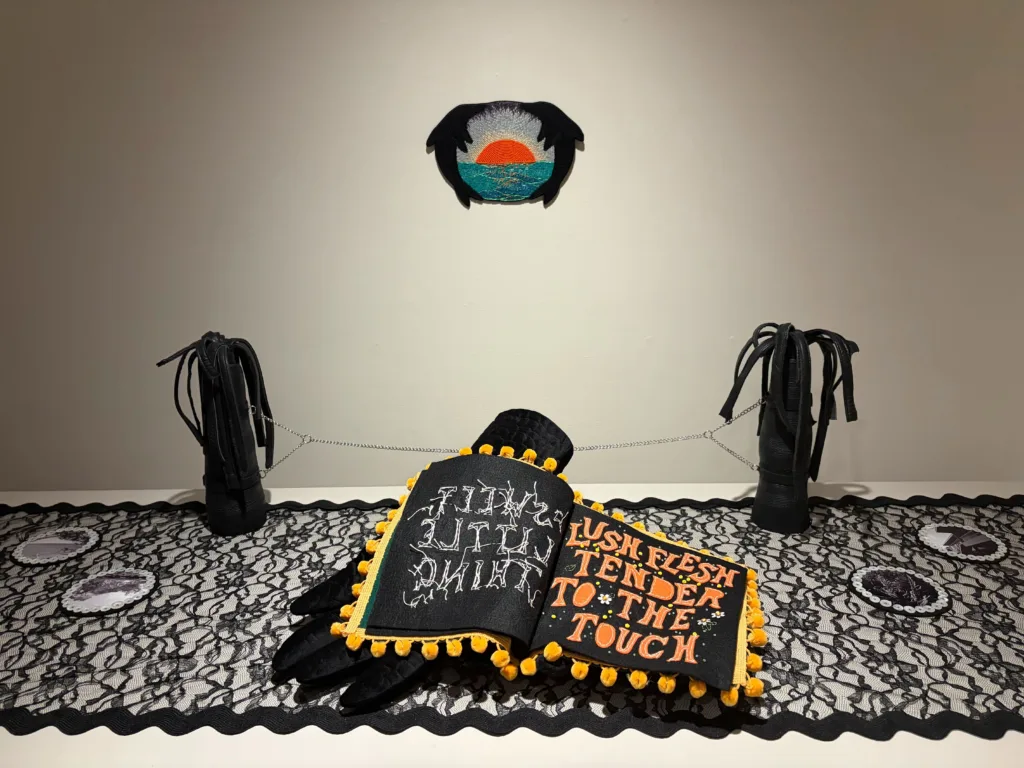
“It felt like this really incredible moment where I’m in communication with a previous generation of artists and makers, and a lot of voices that were lost to the AIDS crisis. And I get to add to that story and continue that legacy,” Stamm says.
Baran leaned into the concept of intergenerational legacies as she curated the two works.
“Queer identity is often very importantly lofted by a sense of faith…[pairing Stamm and Kellard] just felt like two people from across generations keeping alive a legacy that is often also deeply fragile,” she says.
Baran felt Stamm’s practice, which aims to remember lost queer spaces, was fitting for MOCRA’s final exhibition.
“[Stamm’s] work functions as an archive….What is does is remind people of these histories that are often not well-preserved and then keeps them alive through her work,” she says.
As MOCRA’s time comes to a close, Stamm reflects on the space it has offered for queer dialogue.
“The museum almost served as this truly unique entity in that it was a queer art haven…I felt very honored to be a part of not just Adrian’s legacy, and the legacy of queer artists, but also this space’s legacy,” Stamm says.
According to Brinker, SLU will retain MOCRA’s permanent collection to display on a rotating basis at the St. Louis University Museum of Art. Brinker feels the name of the exhibition Liminal captures this pivotal moment in MOCRA’s legacy, defined by a period of change, uncertainty, and reflection.
“This is a time of transition. There are a lot of questions, a lot of emotions, a lot of everything…What are we letting go of, but also, where are we going to end up? So we’re in that space,” Brinker says.
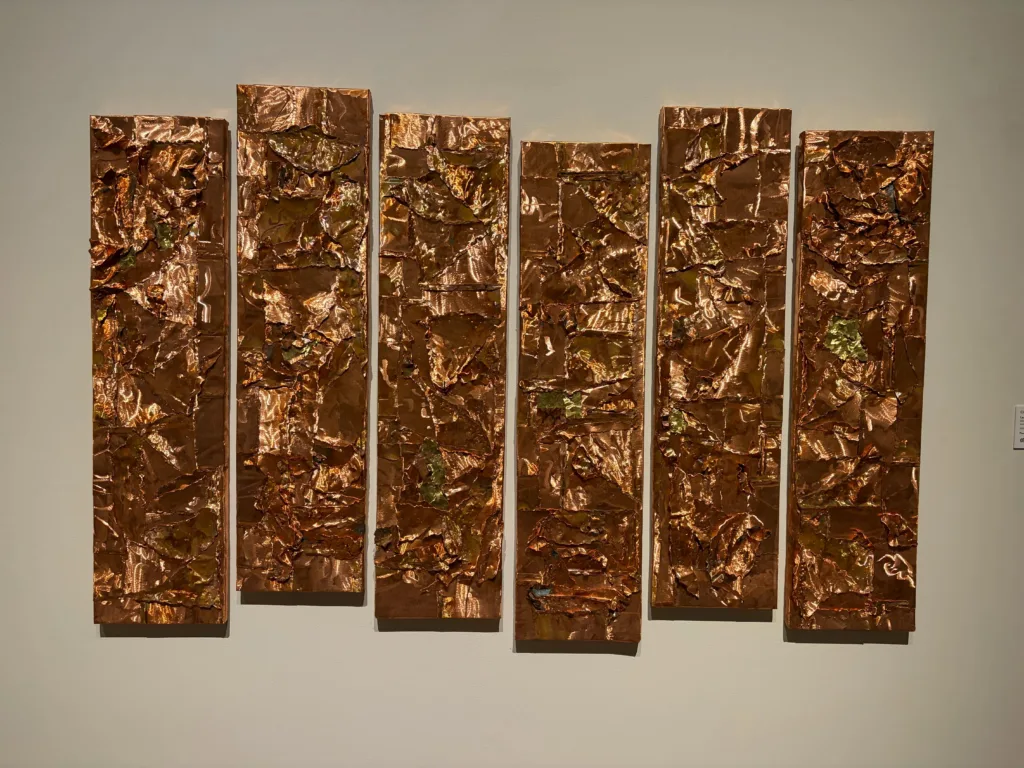
Artist Christopher Schulte reflected on the evolution of his work throughout its years at MOCRA, where it has been displayed in varied ways. Schulte encouraged the museum to display the series of copper panels in his work “Lead Me” however they wanted. When Father Dempsey first brought it to MOCRA, it was displayed on the floor as a “reflecting pod” and has since seen a number of hanging wall arrangements.
“That was them interpreting the art as they wish, rather than me being very rigid and saying it has to be that way,” Schulte says. A self-trained artist, Schulte first engaged with art therapeutically. Today, he donates proceeds from his artwork to the Will Flores Fund in the “art of giving” to make art accessible to all.
Schulte’s practice often grapples with impermanence. He sees this as a continued theme, as MOCRA’s legacy will live on not in the walls of the gallery, but through the artists and viewers the space has touched throughout its years.
“[It’s] the art of impermanence…the space is closing, but the spirit is not,” he says.