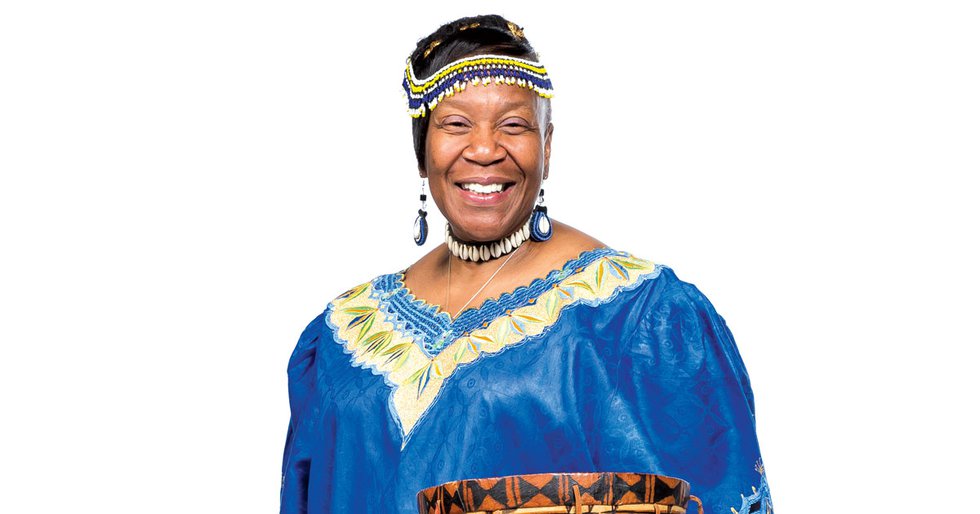
Janice Katambwa shares the tradition of Kwanzaa through storytelling. On December 27, beginning at noon, the Missouri Botanical Garden hosts a Kwanzaa celebration.
- “Kwanzaa” comes from the Swahili for “first fruits.” I like to explain it as “seven times three”: seven symbols, seven days, seven principles that are used to talk about power, roots, and tradition.
- It is a nonreligious holiday that’s celebrated December 26–January 1. Professor [Maulana] Karenga created it in the 1960s for the purpose of gathering, working together, planting, harvesting, sharing, and depending on each other.
- The goal is to encourage people of African descent to embrace our culture and celebrate our past.
- I lived in the Democratic Republic of the Congo for seven years, in a village in a rural area. I saw some of the same togetherness practiced in the village, and I wanted to make sure that people who never had the opportunity to travel to Africa get to realize what the culture is about.
- I do an interactive performance with singing, storytelling, and poetry. As a former English teacher, I believe people learn and retain [more] the more they’re involved.
- We pour the libation, talk about the symbols, purpose, and principles. We do dance movements and play musical instruments. I make sure everybody participates—I want as many people from as many ethnic backgrounds as possible. It’s important to remember who we are and where we come from.
- Years ago, I was telling a story around the principle of “It takes a village” and had some of the audience come up to act out the story. I asked this man in a wheelchair to hold the sun with streamers hanging down as the rays. When we got to the part of the story where the sun begins to rise, he pressed a button, and that wheelchair went up. The audience started cheering. No one else in that audience would have been able to shoot up like he shot up.
- We all have gifts, some special quality unique to us, and we’re to share those gifts.
- The more I celebrate, the more I see things to bring to the table.The more I learn about the culture, the more I learn about myself.