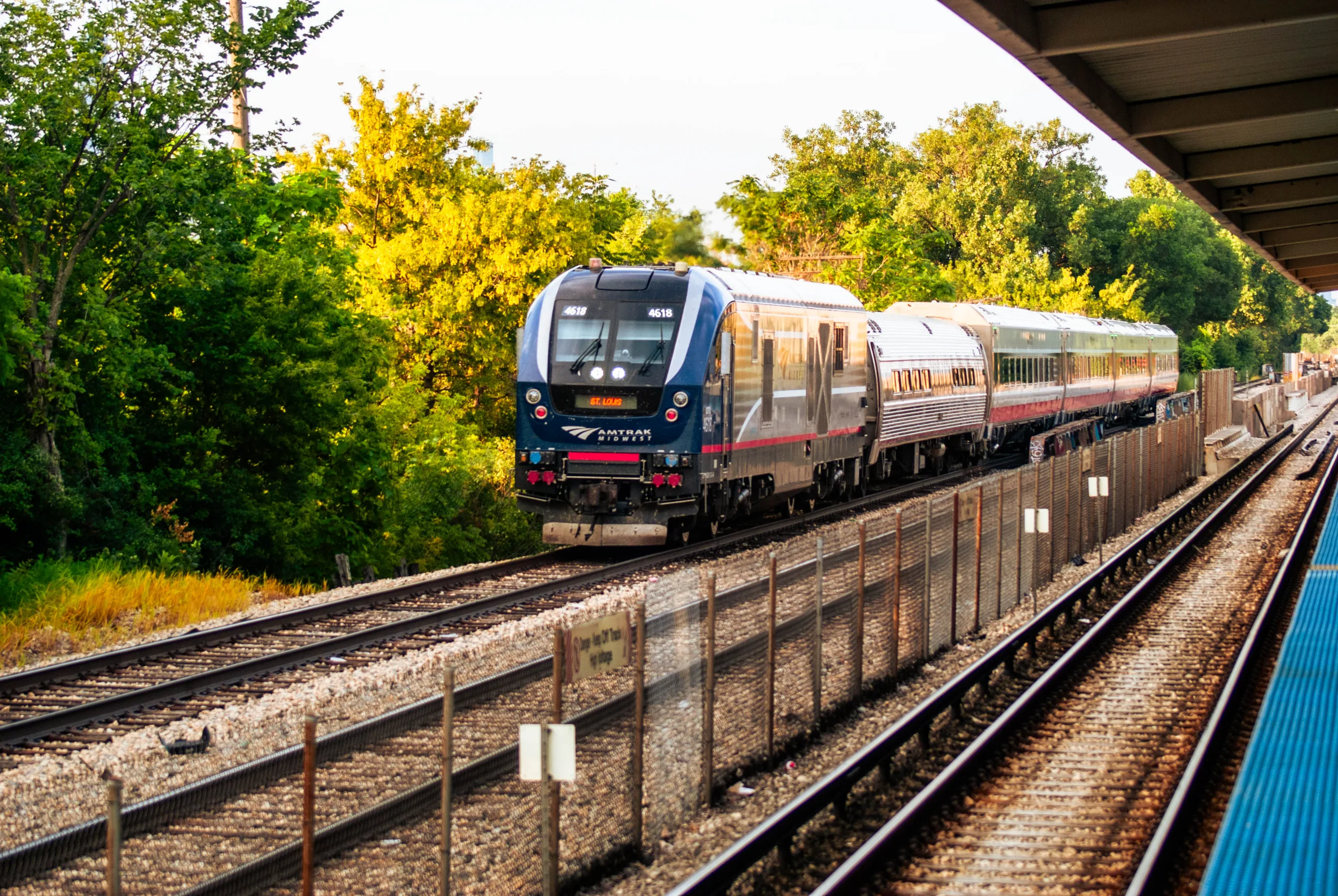
It’s been a little more than three years since Illinois’ High Speed Rail Commission began exploring the creation of a statewide plan for a high-speed rail corridor connecting St. Louis to Chicago. It’s an idea that could cut the travel time between the two metro areas in half from Amtrak’s existing service.
The commission has inched forward, considering numerous potential routes and construction approaches through the center of the state, and even amending the southern terminus to East St. Louis, which would avoid the need to contend with crossing the state line and the Mississippi River.
Keep up with local business news and trends
Subscribe to the St. Louis Business newsletter to get the latest insights sent to your inbox every morning.
A first look at the potential number of people who may use the line was finally shared during last month’s commission meeting, bringing with it a sense of how much revenue such a route could bring in. The figures came from a model Quandel Consultants and WSP worked to develop for the commission to estimate the ridership numbers, as well as how they may grow into the future.
Most of the meeting focused on the route alignment that was projected to have the highest ridership, a primarily greenfield-constructed route starting in East St. Louis with stops in the downtowns of Springfield, Decatur, Champaign, and University Park before terminating in Chicago that could draw as many as 8,060 daily riders. That specific route has a total travel time of just under two and a half hours, and an estimated construction cost between $44 billion and $54 billion.
The consultants also shared that based on Amtrak’s numbers from September 2023, about 260 riders travel daily each way between Chicago and Champaign on the Illini service and 230 between Chicago and St. Louis on the Lincoln service, though they did not clarify how many more passengers may be represented by services that pass through those destinations, such as routes from Chicago to Texas or New Orleans.
Regardless, it means the estimates for a high speed route from East St. Louis to Chicago route represents a dramatic escalation. Over an entire year, it could see over 2.8 million passengers, which is in line with Brightline’s high speed rail corridor between Orlando and Miami, and slightly less than Amtrak’s Acela service between Washington and Boston (though vastly more people ride Amtrak’s Northeast Regional service along that corridor).
Other routes that connect those same cities (or swapping out University Park for Joliet) with different track alignments were modeled to attract between 6,419 and 7,863 daily riders, or 2.25 million annual passengers on the low end and 2.75 million on the higher side.
Ridership could increase between 7 and 10 percent from the base year of 2023 to 2045, according to the Illinois Statewide Travel Model.
“It’s whatever is there today, and whatever has been forecasted,” WSP senior vice president Rhett Fussell explained to the commission. “These numbers do not account for what you would see as development [happens around stations].”
Fussell added the 8,060 figure was based on 16 trains running per direction, with an average fare per mile of $0.40, which equates to $124 for the entire 310 mile route. Dropping the train frequency to eight per direction comes with a decrease of nearly 1,000 daily riders.
That last part is important context for the projected operation and maintenance costs that would come alongside servicing such a route. Running 16 trains each direction per day would cost around half a billion dollars annually, while only generating around half that in revenue, meaning a hefty subsidy would be needed just to operate the route. Cutting the number of daily trains in half brings the subsidy needed down $43 million for the route with the most projected ridership.
One commissioner bristled at this prospect. “Why would we spend billions of dollars in all of the heartache, the political heartache, to just run eight trains a day?” he questioned. “Why recommend that when we know that converting auto trips to public transit requires frequency. We need to address that issue.”
It’s worth noting that eight daily round trips along the corridor from East St. Louis to Chicago is more than Amtrak’s current daily offerings of five trips between St. Louis and Chicago and three between Champaign and Chicago.
The tens of billions of dollars in construction costs had other commissioners concerned about the overall viability.
“It seems to be a big investment for not a substantial growth in ridership potential here for this system,” said commissioner Erin Aleman. “I do think we’re picking sort of the rosiest summary. I get you want to look at what the potential is, but I do think that is a compounding impact, [which] may overestimate where we’re at today.”
She added that she is in favor of a high-speed line, and just wants to be sure whatever final report is generated is detailed enough for those in charge of deciding on a route can “make the best decision that they can.”
In the near term, Quandel Consultants says it will plan a final virtual public meeting and finalize the ridership and revenue forecasts before completing a final report over “the next several months.”
Editor’s Note: This story has been updated to include more detail and clarity regarding current ridership numbers for rail service from Chicago to Champaign and St. Louis.