When Greater St. Louis Inc. was formed four years ago, Bob Clark wasn’t among the investors. The founder and executive chairman of Clayco is a St. Louis native who retains a deep interest in local affairs—and, despite moving his headquarters to Chicago, maintains a residence and some 800 employees in the region.
But Clark was skeptical of the new organization, which was designed to speak with one voice on issues of economic development.
Keep up with local business news and trends
Subscribe to the St. Louis Business newsletter to get the latest insights sent to your inbox every morning.
“I didn’t share a common vision with Jason Hall,” he says of the organization’s founding CEO, who recently took a job in Columbus, Ohio.
To hear Clark tell it, he respected Hall, but he wanted more urgency around the issues facing St. Louis. “ I just think Greater St. Louis came together with too small of a footprint of a 2030 plan,” he says. “There’s not gonna be a 2030 outcome without a ‘right now’ plan.”
Clark believes his efforts for a “right now” plan—and a bigger group at the table—are gaining momentum.
“There’s no deal or anything, but I’ve had good conversations about a more robust footprint and hopefully a leader that comes into Greater St. Louis that has a vision of community voices [and] political leadership,” he says.
Clark says he has been talking with the former chancellor Washington University. “Mark Wrighton and I were talking about putting this other kind of organization to overlay to be side by side with Greater St. Louis,” he says. “You know, what’s missing right now is a strategic plan and a turnaround plan, a pivot plan. What can we do to recover in St. Louis? Greater St. Louis and I have been talking recently about that kind of initiative. You have to do that with three pillars. You have to have voices from the community with voices from the business community and with our political leaders in a room. … We’ve had lots of conversations about convening this larger group to a ‘right now’ strategy together that would involve bringing businesses back to the city.” (Greater St. Louis Inc. declined comment.)
Clark made his comments on an episode of The 314 Podcast, which went live this morning. He framed his interest in local affairs as a deep concern for St. Louis’ direction, which he says also drives his support for Alderwoman Cara Spencer in her challenge to Mayor Tishaura Jones.
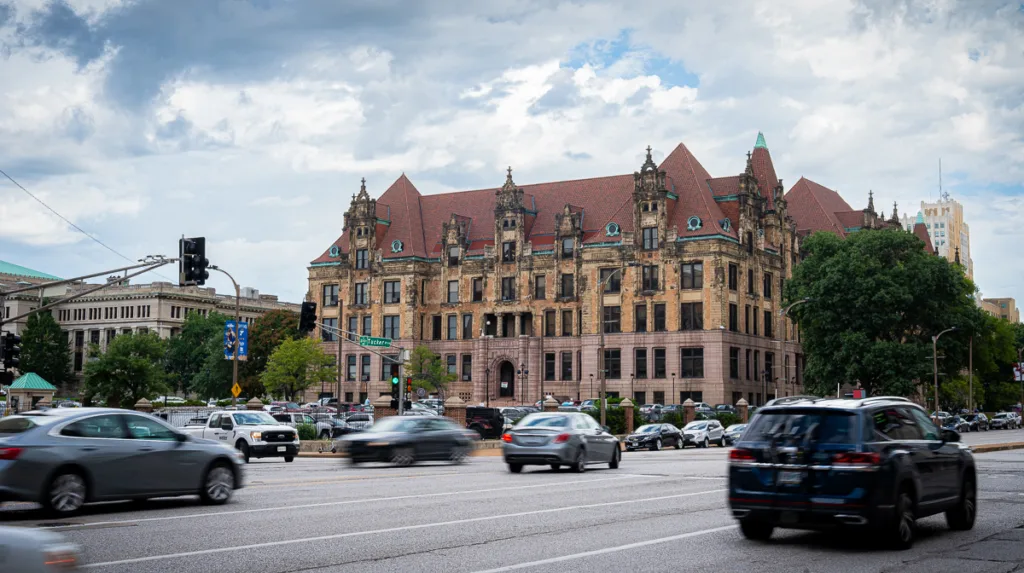
The $111,330 check that Clark wrote to a political action committee supporting Spencer’s candidacy drew fierce condemnation from Jones and many of her supporters, who accused Clark of trying to buy City Hall.
”You know, for a long time, the St. Louis civic leadership has been reluctant to get involved in politics,” he says. “Guess why. I mean, if, if you’re a business person and you’re watching Bob Clark get in the dirt with the mayor, you’re like, ‘I’m not ever gonna do that.’ Hopefully more will. If we get a good outcome, people will see its risk-reward.”
If Spencer is elected, Clark says, he and other business leaders are contemplating a significant investment in downtown St. Louis: “One idea would be to get the top, say, 25 companies, to go down and make a stand in the city in a single building.”
As Clark tells it, the source of his “schism” with Jones came when she refused to hear out his idea of replacing the $210 million expansion plan for the convention center with a much more ambitious $800 million plan for a bigger expansion that would also include demolition of the Dome. “She just shut down,” he says.
The rift deepened when the St. Louis Development Corporation rejected Clayco’s proposal to consolidate some of its operations on a piece of land in the Mark Twain neighborhood of North City. The agency, the city’s development arm, wanted retail on the site, not a cement plant. Clark instead relocated Clayco’s employees to Hazelwood—and later noted that his six-figure contribution to Spencer reflected the amount of money he’d spent on the proposal.
The mayor has said she was not involved in the decision to reject Clayco’s proposal, an idea Clark scoffs at. “ I think it’s clear that she’s a dishonest person and will say whatever she wants,” he says.
Conner Kerrigan, a spokesman for Jones, said via email, “The Mayor’s office met with Mr. Clark about his pitch, but it was clear at that time, and remains clear to this day, that there was no political will in the city, state, or county for the type of plan he was pitching. His plan included a complete tear down of the convention center and the Dome, which would put our tourism and downtown entertainment industry out of business for a number of years, which is completely unfeasible.
He adds, “Mr. Clark overestimates his own credibility. He has worked to delay progress on the Convention Center and the Railway Exchange Building, all in service of lining his own pockets. His frustration with Mayor Jones stems from her unwillingness to sell out the City of St. Louis to him and his business partners, and so he continues to try to find other ways of attempting to buy influence in Room 200.”
As for Clark, he acknowledges that his dissatisfaction with political leadership in the city long predates Jones. Asked why he moved Clayco’s headquarters to Chicago during the administration of Mayor Francis Slay, he says, “No strategic plan. The city of lost opportunity.”
Later in the conversation, he mentions the great potential he sees within St. Louis. He notes that for years, Clayco struggled to convince people to come to St. Louis. Something shifted during the pandemic. “What we’re hearing from our employees now, like, across the country, is people wanna come to St. Louis,” he says. “Because it’s a great cost of living. You can have a big yard, you can have a dog.”
But Clark remains certain of one thing: Urgency is needed. It’s the potential that has him convinced of it. He says, “ You know, there are so many things that you could do with a ‘right now’ strategy.”
Hear more from Clark on The 314 Podcast.