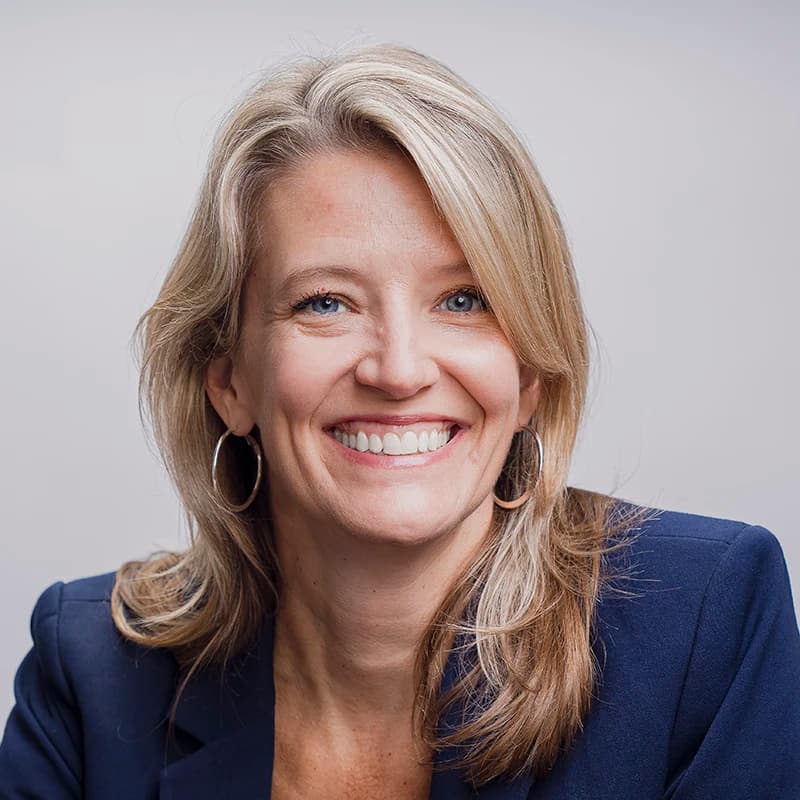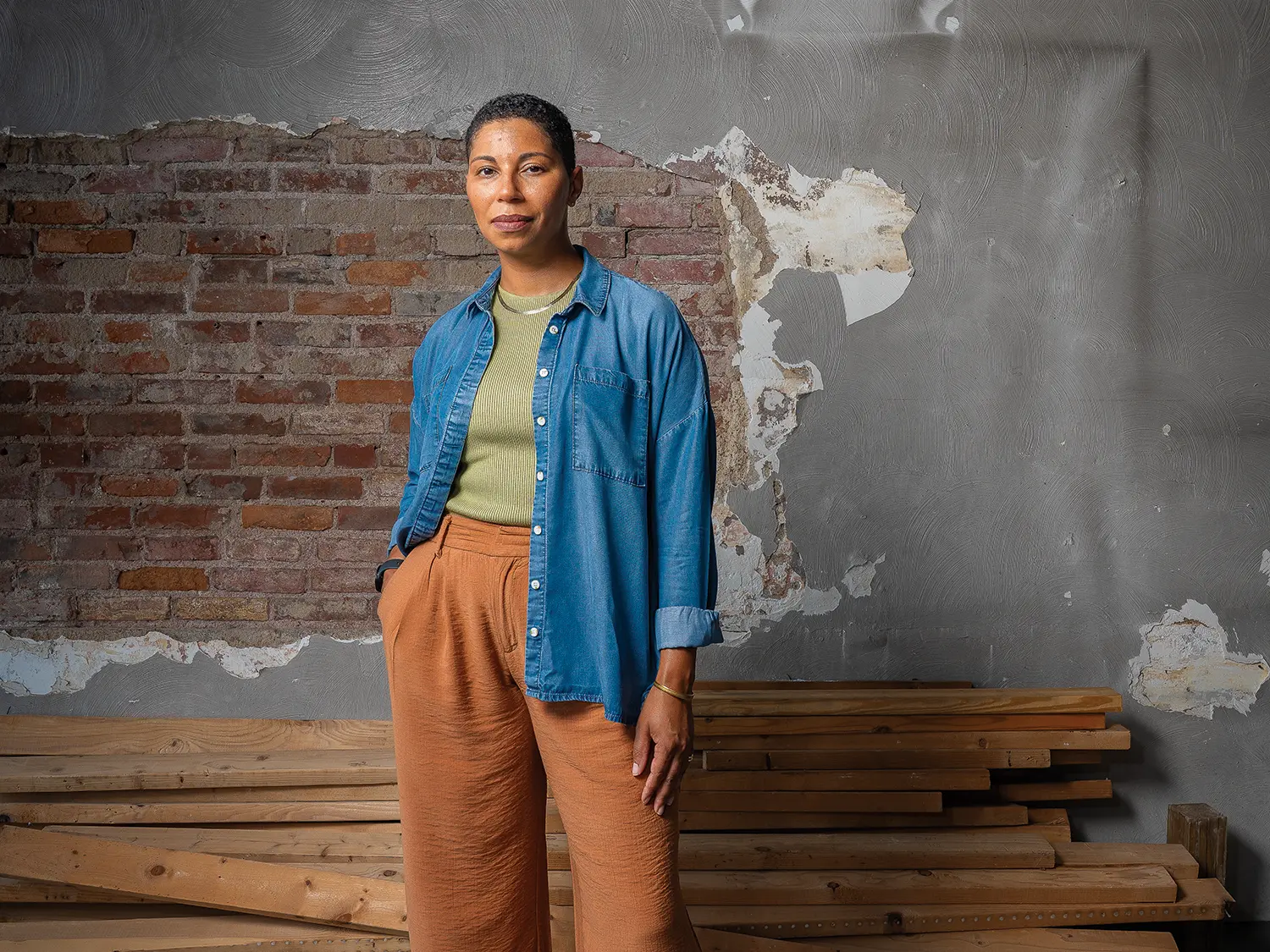
Long before a deadly tornado ripped through St. Louis, decimating thousands of homes and displacing longtime residents, Dara Eskridge was all in on North City. As CEO of Invest STL, Eskridge was two years into the nonprofit’s ambitious three-year pilot program, Rooted, which gave residents of the West End and Visitation Park neighborhoods $22,000 to invest in businesses or homes during a time of gentrification and displacement.
Then came May 16.
When the tornado struck, Eskridge was in a meeting in North County, and in a new episode of The 314 Podcast, she recalls the horror of racing to her kids’ school just moments after the tornado ripped a one-mile wide path through North City. “I am driving by people who are trying to make sense of what just happened in a matter of seconds to them,” she recalls. “And then just the flashbacks to my childhood and the time that I’ve spent in these communities. I’m wondering, How is this person, how is that person? How about that building? Just all of these questions are coming up for me, and it truly was devastating to just see what happened, and immediately thinking about the tremendous loss.”
But Eskridge didn’t allow herself to become immobilized by grief or the magnitude of need, a big reason St. Louis Magazine chose her as this year’s Visionary Award winner. Within 24 hours, she says, she became aware that she had to pivot, and working closely with neighborhood nonprofits 4theVille and Dream Builders 4 Equity, Invest STL set up the 4theVille Hub, providing supplies and stabilizing homes.
Eskridge was in awe of how well front-line groups worked with one another. Preexisting relationships allowed her and other leaders to coordinate through text chains instead of formal meetings, providing much-needed efficiency. “We are troubleshooting in real time,” Eskridge told SLM in July. “We are passing resources to each other in real time. We are comforting each other in real time.”
In the tornado’s immediate aftermath, Invest STL also tackled creation and distribution of a Northside Resilience Fund, raising $4 million to ensure that North City residents whose homes had been severely damaged by the tornado could access $3,000 in cash assistance—faster than any city program, faster than FEMA, and with no strings attached.
“It was built off of what we learned from Rooted, which itself was a very simple application, very clear eligibility,” Eskridge recalls. “The actual idea was also very simple: Give people cash to do the things that they need to do to support their lives.”
But for Eskridge, those payments are just a drop in the bucket of enormous need and a system that has been stacked against Northside residents for decades. Many people moved to North City because the government demolished their homes in Mill Creek Valley, a 1950s urban renewal project that came with no relocation assistance for residents. Once resettled, they encountered redlining by banks and insurance companies and unfair appraisals. Now the sins of the past are haunting the recovery process. If your home was only valued at $60,000, that’s all you can get from insurance after it’s been decimated—if you even had insurance. And if you didn’t, like many homes in North City? ”The most that they’ll be able to get from FEMA is somewhere around like the $98,000 mark,” Eskridge says. “You try and build a house again for $98,000.”
Eskridge was interested in the appraisal gap between Black and white neighborhoods even before the tornado. Two years ago, she says, Invest STL started convening a table of partners to look at what she calls “the huge gap in how we are valuing predominantly Black neighborhoods and the properties within them.” She believes that research will provide a valuable first step towards making North City residents whole.
She can’t get to the second step, however, without enormous philanthropic, and governmental, resources. Eskridge makes clear the $100 million earmarked by the state for tornado recovery and the $30 million in the Rams settlement fund’s interest set aside by the city won’t be even close to enough. And she suggests locals need to step up.
“What I hear from foundations and corporations operating nationally is they are waiting on the sidelines and want to see that significant capital is being unlocked locally, both from philanthropy and from local governments,” she told SLM in July. “Because their reasoning is like, If we’re not seeing substantial capital being unlocked locally, why should we put in for this? Right? This isn’t our neighbor. I think we need to get the ball moving a little bit faster and bigger on that front to unlock what’s available nationally.” The city’s $250 million portion of the Rams settlement, she notes, looms large to out-of-towners: “I have been asked about it over and over again.”
A St. Louis native, Eskridge earned her bachelor’s degree in architecture from Tuskegee University and a master’s in urban planning from Columbia University in New York before working as a planner for St. Louis County and then for the national nonprofit Urban Strategies as its director of operations for the St. Louis region. In 2018, the St. Louis Community Foundation tapped Eskridge to run its community development initiative, Invest STL. (It became a standalone nonprofit in 2022.)
Despite everything she has witnessed, Eskridge remains committed to St. Louis. ”There is a lot here that needs fixing and rewiring, but there is also a lot of beauty here,” she says. “There’s a lot of spirit that I don’t necessarily find in other places that I travel to.”
But she warns that St. Louis needs to pay attention to the urgent problems facing its Black community if it wants to stop the city from hemorrhaging Black residents, a problem that’s already led to population loss so big as to draw national attention.
“We are looking at at least a decade’s worth of work, and really, when we’re looking at four or five generations of where we have not done well by our Black citizens, it’s going to take as much time to make a better case for how we support them,” she says. “But we also need to move quickly. St. Louis will either make or break in this moment.”
Hear more from Eskridge on The 314 Podcast.
A-List Table of Contents
READERS’ CHOICE WINNERS
Arts & Entertainment
Automotive
Beauty
Food & Drink
Health & Wellness
Home & Garden
Shopping & Services
Weddings
EDITORS’ CHOICE WINNERS
Arts, Culture & Entertainment
Food, Drink & Nightlife
People Shaping The Region
Shopping, Service & Family
Wellness, Beauty & Lifestyle
Visionary Award
Keep up with local business news and trends
Subscribe to the St. Louis Business newsletter to get the latest insights sent to your inbox every morning.