When Nigel Taylor first came to St. Louis from San Diego in 1999 to work at the Donald Danforth Plant Science Center, the now-sprawling complex was nothing more than a muddy hole in the ground. But even then, standing at the construction site that would become one of the world’s most vital epicenters of plant research, Taylor knew that he was witnessing something unique about the St. Louis innovation ecosystem.
“It’s been incredible to see the center develop and see the vision of Dr. Danforth and others come to fruition,” Taylor says. “That vision was for St. Louis to become a world-class plant science powerhouse, but also that it would stimulate other developments in St. Louis and the region to make it a major center for plant science research and agriculture research in the world. That has happened. The vision really has come to fruition.”
The Danforth Plant Science Center has been an overwhelming success story for the region, and it isn’t an anomaly. Across sectors, the metro area has cultivated significant growth in cutting-edge industries that have an impact on some of the world’s most pressing challenges. National security, food security, climate resilience, and biomedical innovations that improve health outcomes are all areas in which St. Louis has established itself as a leader. It has attracted new talent, new business, and, most importantly, new ideas that have the potential to make life better for humankind.
“There’s such a need for hardworking, innovative, and creative talent with the knowledge or the eagerness to learn,” says Martha Schlicher, a plant scientist and entrepreneur in residence for the nonprofit venture capital group BioGenerator. “Jump in; the water is warm.”
National Security
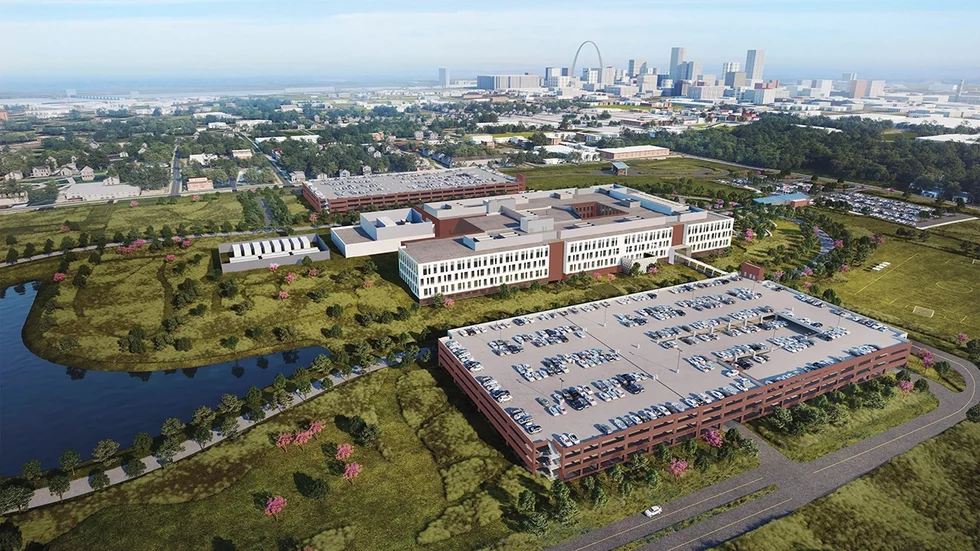
In 2016, the National Geospatial-Intelligence Agency selected North St. Louis as the future home of NGA–St. Louis, a 97-acre campus that will be a key player in the nation’s national security apparatus. The 700,000-square-foot building, which is slated for completion in 2026 and will employ more than 3,000 people, is only part of the story, though. As soon as the NGA made its decision to locate here, local leaders realized it presented an opportunity for St. Louis to become a global hub of geospatial innovation.
In this sense, there is as much (if not more) activity in the geospatial sector happening beyond the NGA. The Taylor Geospatial Institute, which opened at Saint Louis University in 2022, is an interdisciplinary consortium of researchers and scientists from eight Midwestern institutions, all of whom are working to make St. Louis the center of geospatial excellence through a wide range of applications, from national security to food security to agriculture technology.
T-REX, an innovation and entrepreneurship center located downtown, is another hub of geospatial activity, thanks to its Geospatial Innovation Center, Extended Reality Lab, and Moonshot Labs, all of which support those working in the numerous fields that geospatial technology touches.
Marlie Mollett is one of those geospatial professionals. A geodetic earth scientist with the NGA, Mollett began her journey as an astrophysics undergrad at the University of Missouri–St. Louis but fell in love with the geospatial field after working on an NGA project with a professor. That led to an internship and eventually a job with the NGA, something she never imagined that she would be able to do in St. Louis.
“When I first heard about the NGA, I thought, ‘Wow, I can actually have a career in this in St. Louis.’ Until then, I assumed I’d have to leave town to work for NASA or a national laboratory,” Molett says. “It turns out this is a really great location to start your career in geospatial. It’s a super supportive community. Everyone wants to work together to grow it, and there’s so much cutting-edge technology and research going on that it’s drawing people here. People are talking about it.”
Food Security
Just as Mollett is watching St. Louis’ geospatial sector begin to take off, Nigel Taylor has had a front-row seat to the region’s evolution into a leader in plant science and agriculture technology. Its promise is what drew him to town from the Scripps Lab in Southern California 25 years ago, when he was a young scientist working in food security. Taylor’s research centers on the cassava plant, a vital nutrition source in the developing world, and he’s been struck not only by how much the region’s plant science and agtech sectors have grown but also by how intentionally collaborative it is. He feels such collaboration gives scientists and entrepreneurs an opportunity to think about their work without limits.
“Danforth is a collaborative place and was set up to do that because people realized the way we could have impact is if we worked together as a bigger group,” Taylor says. “The leadership has really built on that, and it’s central not only to the Danforth Center but also to the larger scientific community. There’s an entrepreneurial spirit. I helped start a startup, which is something I never imagined I would do. There are so many ways for researchers and scientists to connect with the startup and entrepreneurial communities. This didn’t happen spontaneously; the structures and attitudes and connections are worked at and have been put in place to enable and encourage scientists. If you want the opportunities, they are there.”
Taylor also sees the region’s connection and proximity to agriculture as an asset. For those who want to see their work translated from an academic pursuit into real-world solutions, St. Louis provides the perfect opportunity.
“People here understand agriculture and how it’s important; maybe they grew up on a farm or have an uncle who is a farmer. They are not removed from it,” Taylor says. “And there’s a commitment here to translating the discoveries we make at the Danforth Center into technology that will benefit those farmers. It’s one of the things that makes us different.”
Improving Health Outcomes
Dr. Sarah George—associate professor of infectious diseases, allergy, and immunology at the SLU Center for Vaccine Development—has been impressed with the St. Louis region’s scientific and health care communities since she moved to town 20 years ago. To her, the area is the total package.
“The scientific community here is very good,” George says. “We have a number of major universities that do a fair amount of biological and biotech research, as well as biotech startups in the Cortex district. There are a lot of human resources here in terms of expertise, know-how, and ability to get things done—and a lot of the things people need available to them, like corps for working with animals or cells, very sophisticated human genomics sequencing technologies, X-ray, cryptology, and microbiology resources. We have all of the scientific infrastructure and human resources that are needed.”
Since 2009, George’s research has centered on vaccines, both development and testing of current ones for longevity. In coordination with the National Institute of Allergy and Infectious Diseases, she and her team were central to the development of the COVID-19 vaccines through their testing of all three versions. Their work does not stop there, though. George and her colleagues at the center are also working toward finding vaccines for West Nile, dengue fever, and tuberculosis, as well as for infants and pregnant women.
To those entering the field or considering where to take their career, George can’t speak highly enough about the collegial and supportive environment that St. Louis provides, as well as its quality of life, which together make the region a wonderful place to work and live.
“I’ve found this to be a very collaborative city,” George says. “Costs of living are lower, and you don’t have some of the headaches and hassles of living in a larger city. There’s important work being done, and people are friendly and generally support one another and try to help each other out.”

Climate Resilience
Like George, Martha Schlicher decided to go into the scientific field because she wanted to do something that mattered and make a difference for society. Her work, which centers on increasing crop yields, embodies that desire.
“I think most people understand we are experiencing a warming climate, and with that comes increased insect pressure,” Taylor says. “Right now, 40 percent of global food production is wiped out by insects, and with a warming climate, they are moving further north and metabolizing faster, which means they are eating more. It may not be obvious on the surface, but you want to maximize yields on those crops because the more you can grow per acre, the fewer acres you have to plant. If 40 percent is wiped out, then you have to plant 40 percent more. When you think about what that means in terms of not clearing forests on a global scale, it’s tremendously impactful. At the end of the day, most agricultural innovation companies are climate companies.”
Schlicher, who currently works with BioGenerator and several startups, including Impetus Ag, can’t think of a more vibrant place than St. Louis in terms of the work that she and her colleagues are doing to help make the climate more resilient. The region has become an undeniable epicenter of agricultural innovation, thanks to the wealth of talent from legacy companies such as Monsanto and Bayer, as well as organizations such as the Danforth Center and BioSTL, which help foster a flourishing innovation ecosystem.
“We have companies moving here from out of town because of the culture and climate we have created,” Schlicher says. “We also have investors coming in from Texas, New York, Florida, Ohio, and Seattle saying that if they are going to invest in agriculture, they are coming to St. Louis first.”
And for those who have a great idea or simply want to work in a place that inspires those ideas, Schlicher has nothing but encouragement. “If you are thinking of relocating here or jumping from a big company to a startup, this is such a vibrant ecosystem that you will never be at a loss for a job,” Schlicher says. “If you have a good idea, come here, and we will provide you with supporting infrastructure so you can spend time figuring it out. If it makes sense to start a company, we will help… We need to support these creative and entrepreneurial people with new ideas who are going to make a difference.”