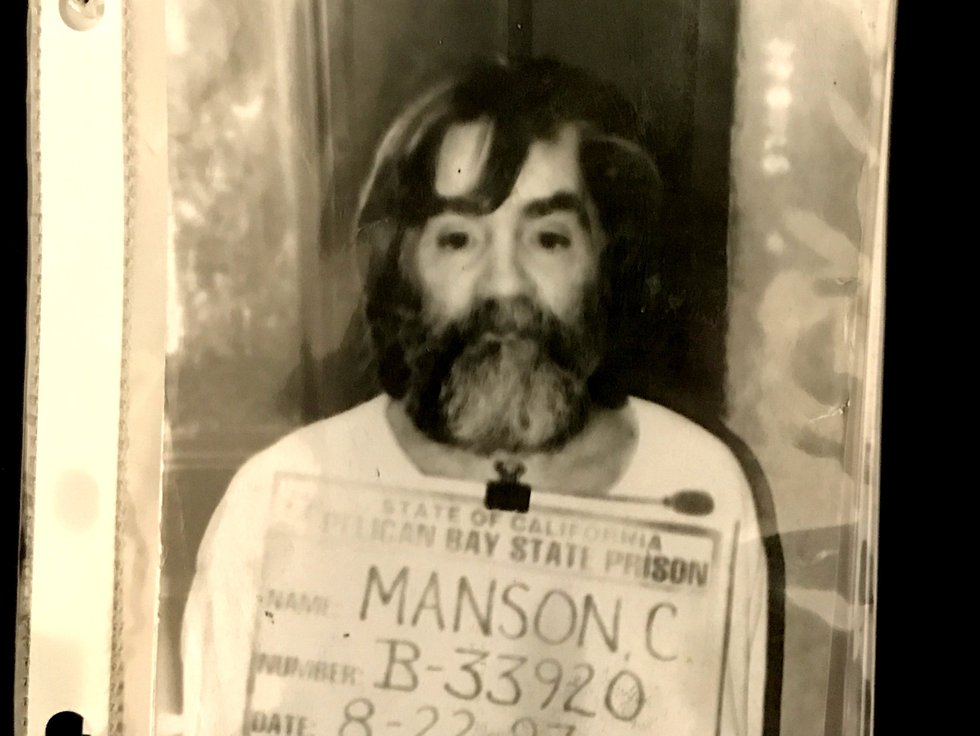
Twelve years ago, Charles Manson was 71, living in the California State Penitentiary-Corcoran, not terribly interested in parole.
Ken Dickerson was 20, an aspiring musician from House Springs, Missouri.
Get a fresh take on the day’s top news
Subscribe to the St. Louis Daily newsletter for a smart, succinct guide to local news from award-winning journalists Sarah Fenske and Ryan Krull.
He wrote Manson a letter.
“I’m a history nerd,” Dickerson explains now. “I’d seen a few documentaries about him, and then I found out he played music.” Got covered by the Beach Boys; won praise from Neil Young. “He was a part of history,” Dickerson continues, “regardless if we want him to be or not. I thought, I might as well write him.”
Dickerson’s casual shrug makes it seem a natural course of action, but Manson’s name alone causes most people to recoil. It’s enough to know that he was convicted of ordering the savage murders of actress Sharon Tate, her unborn child, and four other people who were at her home on August 9, 1969—as well as a married couple, the LaBiancas, the next day.
Dickerson was wide open, though, more interested than scared. So he composed a letter, and then he added a sheet of paper with an outline of his hand and “Reach out and touch somebody” written above it.
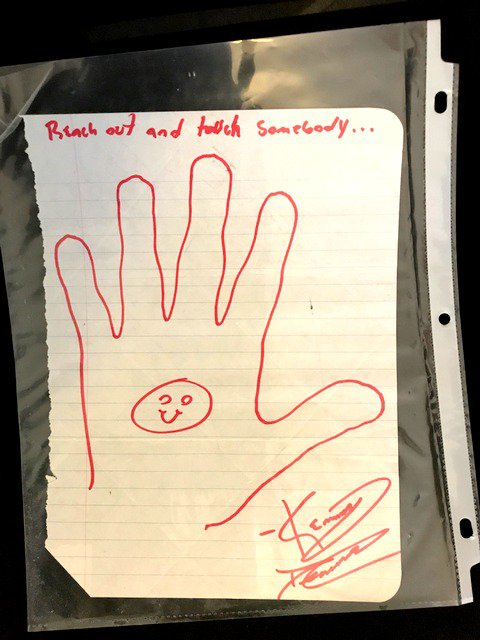
A few weeks later, he was startled to receive a reply.
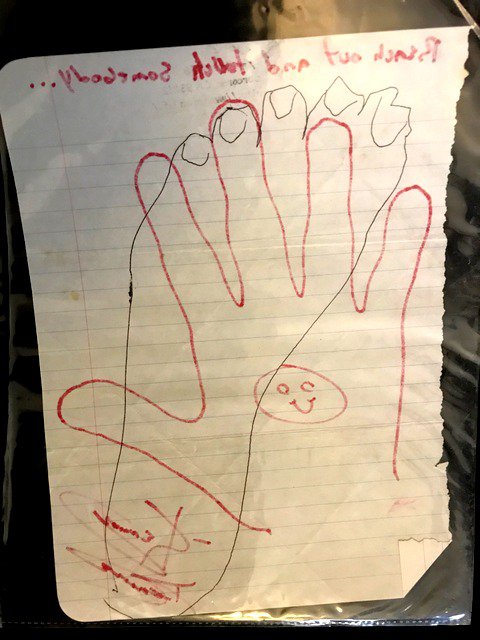
Enclosed with Manson’s letter was the hand print. On the opposite side, he’d outlined his foot.
Dickerson shows me the outline, now sleeved in a binder. Manson even drew in his toenails.
“I still don’t know what he was trying to say,” Dickerson admits. “But look how small his foot was. He used to lie about his height, but he was around 5-2.”
After the letter, Dickerson’s phone rang—a lot. But the sender sounded like a telemarketer, so he ignored it.
One day, exasperated, he finally picked up and heard: “You have a collect call from the California State penitentiary… You have a collect call from Charles Manson.”
Holy crap, Dickerson thought.
A voice said, “Ken? Kenny? Yeah, I’ve been trying to get a hold of you.”
From there unspooled years of conversation, ending five years before Manson’s death this November 19. Dickerson had to focus on a personal crisis and wound up moving, so there could be more Manson letters piled up someplace, lost in the gap before his forwarding address kicked in.
As it is, he has a stack of letters, a binder of artwork and music notation, and more than 12 hours of recorded phone conversations from perhaps the most notorious criminal in U.S. history.
Was he faking the craziness?
Manson’s letters are an incoherent tangle of music, cynicism (“Politicians, you just get paper clips and shit from them”), philosophical ramblings about God and survival and air and water and animals, schemes to “git” stuff (like a “life size TV” for phone conversations) and fury over “cheeters” he couldn’t trust. [His misspellings are preserved.]
He referenced Elvis Presley, Guns n’ Roses (who liked his music), Marilyn Manson (who adopted his last name). He also wrote about Martin Luther, who “cut God’s church in ½ because it was wrong and off track and out of line—nevertheless had he the same faith in all god being good and right he would of kept that faith in ONE.” Manson described World War I and World War II as “2 cross’s at war with each other not knowing why.”
There is, hard as this is to fathom, a capacity for awe in his letters. He wrote that all history and mystery could “fit on the head of a pin and be in the mind of a fly” and urged Dickerson to “Look up at the Milkieway, a billion X a billions X a billion as long as you live you could be just counting the time in between them in light years, and you can see it all now, lights that started 200 million years before you.” A bit later, he wrote, “You don’t realize how little we are and you don’t realize how big we are, how grate and how small. From nothing we are coming into the everything we are.”
There’s always been a thin line between mystical experience and madness, and there’s no way to pinpoint his location at any given time. Often, Dickerson couldn’t even make out the handwriting, let alone Manson’s logic: “He’d get on one of his little trips and be all over the place.”
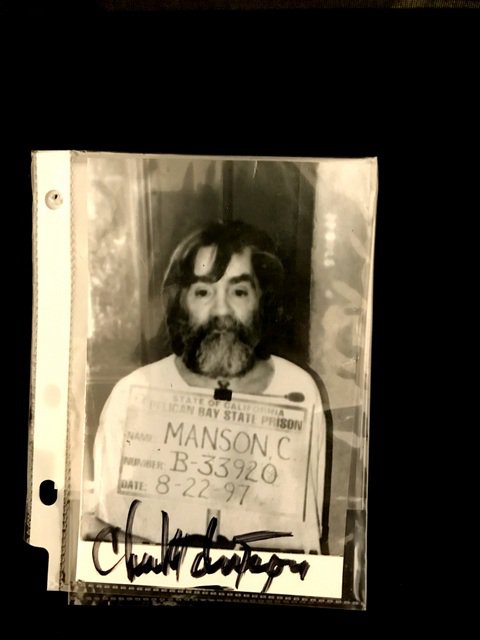
In an early letter, he wrote, “We can start by saying you take what I say and think about it apart from everything you know.” Bits of biography came through: How Manson used different middle names when he got busted, so the records would stay separate. How his mother didn’t even know his exact date of birth. Manson told Dickerson he’d passed through St. Louis in 1955 and got a tattoo on his leg at a shop next to a theater across from the bus station.
But Dickerson was careful never to ask about the big thing, the Tate-LaBianca murders: “I never wanted to push him, because he goes into defense mode. The funny thing is, if you watch the videos of him, he acts like a nutcase, and he most likely is, in some sense. Anyone would be, if they were in prison that long. But I have 12 and a half hours of audio, and he sounds like a normal person. As long as you are respecting him, he’s giving it right back. On the TV interviews, for the most part, he acted like a loon. The only one that seemed more like when I talked to him was the Ronald Reagan Jr. interview.”
Was he faking the craziness?
“I don’t know. I can’t be in his head. On some of these interviews he’d been in 23-hour lockdown for over a year, so his brain was probably mush. Or maybe he was just an attention whore. Maybe he just wanted to act the fool to get people talking… or to trip up the person asking the question.”
Was there a lot of ego?
“There was. He would get upset when people he knew started talking with one another. A lady from British Columbia, she started a fantasized relationship with a guy named Frank who was in prison with Manson; they played music together. And Manson found out about it, and he wasn’t happy, because the lady from British Columbia was married and, believe it or not, Manson found that not cool. Even with all the things he did sexually!” Manson was famous for luring young women to the Spahn Ranch outside L.A. or the Barker Ranch in Death Valley. They later gave vivid descriptions of orgies that started with doled-out drugs.
“The whole desert was full of chlamydia!” Dickerson says, shaking his head. He didn’t buy Manson’s feigned disapproval: “I think he may have just made that up because he wasn’t in control anymore. He always wanted people to get rid of their ego, but he had the biggest ego in the world. At the ranch, he was in control. Had a whole freakin’ desert. He was 15 to 20 years older than these middle- and upper-class girls who were running away. And, being a con, he was able to manipulate them.”
How?
“He would make sure that any weirdness you had inside you, he found it.” Manson used that knowledge two ways: “He’d make you feel good about yourself, always make sure that you were happy in one way or another, give you compliments. If you didn’t feel comfortable with your body, he’d always say, ‘You are perfect. There’s nothing wrong with you. What’s wrong is other people judging.’” On the other hand, he also knew how to “make you as uncomfortable as possible.” Suggest homosexuality to someone who was totally straight. Keep people off base.
Prison psychiatrists diagnosed him with paranoia and schizophrenia. “Sure I’m paranoid,” he retorted in Manson in His Own Words. “I’ve had reason to be ever since I can remember.” As for schizophrenia, he said, “I’ve got a thousand faces, so that makes me five hundred schizophrenics. And in my life, I’ve played every one of those faces. Sometimes because people push me into a role, and sometimes because it’s better being someone else than me.”
A streak of paranoia shows in the correspondence: “No lies” are the first words of his first letter to Dickerson.
“I’ve got a lot of people that want to control the music,” Manson says on one of the phone tapes. Then he breaks off and shifts into friendly concern: “So everything is good for you?” Dickerson assures him that he’s fine, and he hasn’t talked to the guy who Manson believes is taking advantage of him.
“We’re right on,” Manson says, clearly pleased. “Just me, you, and the central computer.”
Free guitar lessons
“Generally he’d prefer talking on the phone to writing,” Dickerson says. “He’d call anywhere from one to three times a day, between 2:30 and 9:30 p.m. Sometimes he’d call every day and then I wouldn’t hear from him for a week or two, sometimes for months. The long conversations were about music. He was great at just picking up a guitar and doing a 13-minute-long song that kind of made sense and sounded good. He learned guitar from an old gangster in the Ma Barker gang.”
The first time Dickerson played guitar for Manson, his response was, “All right, let me tell you something. Do you want some advice?”
“Yes, of course,” Dickerson said.
“Tune the f–king guitar.”
“That’s when he started sending me music notation and teaching me,” Dickerson says. “One time I did a blues riff for him and he just started laughing. He said, ‘Man, you lied to me. You can play. You can really play!”
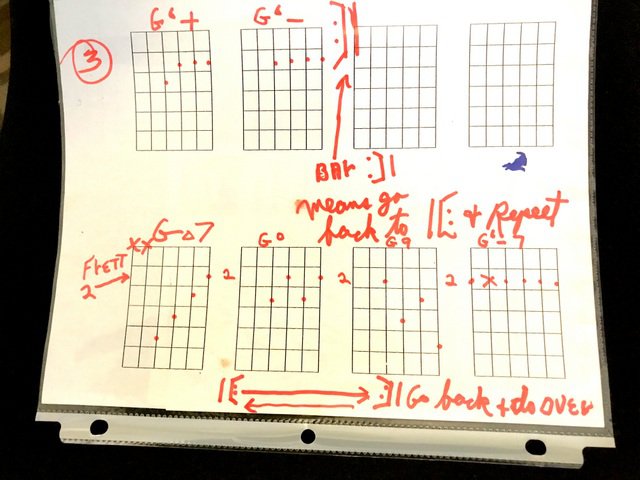
Dickerson finds the song Manson performed for music producer Terry Melcher (son of actress Doris Day) and plays it for me: “It’s not the Beatles, but it’s not bad. You can hear how nervous he was.”
Each remark Manson makes ends in a high giggle so overeager, it’s painful. “Can’t you just turn it on and let it go?” he asks Melcher’s sound people. “And then take out what you want and the rest throw away?” Finally, he starts singing: “I’m just one of those restless people, can’t never be satisfied with livin.’”
Air Trees Water Animals
Other phone conversations were about Manson’s organization, ATWA, for Air Trees Water Animals. “He was a big environmentalist,” Dickerson says, no sarcasm in his voice. “It also meant All the Way Alive. And one time he said, ‘If you put an R at the end it means AT WAR.’ He was at war trying to save the planet.”
I’m skimming letters as we talk, and, yeah, there are tons of references, downright lyrical ones, especially to the air. One of the postcards comes from the Sierra Club. In a phone call, Manson rants about how “the ding dongs are trying to cut all my goddamned trees down for paper.”
It makes sense, I guess. He spent more than 60 years of his life behind bars, much of that time in lockdown. The outdoors became an obsession.
“Once he said that if he could go back in time, he would plant fig trees—I think it was fig trees,” Dickerson recalls. “He’d planted them throughout the desert, and later on he found out it took two of them to grow. So he wanted to go back and plant more.”
And that was his only regret?
“He fell off a cliff and cracked his head open on a rock in Mexico,” Dickerson says. “There was a parrot at the hospital, for some reason, and he taught the parrot how to say ‘motherf–ker.’ He said he regrets that as well. Because as he was leaving the hospital, that parrot was flying up and down the hall screaming, ‘Motherf–ker!’”
Crafts
Manson painted, and he made beads and guitar picks out of tightly compressed, hardened cigarette-rolling papers. Dickerson sculpted Halloween masks because, he says, he wasn’t a very good sculptor: “It’s easy to make a zombie. It’s hard to make an angel.” Anyway, he sent Manson a photo, and it must have inspired him: “Someone in his cell block said he was running up and down in a mask he made, man in his seventies, chasing one of his friends.”
Another time, Manson made himself a cane. “One of his buddies told me he was walking around looking like Moses,” Dickerson says. Manson was written up for having a weapon because he was using an “inmate manufactured walking stick.”
“He was an inventor,” Dickerson continues. “He wanted to make ecofriendly paintballs that dissolved in the ground: Instead of being paint, it would be manure and a seed. I thought, where on earth in your brain did you even think of something like that?”
Was he smart?
“Well there’s different types of smart. I’d say he was savvy. As far as well-read, I don’t know about that. I know he read Newsweek ’cause he sent me a Newsweek he signed and it had his name on the subscription label. And I know he read that book in the ’40s, about how to win friends and influence people. He read that a lot.”
Dale Carnegie was the source of Manson’s infamous charisma?
Dickerson shrugs. “I never figured that out. You heard him”—he gestures toward the vintage cassette recorder he used for their calls. “I don’t hear any charisma.”
True. Much of what I heard was incoherent.
“From 1967 to ’69 were the Flower Power years,” Dickerson notes. “I think it was just hippie kids trying to find a place to rest their head for free. And Charlie put them to work picking up throwaway food from dumpsters to feed everyone.”
Still, he had a way with him. His rough, twangy speech softened and took on a shine when he spoke to a young woman. He gave people nicknames, like Star (who grew up near St. Louis and, late in his life, came close to marrying him). Dickerson was “Soul Soldier”—later, to his relief, shortened to “Soul.”
“Clear your brain from program patterns,” Manson wrote to him, adding that “all that week church do good kindness is weekness lies and such.” He was frankly opportunistic: “I can git stuff. If you get the power with the people who run this prison thing they work for you and money.” He paid somebody to let him sit on a tractor in the prison yard and take a picture. He wangled preprinted letterhead with his picture centered at the top.
He urged Dickerson to use him as collateral: “You got me, you go to the bank and say what’s he worth, we are doing a book album and movie. Git your money.”
“Dude,” Dickerson said, “it doesn’t work that way.”
But after years in prison, many of them in solitary confinement, Manson had built up his own unchallenged notions of the world. Reality was irrelevant.
The dog ghost
In one letter, Manson called himself Comeback (“Comback”) Man. But Dickerson never got the sense he wanted to leave prison. He preferred pulling strings from behind the bars.
“Once I said, ‘Man, I don’t have any credit,’” Dickerson recalls. “He goes, ‘You don’t need credit. You need con.’” He didn’t just mean con artistry, Dickerson adds. “He said, ‘Those three letters are the start of confidence.’”
Again, Dickerson tried to tell him that wasn’t the way the world worked anymore.
And?
“He said I didn’t have the drive!”
Asked what Manson was like, Dickerson takes a minute to think it through. “Definitely manic,” he begins. “Loved to talk; he’d chew your ear off. He was pretty easy to get along with… He wanted to come off as outgoing, but in real life? If he was in control, he was very outgoing; if he was not in control, he was like a puppy that just peed on the floor.”
Any hints, ever, of violence?
“Only once. I actually had to stop that conversation quick. There was this guy who was kind of ripping off Manson. Manson would send him crap, and it turned out he had a murder website. I thought it was an ATWA-based organization. He called and asked if I was still talking to that guy. And that was the only time I ever felt a little nervous or scared. He said, ‘Yeah, I got some people in Florida that really want to say hi to him. They really want to come up and said hi.’ Those phone calls are recorded, so he couldn’t come out and say anything. But just the sarcasm in his voice…”
What angered him, fast as a struck match, was any hint of “people ripping him off or lying to him.” He was kept in protective housing—geared for snitches and celebs—because so many inmates would want to kill him. Those in his small unit tried to trade on his fame.
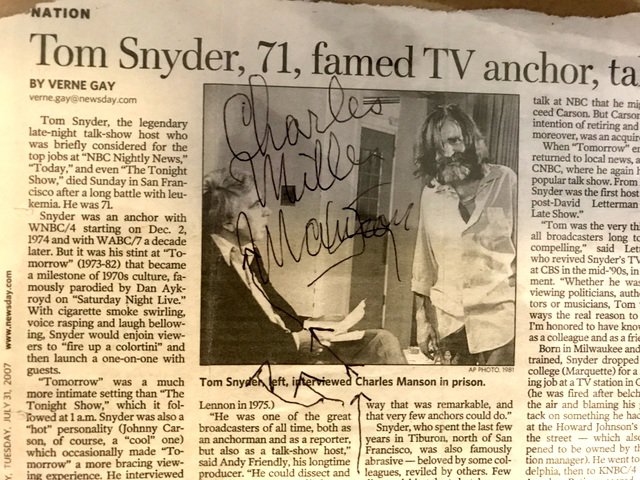
Once, Dickerson says, Manson had a custom guitar sent to him, and he painted it by hand, decked it out. During a move to another wing of the prison, “a bunch of people rushed in and beat the hell out of him and shattered the guitar. He said, ‘Man, I didn’t even care about how messed up I was, but my guitar! It felt like my dog died.’”
Dogs, oddly enough, cropped up often in his conversation and letters. He compared himself to a dog and spoke of dogs with sympathy. “Dogs don’t live long,” he wrote, “and being razed as a dog I’m the dog ghost, and that means each time I go to prison when I git out all the dogs of the world are dead.” Every dog that had been alive when he went into prison, in other words, was now dead.
He added that when he got out of prison, “Dogs didn’t bark at me and always showed great fear. They could sence and see me as a dog ghost.”
Who writes to Charles Manson?
Almost as intriguing as the Manson tapes and letters is Dickerson himself. He rarely mentioned his correspondence; for a while, his dad thought he was communicating with someone from the Internet pretending to be Charles Manson.
When we talk, Dickerson’s lab mix is playing in the yard, he’s just saved a snake from his cat’s paws, he’s given over a back room for his baby nephew to stay, and he’s worried about giving me his cold. How did somebody this gentle sustain a friendship with Charles Manson?
“I think I separated the two people,” Dickerson says slowly. “I separated what you see on TV and what I knew and spoke to him as if I were speaking to anyone else.”
But how could he reconcile who Manson was to him—a friend who called with rambling discourses and free guitar lessons between 2:30 and 9:30 p.m.—with what Manson did?
“What did he do?” Dickerson counters. “As far as the Tate murders, he was never there.” He hesitates. “I can’t stand up for the guy, though. He was at the LaBiancas’ house. He left before anything happened, but he’s the one who tied them up while the others waited outside. That is the one thing I can’t explain away.”
Dickerson thinks—hopes—the whole thing had a lot more to do with a bad drug deal, a revenge stabbing, and the group’s notion that they could get their friend sprung if more murders took place while he was locked up in jail. Then, he figures, the Manson ego came into play: Why not start at the (former) house of Terry Melcher, the music producer who’d rejected his song? Sharon Tate just happened to be renting it.
Indeed, that’s the stripped-down version some urged the prosecutor to stick with at the time. Instead, district attorney Vince Bugliosi told a bizarre tale of murders done to kick off a race war and Manson planning to hide in the bowels of the earth until blacks begged him to be their leader—the tale that’s held the nation spellbound for 40 years.
What’s particularly horrifying about it is the idea that one man can wield enough power over other people to make them savagely murder innocent strangers, just to fulfill his delusion. Reporters over the years have paid relatively little attention to the mental states and motives of the actual killers, because the possibility of such a rare and diabolical remote-control manipulation is so fascinating. Manson himself played with it, going just far enough to con or confuse (a word he used often) media and the authorities. He made his slight frame larger than life, keeping a stable of followers even from the penitentiary, performing and scheming even as he ridiculed others’ terror of him.
“I really shouldn’t blame the readers,” he wrote in his autobiography, “’cause I kind of get caught up in the stories myself.”
One day he asked Dickerson, “Are you taping this?”
“No,” the young man assured him.
“Well, you should,” Manson said. “Because it’s history.”