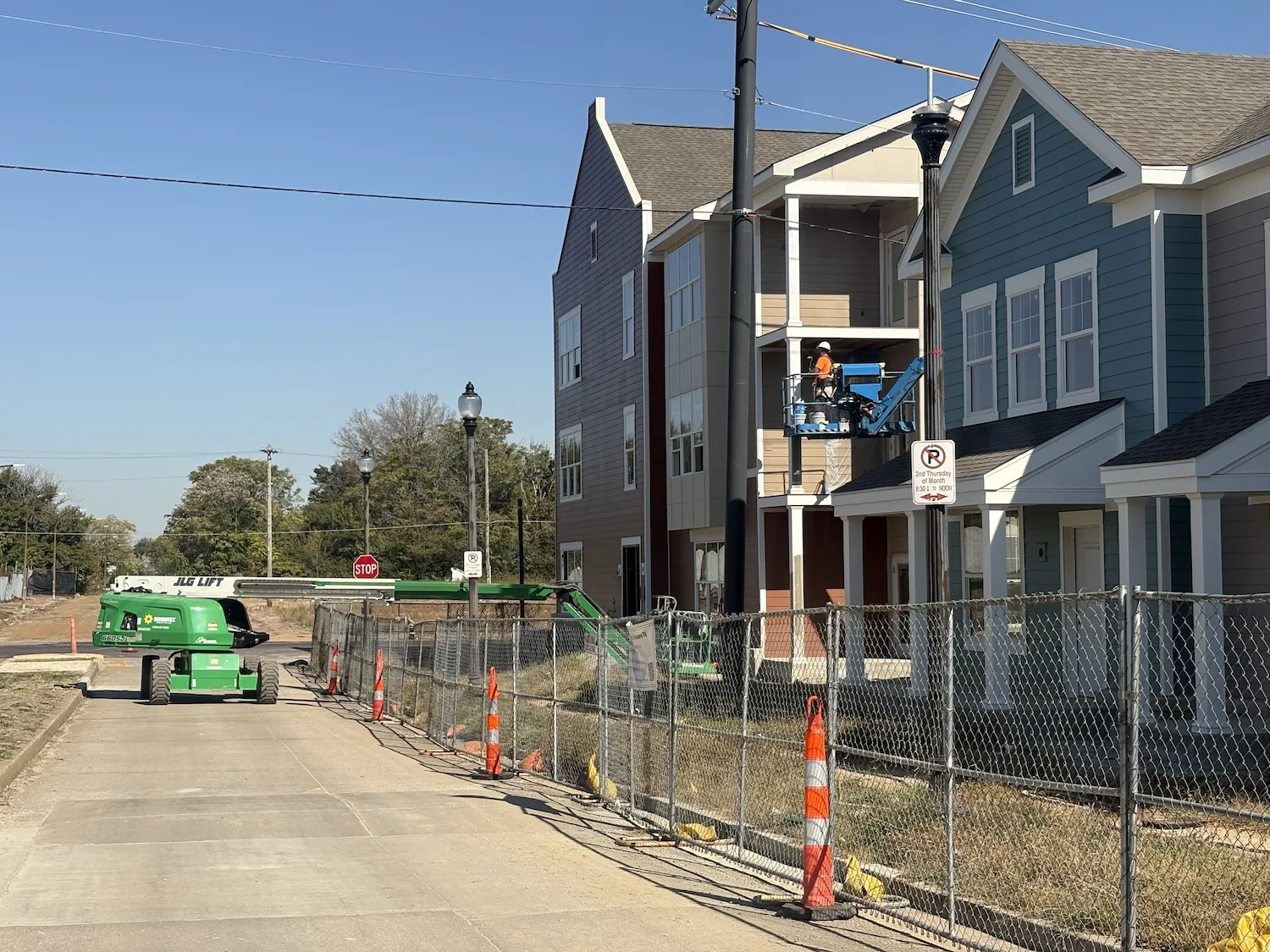
The redevelopment of an affordable housing complex decades in the making is inching closer to completion, steadily bringing hundreds of renovated units to St. Louis’ Northside.
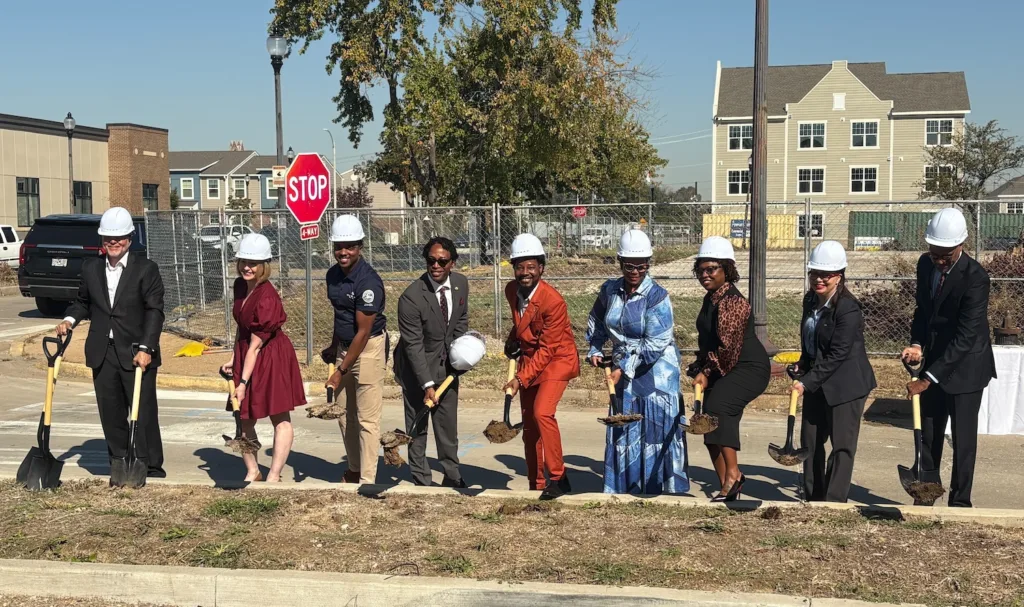
On Thursday, city leaders and interested parties came together to mark the beginning of the final phase of the redevelopment of Preservation Square in between Cass Avenue and Hogan Street, not too far from the new National Geospatial-Intelligence Agency West headquarters. The 40-year-old housing complex was selected for demolition and replacement around a decade ago as a part of the U.S. Department of Housing and Urban Development’s Choice Neighborhoods program, designed to revitalize “struggling neighborhoods with distressed public or HUD-assisted housing.”
Get a fresh take on the day’s top news
Subscribe to the St. Louis Daily newsletter for a smart, succinct guide to local news from award-winning journalists Sarah Fenske and Ryan Krull.
All told there will be around 550 total units in the new Preservation Square, and a “broader redevelopment plan” will bring a total of 695 units online. Work is set to finish in December on the penultimate, fourth phase of construction, developer McCormack Baron Salazar says, bringing a little more than 100 units online. The final phase is set to complete in the coming years. Certain units will be set aside for people with housing vouchers, while around 20 percent of the units will be “unrestricted” market-rate units (ranging from $926 for a one-bedroom to $1,125 for a two-bedroom). Qualifications for restricted units will be based on renter income and area median income, McCormack Baron Salazar says. That creates a more mixed-income environment than traditional public or private housing developments.
It doesn’t look like what it used to, says Alderman Rasheen Aldridge, who grew up nearby in Carr Square.
“As an alder, I get to do the ground-breakings and the ribbon cuttings—and you know they’re always important and they’re always special—but this one is different,” he says. “I grew up in this neighborhood. … I walked these streets with a lot of friends and a lot of different folks that live in this area, and to see the transformation that this community is starting to see …this was a planned vision by leaders in our community that really wanted to see the betterment for our neighborhood.”
You can hear the din of construction workers at the site, and residents express pleasure with the renovations. Diane White, who’s lived in one of the newly remodeled units for nearly two years, says the construction noise doesn’t bother her. She says she feels “peaceful,” though she’d like to see a park for children. She also says she appreciates that some of the residents who lived there before will be able to come back.
“I feel very safe and I’m peaceful,” she says. “I ain’t going nowhere because I’m comfortable.”
Tyra Dunn, another resident of Preservation Square, tells SLM that she grew up in the Darst-Webbe public housing complex in South City. She’s also pleased with the way Preservation Square is shaping up. She says she’s met many people who look down on public housing, but adds that everyone deserves to feel proud of where they live and where they’re from.
“You can be from the city, from the county, or you know, wherever: it doesn’t matter,” she says. “It’s how you feel, and that you are comfortable with your living situation.”
Another key piece of the work celebrated Thursday was the additional support services that are offered there, provided by Home State Health and Urban Strategies Inc. in partnership with McCormack Baron Salazar, to “to connect current, former, and future Preservation Square families with healthcare, resident services and economic opportunity.”
Home State Health has helped get people their applications for Medicaid, health screenings, and SNAP benefits, among other resources, they say. Urban Strategies also works directly with residents to develop relationships with people, connect people to services, and support as needed.
Why It Matters: There is a litany of research into the impacts of what’s often called “place-based investment,” like the money going into Preservation Square. When done right, these investments can help elevate the economic outcomes of residents in key ways, though researchers stress some caveats.
The Choice Neighborhoods program was borne out of the Obama administration, which wanted to broaden the scope of public investment into housing beyond the earlier HOPE VI HUD program (which only invested in public housing authorities) and invest in private sector developments too, according to a HUD magazine describing the program.
The economic mobility researchers at Harvard-based Opportunity Insights, who studied the impact of HOPE VI, found that its place-based improvements had a marked effect on children living in the renovated units. “Each year of childhood exposure to a revitalized public housing unit raised children’s earnings in adulthood by 2.8 percent,” a summary of research from earlier this year reads. “Those living there from birth earned 50 percent more as adults.”
The researchers found no economic gain, however, for adults. Poverty rates fell in HOPE VI developments, but that was attributed to wealthier people moving into market rate units. Overall, though, Opportunity Insights found the future earnings gains per child (estimated at $500,000) far exceeded the taxpayer cost-per-unit of $170,000.
Researchers into the efficacy of programs like Choice Neighborhoods see programs like the one with Home State Health as a clear factor in improved outcomes, though more research is needed. Partnering with local schools is another important factor, per a paper from Brown University’s Annenberg Institute (two Washington University researchers were on the team).
“We demonstrate that neighborhood redevelopment initiatives that work directly with schools positively impact student outcomes, suggesting substantial school effects,” the paper’s conclusion reads. “We also observed substantial family effects through the utilization of case management services.”
What’s Next: The fourth phase of the project is expected to finish in December, with the fifth and final phase commencing soon.
The city’s chief recovery and neighborhood transformation officer Julian Nicks spoke for the mayor’s office on Thursday. He’s hoping that the project can be a model for replicable, block-by-block investment—and also that the timelines for future projects can be much shorter than this one. The $29.5 million Choice Neighborhoods Implementation grant was announced in 2016. “We can’t have our development taking 10 years to build new,” he says.
“One way to think about it is: You take a massive area, you rebuild drastically where there’s a lot of vacancy,” he says. “Or, you can turn major segments into parks and things like that. But this is what you can do if you are thoughtful around land assemblage.”