Tornados don’t hit cities because tall buildings interfere with their formation … right?
If you thought this, you’re not alone.
Get a fresh take on the day’s top news
Subscribe to the St. Louis Daily newsletter for a smart, succinct guide to local news from award-winning journalists Sarah Fenske and Ryan Krull.
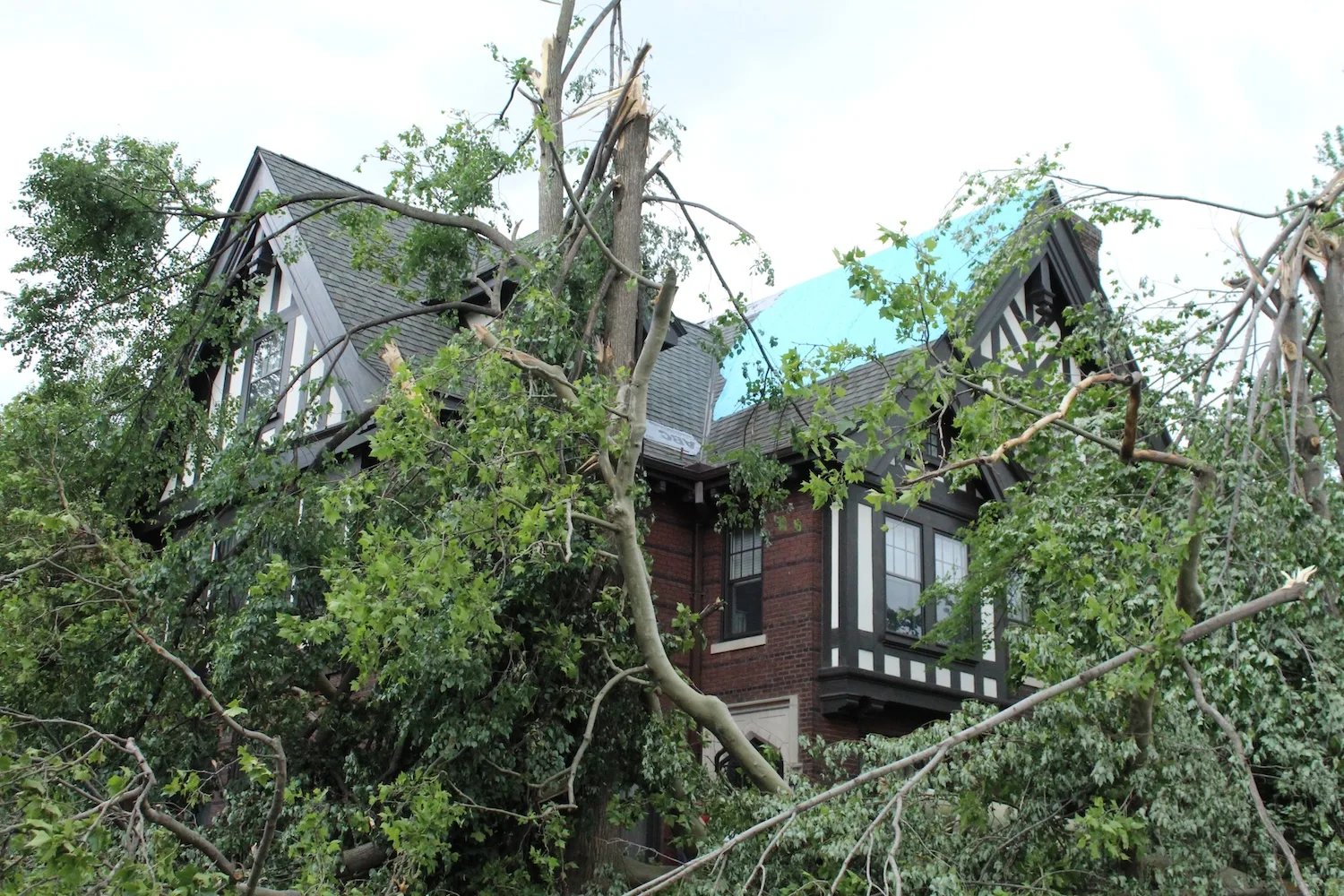
The EF-3 tornado that ripped through its mile-long path in St. Louis on Friday debunked some misconceptions surrounding tornadoes—but others remain. Throughout 40 years of research, Harold Brooks, a senior research scientist at the National Oceanic Atmosphere Administration National Severe Storms Laboratory, has heard it all. He helped us debunk some of the most common myths.
Tornadoes can’t form in cities
“St. Louis is a perfect example of how that’s just not true,” Brooks explains. While buildings may seem tall to us, they aren’t big enough to actually prevent a tornado from forming. Tornados don’t avoid anything—in fact, they can form anywhere because they begin tens of thousands of feet above the ground. While it seems like they usually form on farmland, that’s because cities are relatively small dots on the landscape compared to the vast acreage separating them. Cities are as susceptible to the storms as the local corn field.
We’re safe on this side of the river
“One of the big ones [myths] is people thinking tornadoes don’t like to cross rivers,” Brooks says. Some people think they may be safe if a tornado forms on the opposite side of the river, but there have been many occasions where we’ve witnessed the funnel cloud crossing the Mississippi or the Ohio River—including, yes, the tornado that struck St. Louis on May 16 and then continued to tear across Illinois almost all the way to Edwardsville. Tornados can, and will, cross rivers.
The hills will protect us
Similar to the theory that tornadoes can’t cross rivers, some people believe that the hills surrounding their town will protect them. Brooks’ own father thought that even after his son had been in tornado research for 35 years. Brooks clarifies, “There’s a hill southwest of Topeka called Burnett’s mound, the people of Topeka thought the hill would protect them until June 8, 1966, when a very large, violent tornado came right across Burnett’s mound and went right through the middle of Topeka.”
Letting some air in will help
Brooks has heard others advising people to open their windows during a tornado to “equalize pressure.” In reality, this is one of the worst things you can do. “Houses don’t fail because of pressure, they fail because wind gets inside and lifts the roof up, or wind lifts the roof from the edge,” he says. When a storm hits, keep your windows closed.
Find the right corner when the storm hits
In the 1890s people were under the impression that you should go to the northeast corner of your basement, because the tornado was probably coming from the southwest. Then, that was dispelled and the conventional wisdom became you should go to the southwest corner, because the debris when your house fails will float past you. “But in 1966 we saw that also didn’t work,” Brooks says. Now, the belief is you should go into the middle of the room, in a smaller room or under the staircase—if you can.
Turn on the Arch
This one is local–only, and generally tongue in cheek but that means it can’t really be dispelled, can it? So next time a tornado is heading our way, someone please remember to turn on the Arch.