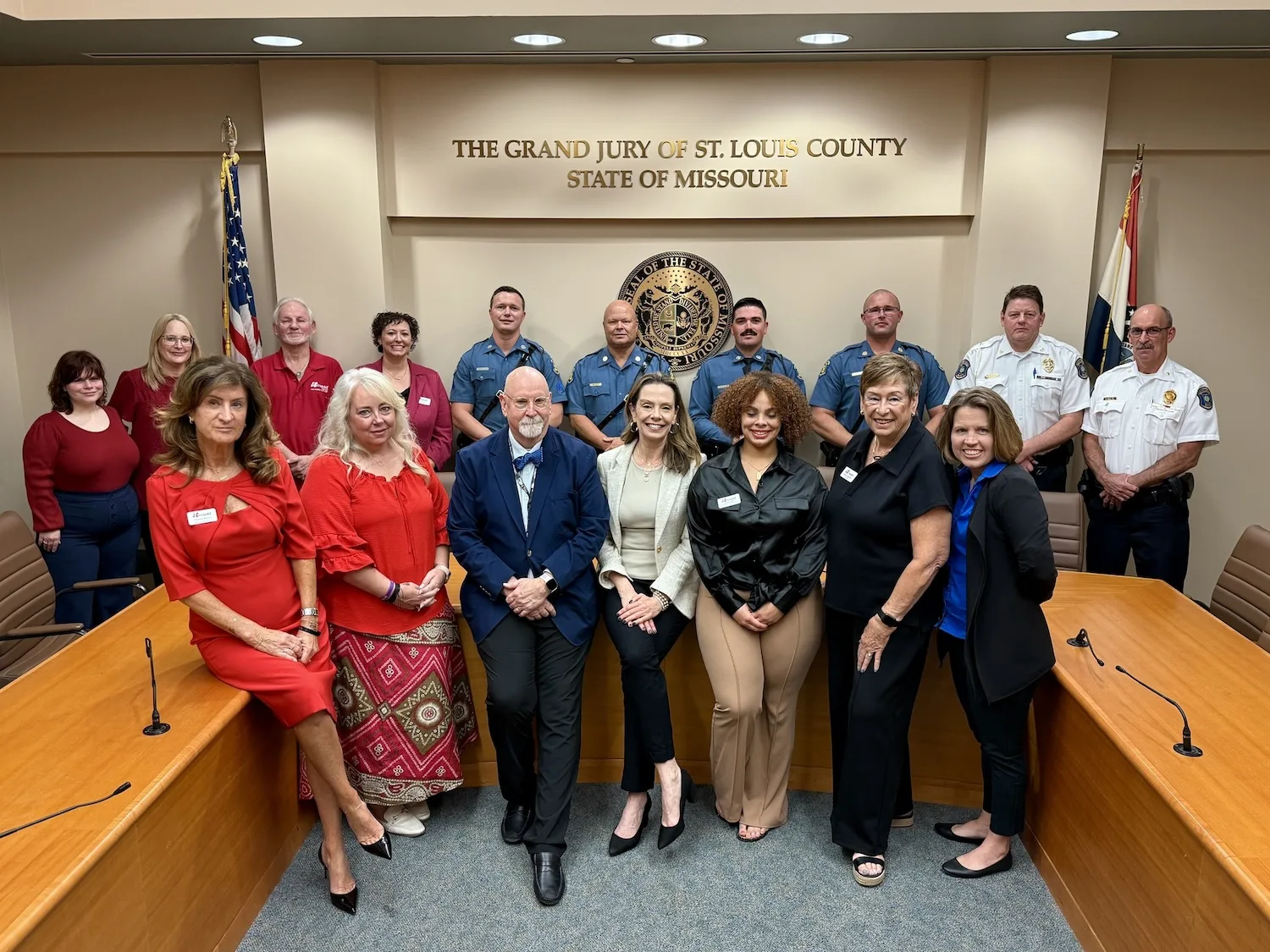
Earlier this month, St. Louis County Prosecuting Attorney Melissa Price Smith stood side-by-side with leaders of Mothers Against Drunk Driving’s Missouri chapter. They were announcing a big change for people suspected of driving under the influence in St. Louis County. From now on, Smith said, the county would be a place of “no refusal”—any driver who declines to cooperate with a Breathalyzer will have to submit to a blood draw.
MADD has advocated for the change to county prosecutors across Missouri, says Tabitha Perkins, state executive director, but only a few have signed on to date. Enlisting the state’s largest county is quite a coup, and one MADD hopes will deter drunk driving.
Get a fresh take on the day’s top news
Subscribe to the St. Louis Daily newsletter for a smart, succinct guide to local news from award-winning journalists Sarah Fenske and Ryan Krull.
“The message that is sent to the public when a county becomes a non-refusal county is, ‘If you drive impaired, you will be arrested and prosecuted,’” says Perkins. “MADD hopes this message will deter people from getting behind the wheel of a vehicle in an impaired state and turning the vehicle into what could become a deadly weapon.”
But not everyone thinks it will change the paradigm in St. Louis County—even as it could entail a lot more work for prosecutors.
Currently, if people refuse a Breathalyzer, their license is automatically revoked for a year. And, as lawyers stress, even in a county with a “no refusal” policy, you still have the right to refuse. In that case, prosecutors have the option to write up a warrant for your blood and persuade a judge to sign off on it. If they do, then you have no choice but to allow them access to your veins.
Defense attorneys say that it’s standard for prosecutors to get such warrants if a driver turns down a Breathalyzer after a crash. But seeking them out any time a driver is suspected of being drunk represents a lot more work for prosecutors.
“I don’t have the numbers, but you’d have to imagine the amount of DWI stops in St. Louis County on any given night is staggering,” says attorney Talmage Newton of the firm Newton Barth. “Are they going to go through the warrant process for every one of them, wake up a judge for every one of them?”
Newton also questions whether hospitals will prioritize taking the blood before the driver sobers up; the overnight shift, after all, can be busy. “These hospitals are already not huge fans of involuntary medical procedures,” he observes. “As you stop drinking, your blood alcohol will continue to increase for a period of time, and then it will begin to decrease. So with the time between a traffic stop and the eventual pulling of blood, where are you on that curve? And how’s that going to get processed?”
Defense attorney Terry Niehoff takes a skeptical view of the new policy’s impact.
“For 97 percent of cases, it won’t change anything,” he says, suggesting that DUI cases are easy enough to build even without a Breathalyzer. “The police or the prosecutors can make a DUI case because they have body cam, dash cam [footage]. They can show you failing the field sobriety test.”
And even if they don’t, the one-year license revocation is a big deal for most people in a region as car-dependent as St. Louis, one in line with current penalties for driving under the influence in cases where no one gets hurt. (Suggesting just how much a revocation is dreaded, the state Department of Revenue says 3,000 drivers across the state appealed their revocation last year alone.)
Says Niehoff, “So this is just extra effort with really no payoff for them—other than she’s got MADD on her side now. This is what it’s for. She’s running for reelection, and she wants to be able to say, ‘Look, I’m tough on crime.’”
Price Smith’s record, however, suggests getting tough on drunk driving is more than just talk. So far this year, the St. Louis County Prosecuting Attorney’s Office has issued charges in 671 cases of driving under the influence, a sharp increase from the 498 they handled throughout 2024.
While only a small percentage of those involve drivers who refused a Breathalyzer, it’s also not the sum total of people driving drunk in the county. Municipal prosecutors also handle numerous cases (generally in DUI cases that don’t involve a crash, fleeing the scene, or an injury). Price Smith says her office also helps police obtain search warrants on those cases, which could mean an even higher workload under the new policy.
How the policy plays out with drivers is not yet clear. Niehoff says his advice to most first-time offenders—unless they’re involved in a crash or a more serious incident—would be simply to blow. “They’re going to make their case anyway,” he says.
But Newton looks at it differently. While each case has its own set of facts, and he hesitates to offer across-the-board advice, he tells people to know their rights—and those rights don’t change in a no-refusal county.
“You absolutely have the right to refuse,” he says. “And I almost always counsel people to not give evidence against themselves. Do not make statements, do not consent to searches, do not allow the government access to things you don’t have to. So as a general rule, I would say you always decline.”