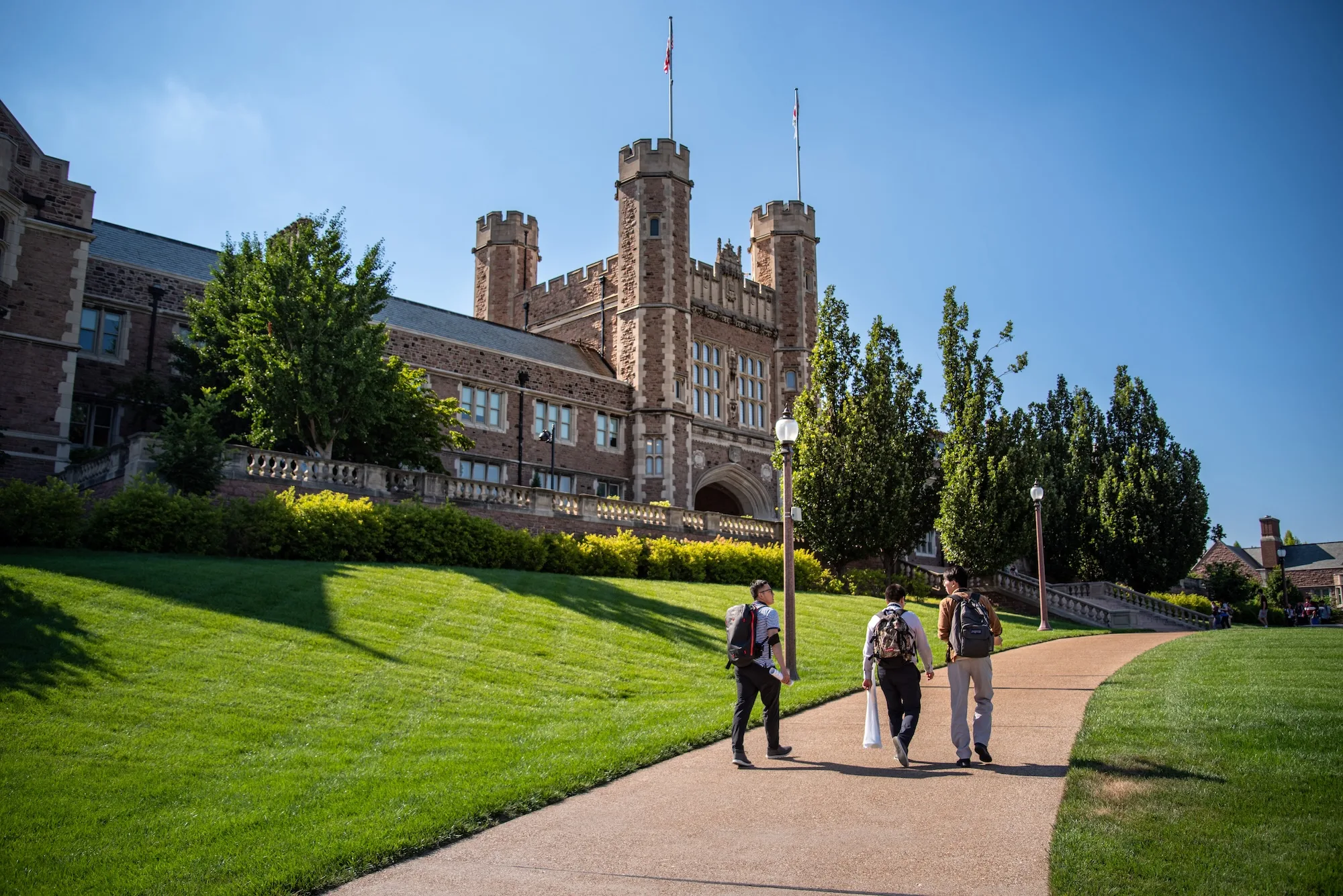
Even though class is out for the summer, Washington University faculty are abuzz with discussions of a recent report—jointly commissioned by the chancellors of WashU and Vanderbilt University—meant to evaluate the state of the humanities and humanistic social science scholarship. The committee was chaired by New York University philosophy professor Paul Boghossian, and the 10 scholars authoring the report do not hail from either of its sponsoring schools.
The report’s authors warn that humanities and humanistic social science scholars have become biased towards objectives like “anti-racism, feminism, and decolonization,” which they say stray from the disciplines’ core missions to pursue knowledge.
Get a fresh take on the day’s top news
Subscribe to the St. Louis Daily newsletter for a smart, succinct guide to local news from award-winning journalists Sarah Fenske and Ryan Krull.
A few days after the report’s June 5 release, university provost Mark West sent a letter to WashU faculty clarifying that the report is not WashU-specific and contextualizing it as an “invitation to discussion.” The letter also states the university is planning to hold structured discussions with faculty about the report in the fall and will share more details as they become available.
A university spokesperson did not respond to questions about faculty feedback on the report or the amount paid to the scholars commissioned to write it.
West’s letter has seemingly done little to quell criticism on campus. WashU anthropology lecturer Scott Ross pushes back on WashU administration’s framing of the report as the start of a conversation. The discipline of anthropology is singled out in the 30-page report as being particularly emblematic of scholarship conducted with political or social justice leanings.
“You don’t really start a conversation by telling people that their work is illegitimate and biased,” Ross tells SLM. “Everything in the report comes across as an attack, and that for me is not really a way to start a collegial conversation among scholars.”
Soon after the Provost’s email, WashU and Vanderbilt’s chapters of the American Association of University Professors released a joint statement condemning the report as a hypocritical and politically motivated attack on scholarship.
“It suffices for us to say that the report falls far short of the standards of political neutrality and disinterested inquiry it claims to champion,” the statement reads. “Historians, literary scholars, and anthropologists are singled out for caricature while the authors fail to acknowledge their own public biases against scholarship performed in the name of social justice.”
Ross believes that the report’s authors cherrypicked recent anthropology-related controversies to demonstrate that anthropologists conduct their scholarship with social justice goals in mind. “They just chose these select moments, and then said, ‘Look how egregious and biased this is,’ when it’s really part of a long academic conversation,” Ross says.
Some of the anthropologists cited in the report as examples of biased scholarship have alleged to Inside HigherEd that the report’s authors misrepresented their work.
And while those are not WashU professors, a WashU leader and faculty member recently published his disagreement with the report’s findings. Director of the Center for the Study of Race, Ethnicity & Equity and distinguished professor of race and literary studies, Dwight A. McBride wrote in an op-ed published by Inside HigherEd that the report conflates more diverse scholars asking new and better questions with a decline in scholarship.
“The report asks whether scholarship has become too political,” McBride writes. “It never seriously asks whether what it regards as political is, in fact, the consequence of a more inclusive and intellectually expansive understanding of knowledge.”
Curiously, in some national conversations about the report, WashU’s involvement has seemingly been forgotten even though it was a joint venture by the two chancellors. For example, recent articles have described it as the “Vanderbilt report” and prominently featured Vanderbilt’s logo.
Marlon Bailey, professor and chair of African and African American studies and professor of women, gender, and sexuality studies at WashU, criticized the report for its methodology and for not involving or consulting the scholars it critiques. “This is no shade to undergraduates, but my undergraduates could write something better than [the report],” Bailey tells SLM.
“I call upon the faculty to reject this, whether they are in the humanities or humanistic social sciences or not,” Bailey says. “We need to have a conversation that includes the very faculty at the respective universities with their name on the report—WashU and Vanderbilt—not starting with this report. The report is illegitimate.”
SLM couldn’t find any WashU faculty members who’d publicly praised the report, although faculty at other schools have done so. Brandon Warmke, a philosophy professor at the University of Florida wrote on X that some criticisms of the report are “willfully obtuse.”
“The complaint isn’t that people are studying race or inequality,” Warmke wrote. “It’s that certain conclusions are assured, that enforced political monoculture creates a bad epistemic environment; that shoddy work is given a pass for having the right political vibes.”