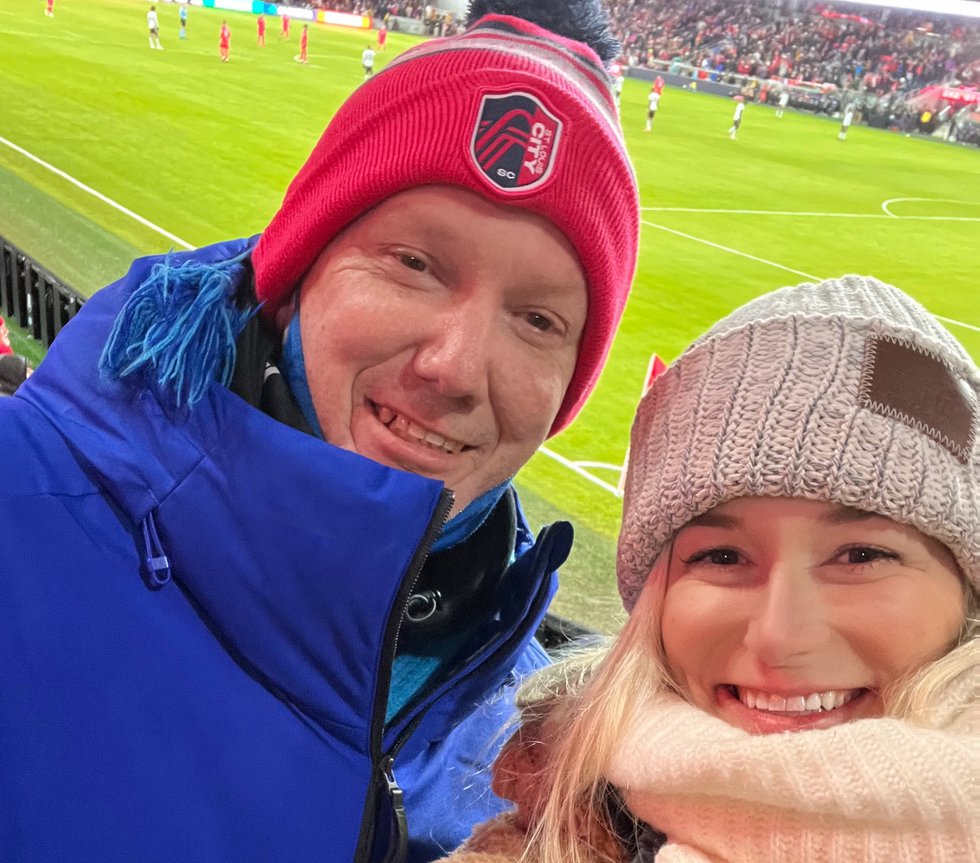
This month—just like every April—Jim Tietjens feels thankful.
That’s because it’s National Donate Life Month, a reminder to Tietjens of all the priceless gifts he’s received over the years. Across the past three decades, the St. Louis Soccer Hall of Famer has undergone two heart transplants and a kidney transplant, while also battling Stage 4 non-Hodgkin’s lymphoma, as well as tongue and throat cancer. Death has come looking for Tietjens several times since 1992, but he’s always met those encounters with a fight.
Are you a CITY SC fan?
Subscribe to the CITY Scene newsletter to get a fan’s guide to the pro soccer scene in St. Louis.
“I consider myself the luckiest person,” Tietjens says.
Of course, Tietjens hasn’t waged this battle on his own. Tietjens says the care he’s received from the medical team at Barnes-Jewish Hospital, where he has received all of his treatments during the past 30 years, has been instrumental in helping him navigate all of the obstacles that have come his way. That’s why he’s encouraging anyone who’s able to donate an organ to consider doing so in order to save more lives.
“You see these patients go from a very short expectation of life to living their lives,” says Cindy Pasque, a longtime member of Tietjens’ care team and a heart transplant coordinator at the Washington University and Barnes-Jewish Transplant Center. “In Jim’s case, he was able to get married, he was able to have kids, and he was able to continue his career. Just seeing how hard he’s worked and how much it means to him that he’s come this far and been given these opportunities is amazing. That’s what I would say to anybody who’s faced with the possible tragic circumstance where they’re asked to donate their loved one’s organs. It makes a huge difference on all fronts.”

During his playing days, Tietjens was a hard-nosed goalkeeper who helped Oakville to a state title in 1976, and later played at Saint Louis University. As a professional, Tietjens played both indoor and outdoor soccer, spending time with the Fort Lauderdale Strikers of the North American Soccer League, the Kansas City Comets of the Major Indoor Soccer League, and the Fort Lauderdale Sun and the South Florida Sun—both of the United Soccer League.
A genetic heart disease called cardiomyopathy runs in Tietjens’ family. The disease killed his father and sister when both were 32 years old. In 1992, only a few years after concluding his playing career, Tietjens was 32 and dealing with a life-or-death scare of his own—his first heart transplant. For Tietjens, his medical issues were only beginning. In 2003, he was diagnosed with late-stage non-Hodgkin’s lymphoma. Ten years later, doctors found he had developed throat and tongue cancer. And in 2018, Tietjens underwent a kidney transplant and second heart transplant.
It was a lot to process—and a lot to go through. The surgeries and treatments affected not only Tietjens, but those closest to him, too. For Tietjens’ daughter, Annie, watching her father deal with such a difficult series of events left a mark. She was inspired to help others receive the same level of treatment from which her father benefited, and recently graduated from Barnes-Jewish’s Goldfarb School of Nursing.
“I wanted to work in the cardiac ICU because it’s such a special place in my heart,” Annie says. “I feel like I can give back something to people for all of the gifts my family has been given. If my dad didn’t get his first [heart transplant], I wouldn’t be here. My brother wouldn’t be here. When you donate an organ, you’re saving countless lives.”
Today, Tietjens dedicates every day to the donor of his newest heart; a 22-year-old National Guardsman who served as a combat medic before his death.
“He was a very special person, who has a very, very special mom, and I’m so fortunate to have received a heart of that quality,” Tietjens says.