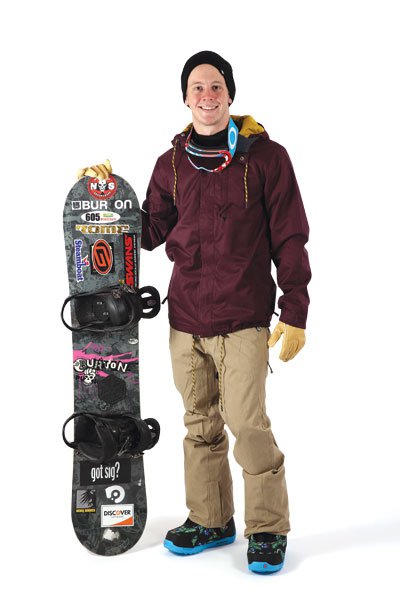
Tom Boldt didn’t learn to snowboard in St. Louis. But at some point during family vacations in Colorado, the kid got good. Now that the 23-year-old local has won a gold medal in the parallel giant slalom at the USA Snowboard Association National Championships, he’s gunning for the 2018 Winter Olympics.
• When I was about 13, I wanted to switch from skiing to snowboarding, and my father said, “If you beat me in a ski race, you can switch over.” He wanted me to learn how to ski first. Eventually, I beat him.
Are you a CITY SC fan?
Subscribe to the CITY Scene newsletter to get a fan’s guide to the pro soccer scene in St. Louis.
• The way that you figure out which foot to lead with on your snowboard is that when you first get into the sport, a coach tells you to stand with your feet next to each other. When you’re not expecting it, they shove you forward. Whichever foot you put forward first to brace yourself is the one they tell you to use as your dominant foot.
• Parallel means racing next to another snowboarder. It means there’s more pressure on you. In slalom, there is a little rubber piece that holds the bottom of the flag to the ground. Your board can hit it, but it has to go on the outside of the rubber piece. If you go inside of it, you’re disqualified.
• My racing outfit is tight and aerodynamic, but loose enough so I can bend my knees and get into the positions I need to. I also wear a helmet and goggles and gloves.
• In a very competitive race, the difference between first and second will be within one-tenth of a second.
• While I’m racing down the mountain, the only thing that really goes through my head is my form, my positioning. My head is pointing down the mountain, looking two to three gates ahead.
• I’m in training now in Colorado, with the best team of giant slalom snowboarders in the U.S. The Olympic coach is my coach. This past summer, I trained with weights in St. Louis at the Central Institute for Human Performance. They’ve done research on snowboarding to figure out what I need to do to improve my core and my back, what supplements to take, how to eat right.
• I usually wipe out at least once per training session.
• It’s not usually bad, though. I had a couple bad ones last year. I had a micro concussion after one. Another one was a repetitive fall: Every time I would fall, I would land on my left shoulder, and I injured it.
• This summer, I ran into [former Blues player] Chris Pronger and asked him what was the best way to fall. He said you want to go down on your elbow and roll onto your back. He jumped up in the air and showed me how to do it. It seems like a good plan.
• During the season, I train five days a week on the mountain for four to five hours a day. Then I hit the gym. In between, there’s a nap.
• If it’s really smooth, and I’m really laying into the turns, and everything is right, I can feel it. But the snowboard is not very forgiving, and you know if you make a mistake and lose time.
• Going that fast is like being right on the edge of being in control and out of control. You have to be just enough in control that you can make that turn or react to a bump on the hill, but you’re always pushing yourself toward that edge.
• I still get an adrenaline rush. I get it when I race and when I train, too. I don’t think that will ever go away.